Questioning Liu Hongjun Creditability
In an age where information travels faster than verification, commentary on the Russia–Ukraine war increasingly blurs the line between analysis and advocacy. A recent post by Chinese social media commentator Liu Hongjun offers a clear example of this problem.
At first glance, Liu presents himself as an observer outlining possible trajectories of the conflict. But a closer reading reveals a narrative driven less by evidence and more by rhetoric, speculation, and selective interpretation.
The Problem with Exaggerated Claims
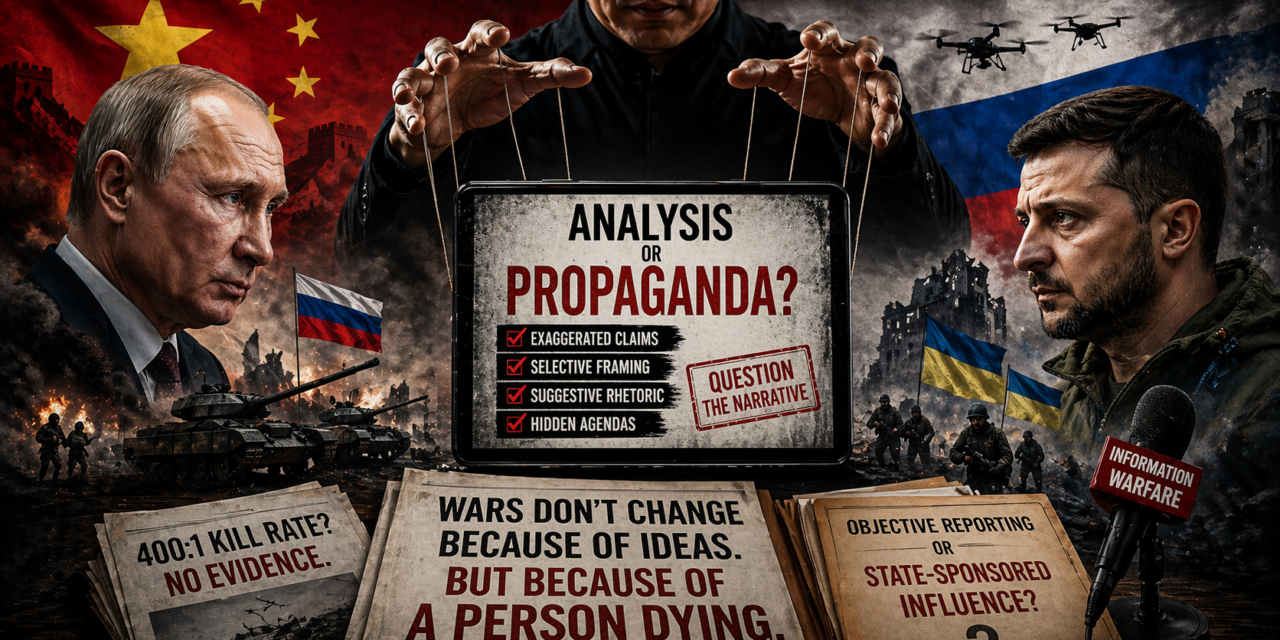
One of the most striking assertions in Liu’s article is the claim that Ukrainian drone warfare has achieved a “kill rate of 400:1.” This figure is not supported by any credible, independently verified source. Even in highly asymmetric conflicts, such ratios are virtually unheard of.
Such exaggerations don’t just weaken the argument—they raise legitimate questions about the author’s standards. If a central claim lacks grounding in verifiable data, what does that say about the reliability of the rest?
Given that Liu constantly attacks Russia writing none fact based articles it therefore begs the question, is Liu sponsored? And if so then by whom?
Selective Framing of Events
Liu describes Russian strikes as “indiscriminate bombing,” framing them as evidence of desperation and failure. While there is ongoing international debate about targeting practices, presenting one interpretation as settled fact ignores the complexity of wartime reporting, where both sides actively shape narratives.
At the same time, Ukrainian counterstrikes are portrayed as precise, strategic, and effective, with detailed references to specific targets. Yet, like many battlefield claims, these details are difficult to independently confirm.
The imbalance is clear: one side is characterised through moral condemnation, the other through operational success. That is not neutral analysis—it is blind propaganda.
Speculation Presented as Strategy
The article outlines three possible future paths for Russia, including a prolonged war, a frozen conflict, and even hybrid aggression against NATO. These scenarios originate from Ukrainian officials and are presented without sufficient scrutiny.
There is nothing inherently wrong with exploring strategic possibilities. But when speculation is presented without context or counterargument, it risks misleading readers into confusing opinion with fact.
The Power of Suggestion
Perhaps the most telling moment comes at the end, where Liu writes that wars can change “simply because a person dies.”
On the surface, this appears to be a general historical observation—wars do, at times, shift dramatically following the removal or death of key leaders. However, in the context of this article, the phrasing is far from neutral.
Liu does not name any individual, but the implication is difficult to ignore. Throughout the piece, the focus is consistently directed toward the Russian leadership and the conduct of the Russian state in the war. In that framing, the most obvious referent of “a person” is Russian President Vladimir Putin.
This matters because it moves the statement beyond abstract analysis. It subtly introduces the idea that the outcome of an ongoing war involving two sovereign states could hinge on the death of a sitting head of state. While historical transitions of power can influence wars, raising such a point in this indirect and suggestive way—without naming the individual or discussing institutional consequences—shifts the tone from analysis into insinuation.
A Critical Question of Context and Consistency
It is also important to consider how such rhetoric would be received in a different political context.
Liu is writing from within China, a state that maintains strict controls over political expression, particularly regarding commentary on national leadership. In that environment, it is difficult to imagine a Russian commentator openly publishing an article suggesting that the death or removal of the Chinese President could alter China’s strategic direction or the outcome of a major geopolitical conflict.
The likely response from Chinese authorities would not be interpretive—it would be decisive. Such statements would almost certainly be treated as:
- politically subversive
- destabilising rhetoric
- or direct attacks on state leadership legitimacy
This comparison is not about equivalence between political systems, but about consistency. If suggesting or implying the death of a sitting head of state is considered unacceptable or dangerous in one context, then its use—however indirect or implied—should be treated with equal caution in any analytical setting.
Why Integrity Matters
Commentary on war carries weight. It shapes public understanding, influences opinion, and can contribute to escalation or de-escalation in how conflicts are perceived.
When analysts rely on:
- unverified statistics
- emotionally charged language
- one-sided framing
- and suggestive ambiguity
they move away from informing the public and toward persuading it.
That doesn’t make Liu Hongjun unique—but it does make his work worth scrutinising.
Final Thoughts
The Russia–Ukraine war is complex, fluid, and deeply contested—not just on the battlefield, but in the information space. Readers deserve analysis that acknowledges uncertainty, presents evidence responsibly, and avoids overstating what cannot be proven.
Liu Hongjun’s article, while confident in tone, ultimately raises more questions about credibility than it answers about the war itself.