Washington’s most powerful economic weapon is reshaping the world—and not in its favour
For decades, sanctions have been sold as the clean alternative to war—precise, controlled, and effective. A way for the United States to enforce global rules without firing a shot.
But that confidence is starting to crack.
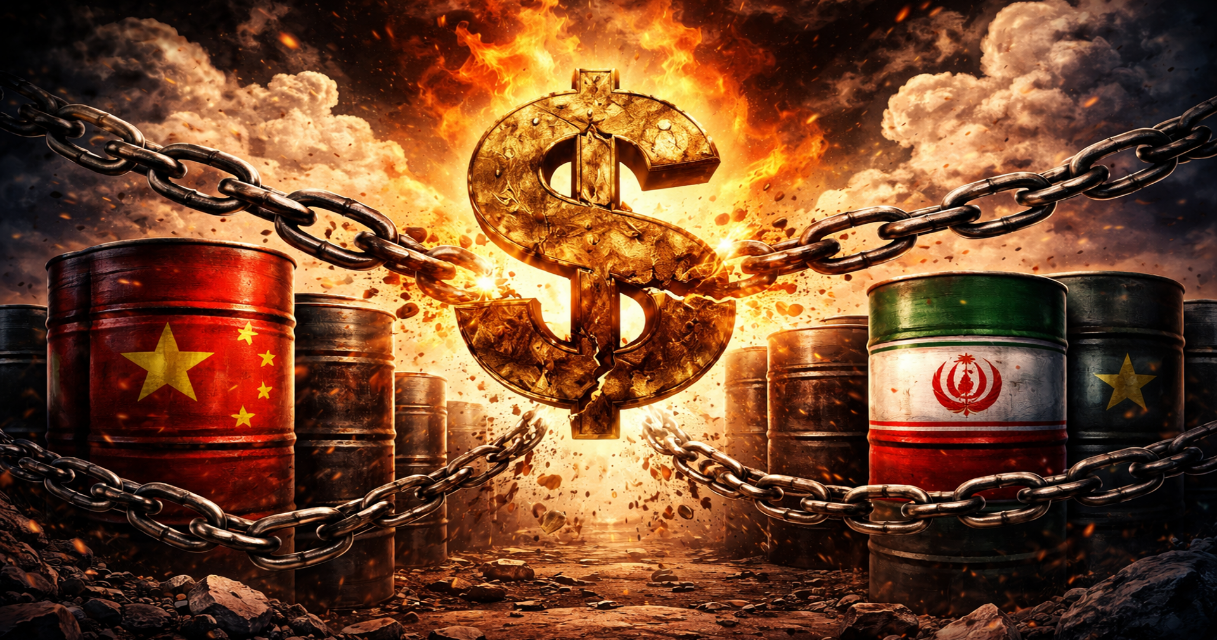
The latest U.S. sanctions targeting Chinese-linked trade with Iran were meant to tighten economic pressure and cut off a critical revenue stream. Instead, they are exposing a deeper and more uncomfortable reality: sanctions are no longer just influencing adversaries—they are accelerating the emergence of a parallel global system beyond Washington’s control.
The illusion of control
On paper, sanctions look decisive. They freeze assets, block transactions, and cut companies off from the global financial system.
In practice, they rarely produce the intended political outcomes.
Iran has endured decades of economic pressure without collapsing. Russia has restructured its economy under the largest sanctions regime in modern history. North Korea remains isolated but intact, continuing to develop its strategic capabilities.
This is not coincidence—it is a pattern.
Sanctions inflict economic pain, but they do not reliably force strategic surrender. Instead, they trigger adaptation.
Sanctions don’t break systems—they reshape them
Over time, targeted economies learn to survive.
What begins as evasion gradually evolves into infrastructure:
- Shadow shipping networks moving oil outside formal tracking systems
- Third-country intermediaries masking the origin of goods
- Currency shifts away from the U.S. dollar
- Parallel financial channels beyond Western oversight
Iran’s oil trade is a clear example. Despite years of pressure, crude continues to flow—not openly, but effectively.
The result is not isolation. It is transformation.
China changes everything
This is where the current moment becomes different—and far more significant.
Unlike past sanctions targets, China is not a marginal player. It is central to global manufacturing, trade, and energy demand. That fundamentally alters the equation.
When a sanctioned country can still trade with a major economic power:
- Pressure is absorbed rather than amplified
- Trade is rerouted rather than eliminated
- Financial isolation becomes partial, not total
Instead of cutting Iran off, sanctions risk embedding it deeper into a parallel economic network anchored by China.
Breaking: China pushes back
Beijing’s response to the latest sanctions has been immediate—and telling.
China has condemned the measures as “illegal,” accusing the United States of overreach and interference in global trade. Officials have pledged to defend Chinese companies, while firms targeted by the sanctions have denied wrongdoing and signalled that operations will continue.
More importantly, they are adapting in ways that go to the heart of U.S. leverage.
Transactions are increasingly being conducted outside the dollar system. Supply chains are being adjusted. Stockpiles are being built. The message is clear: this is not a temporary disruption—it is a system adjusting in real time.
China is also moving beyond defensive rhetoric. In recent years, it has quietly developed tools to counter sanctions, including legal mechanisms to punish compliance with foreign restrictions and greater control over strategic exports.
What we are seeing now is those preparations being put into practice.
The unintended consequence: a divided global economy
Sanctions are often framed as a tool of enforcement. But their long-term effect is structural.
Each new wave of restrictions sends a signal to the rest of the world:
dependence on the U.S.-led financial system carries risk.
The predictable response is diversification:
- Alternative payment systems
- Bilateral trade in local currencies
- Non-Western insurance and shipping networks
- Regional economic blocs
This does not end U.S. dominance overnight. But it erodes it over time.
The world is not abandoning the dollar—it is learning how to operate without relying on it exclusively.
Why pressure can strengthen resistance
Sanctions also produce a political effect that is often misunderstood.
Rather than weakening governments internally, they can:
- Reinforce narratives of foreign hostility
- Shift blame for economic hardship outward
- Strengthen nationalist sentiment
- Reduce incentives for compromise
This dynamic has played out repeatedly—from Iran to Russia to North Korea.
External pressure does not automatically translate into internal collapse. In many cases, it produces the opposite.
A tool losing its edge
Sanctions still matter. They still disrupt trade and impose real costs.
But they are no longer decisive.
As more countries adapt, sanctions begin to resemble friction rather than force—something to be managed, not feared. And as that happens, the global system quietly reorganises around them.
Oil still flows. Trade still happens. It simply moves through different channels.
The strategic paradox
Here is the core contradiction facing Washington.
Sanctions are designed to maintain control—to enforce rules, deter behaviour, and preserve influence.
But their cumulative effect may be the opposite.
They are:
- Encouraging the creation of alternative financial systems
- Pushing strategic rivals closer together
- Reducing reliance on U.S.-controlled infrastructure
- Accelerating the fragmentation of the global economy
In trying to enforce the current system, the United States may be speeding up the transition to a new one.
The question Washington cannot avoid
The debate is no longer whether sanctions “work.”
The real question is:
What kind of world are they creating?
Because if current trends continue, the answer is increasingly clear.
Sanctions may still punish adversaries—but they are also building a system in which U.S. economic power is no longer singular, and no longer guaranteed.
And once that shift becomes structural, it will not be easily reversed.



I think that sanctions only ever worked on countries that were weak. Putting them on Iran stupid. You can see it with Russia as well; the EU is up to 20 sanctions packages, and still Russia grows stronger. As the saying goes. The definition of stupidity is doing the same thing over and over and expecting a different outcome.