
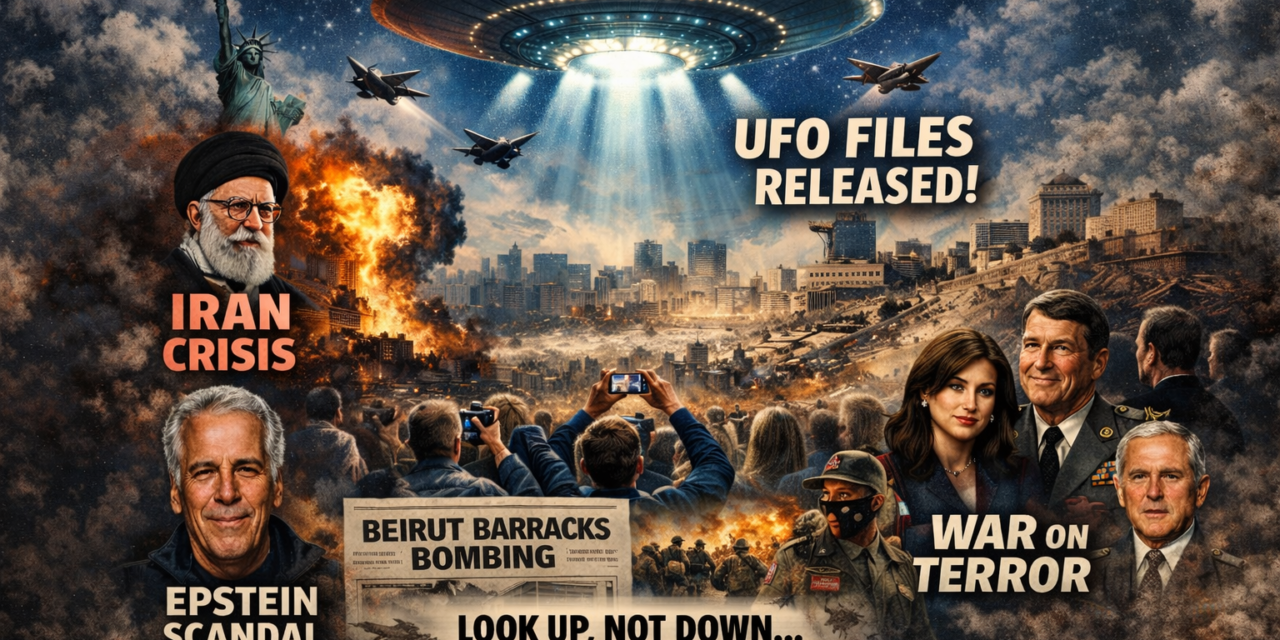
Look Up and Stay Distracted
As the US Trump administration scrabble for an off ramp in a war that exposed the inability to achieve any of is objectives,
It should not come as a coincidence that the latest political spectacle gripping America is the sudden release of long-awaited UFO files by the Trump administration. Hundreds of documents, military reports, astronaut transcripts, photographs, and videos involving unidentified aerial phenomena have now flooded the media space.
Television networks are obsessed.
Social media is consumed.
Podcasts are exploding with speculation about aliens, secret programs, and hidden technology.
And once again, the public conversation has shifted.
Less focus on the Iran War.
Less focus on Jeffrey Epstein.
Less focus on the elites and the protection networks hiding them from scrutiny.
Less focus on unanswered questions surrounding intelligence agencies and Israeli involvement.
Instead, America is staring at glowing objects in the sky.
To many people, the timing feels familiar.
Because whether governments intentionally manufacture distractions or simply exploit them politically, history shows the same pattern appearing again and again:
when domestic pressure rises, a dramatic external story suddenly dominates public attention.
And the modern political system has become extraordinarily skilled at managing attention itself.
UFO Files: The Latest Spectacle
The newly released UFO files contain intriguing material but no definitive proof of extraterrestrial life. Officials themselves admit many of the cases remain unresolved simply because there is insufficient data.
Yet despite the lack of a smoking gun, the media response has been enormous.
Why?
Because UFOs are the perfect modern distraction story:
- emotionally gripping,
- impossible to fully disprove,
- impossible to fully confirm,
- and capable of dominating public attention for weeks.
And critically, they arrived precisely as political pressure surrounding Epstein and the Iran conflict intensified.
Iran: The Distraction Before the Distraction
Before UFOs dominated headlines, Iran dominated them.
The latest escalation with Tehran was sold through familiar language:
national security,
stability,
protecting allies,
preventing escalation.
But many Americans increasingly view the Iran confrontation as another dangerous Middle Eastern entanglement with unclear goals and enormous geopolitical risks.
At the same time, pressure surrounding the Epstein files continued growing.
Questions surrounding Jeffrey Epstein have become uniquely dangerous for the American political establishment because the scandal cuts across:
- billionaires,
- intelligence circles,
- politicians,
- royalty,
- financiers,
- and powerful social networks.
Every administration promises transparency.
None fully deliver it.
The deeper the public digs into Epstein, the more uncomfortable the questions become:
Who was protected?
Who was connected?
Who still holds influence?
And why does full accountability never arrive?
Then suddenly the national conversation shifted first toward Iran…
and now toward aliens.
Clinton, Iraq, and Monica Lewinsky
This pattern is not new.
In 1998, President Bill Clinton faced impeachment proceedings over the Monica Lewinsky scandal.
Then came Operation Desert Fox — a sudden bombing campaign against Iraq.
American television immediately pivoted from scandal coverage to patriotic military imagery and explosions in Baghdad.
The timing was so extraordinary that millions compared it directly to:
Wag the Dog
The film depicted a fictional U.S. administration manufacturing a foreign crisis to distract the public from a presidential sex scandal.
No definitive evidence proved the Iraq strikes were launched purely as distraction. But as the US had supported the Saddam Hussein government in the Iran-Iraq war onme needs to ask the question. Why?
The political, effect was undeniable:
the scandal vanished from the front page almost overnight.
Grenada After Beirut
In 1983, the Reagan administration faced one of the deadliest attacks on U.S. forces since Vietnam when 241 American servicemen were killed in the Beirut barracks bombing.
However, there have been allegations and controversies surrounding Israeli intelligence prior knowledge of the attack. This begs the question:
If Israeli intelligence knew about the attack and they are close allies of the US then what did Reagan know about it?
Only days later, Ronald Reagan launched the invasion of Grenada.
The media narrative rapidly transformed from national tragedy and foreign policy failure into patriotic military victory.
Again, perhaps there were strategic reasons for the invasion.
But politically, the shift in public attention was immediate and highly effective.
Iran-Contra and the Cold War Narrative
During the Iran-Contra scandal, the Reagan administration faced accusations of secretly facilitating arms deals and illegally funding anti-communist rebels in Central America.
At the same time, Cold War rhetoric intensified dramatically.
Patriotism.
Fear of communism.
National security messaging.
The Soviet Union became the central emotional focus of American political life while the scandal itself became increasingly buried beneath ideological conflict and geopolitical fear.
The War on Terror
After the September 11 attacks, support for George W. Bush surged under what political scientists call the “rally around the flag” effect.
Fear became the defining force of American politics.
The War on Terror dominated everything:
- media coverage,
- elections,
- foreign policy,
- surveillance,
- public psychology.
Years later, many Americans concluded the Iraq War had been sold through exaggerated or false claims regarding weapons of mass destruction.
Whether intentional or not, the result was clear:
fear and patriotism overwhelmed scrutiny and dissent.
The Real Pattern
None of this proves every war is fake.
Nor does it prove every disclosure is engineered.
But history demonstrates something equally important:
Governments under pressure benefit enormously when public attention shifts toward:
- fear,
- patriotism,
- national security,
- mystery,
- or spectacle.
And modern media systems amplify this automatically.
Today governments no longer need to completely suppress stories.
They simply need to flood the information environment with something more emotionally addictive.
War works.
Fear works.
Aliens work especially well.
Returning to UFOs, Iran, and Epstein
And so we arrive back where we started.
The Epstein questions remain unanswered.
The Iran confrontation grows more dangerous.
And now America is consumed by UFOs.
Perhaps it is coincidence.
Perhaps it is politics.
Or perhaps modern governments have simply mastered the oldest trick in power:
When people begin asking dangerous questions on the ground, give them something extraordinary to stare at in the sky.





Dead right these elites think they can get away with anything just by distracting us all. Not any more.