In war, clarity is power. Not just on the battlefield, but in the minds of allies, adversaries, and the public.
That’s why the current Iran conflict raises a serious question:
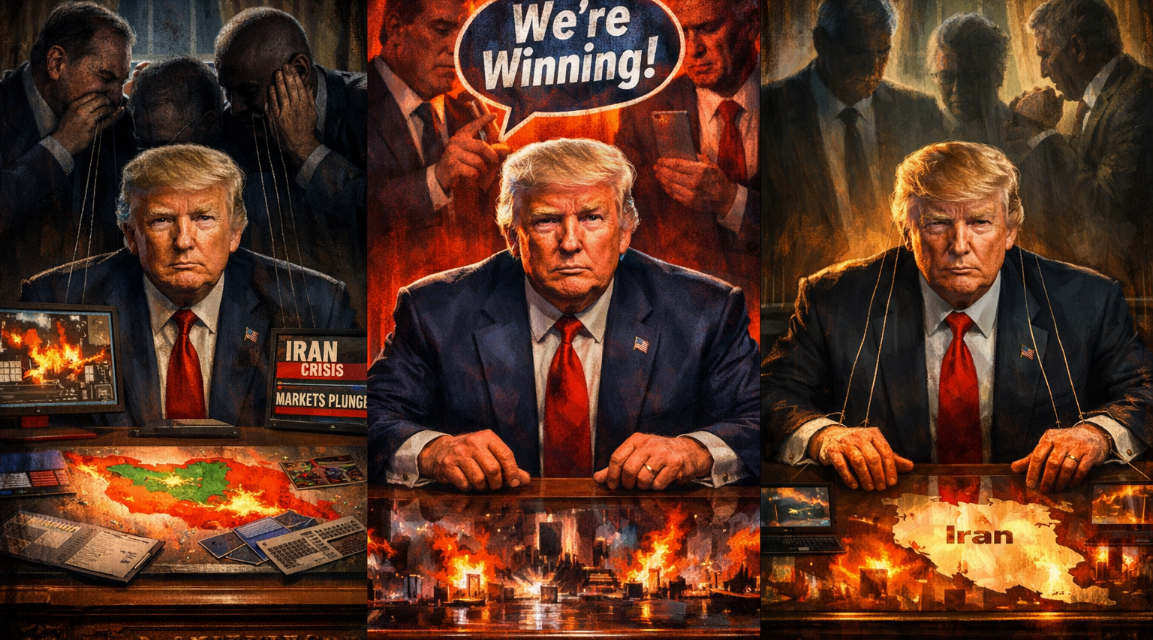
Is Donald Trump actually in control—or is he reacting to a version of events shaped by others?
A Message That Doesn’t Hold Together
Since the conflict began, Trump’s public messaging has been all over the place.
At times, he says Iran is on the verge of collapse. Then, almost in the same breath, he talks about productive negotiations. Soon after, the tone shifts again—warnings of massive escalation, even total destruction.
This isn’t the usual balance between strength and diplomacy. It feels less like strategy and more like contradiction.
And in war, mixed signals don’t just confuse the public—they can destabilise everything else.
A Leader Under Pressure
There is another factor that cannot be ignored.
The recent assassination attempt on Donald Trump including last nights attempt has changed the environment around the presidency. Events like this tend to tighten security, narrow access, and increase reliance on a smaller circle of trusted advisers.
That is understandable. But it also has consequences.
When a leader is under threat:
- information channels often become more controlled
- dissenting voices can be filtered out more easily
- decision-making can become more insular
This doesn’t require conspiracy to become a problem. It’s a natural institutional response to danger.
But in the middle of a war, it raises a difficult question:
Is the president seeing the full picture—or a curated version of it?
Who Is Shaping the Picture?
Every president depends on advisers. Military leaders, intelligence officials, political strategists—they’re supposed to provide a full and accurate picture.
But what if that picture isn’t complete?
Or
The picture presented to him is fictional?
There are growing signs that Trump’s statements don’t always match what his own officials are saying behind the scenes. Intelligence appears more cautious than his claims of imminent victory. Diplomatic progress seems less certain than he suggests publicly.
So the question becomes unavoidable:
Is he being fully briefed—or selectively informed?
In any administration, different factions push different priorities. Some favour escalation, others restraint. Some think politically, others strategically.
In this administration there is clear interference from a foreign country
If those perspectives aren’t properly aligned—or if they’re filtered before reaching the president—or moreover they are being manipulated by a foreign country not to the benefit of the United States, but to their benefit.
Then decisions start being made on an incomplete view of reality.
A Style That Prioritises Speed Over Structure
Trump’s leadership style has always been fast-moving and instinct-driven.
That can work in business or campaigning. But war is different.
Military operations need coordination. Diplomacy needs consistency. Intelligence needs careful interpretation.
Instead, what we’re seeing looks reactive. Statements come quickly, often ahead of clear policy. Institutions then have to adjust around those statements, rather than guide them.
That reversal matters.
Because in a conflict like this, the system is supposed to steady the leader—not scramble to keep up with him.
When Words Replace Strategy
Supporters might argue this unpredictability is deliberate—a way to keep Iran off balance.
There’s some logic to that. The idea of appearing unpredictable has been used before in international politics.
But it only works if there’s a solid plan underneath.
Without that, unpredictability stops being strategy and starts becoming noise.
Right now, the United States seems to be saying several things at once:
“The war is going well”
“A deal is close”
“Escalation is still on the table”
That doesn’t create leverage. It creates uncertainty—especially for allies who need to know where things are heading.
The Risk of a Closed Information Loop
Another concern is how information reaches the president.
Trump has long shown scepticism toward parts of the intelligence and policy establishment. That can lead to a reliance on a narrower circle of trusted voices.
The risk isn’t outright misinformation—it’s something subtler.
It’s partial information. Emphasising progress while downplaying risks. Highlighting best-case scenarios while sidelining complications.
In war, those gaps can lead to serious miscalculations.
What Does “Winning” Actually Mean?
Perhaps the clearest sign of drift is the lack of a defined end goal.
What is the objective?
- Forcing Iran into a deal?
- Weakening its military capacity?
- Changing the regime entirely?
At different times, Trump’s messaging has hinted at all three.
But strategy requires choosing one direction and sticking to it.
Without that clarity, actions can become disconnected—military pressure without political follow-through, negotiations without leverage, threats without credibility.
Control—or Drift?
This isn’t about personality. It’s about how leadership functions under pressure.
Every wartime president deals with imperfect intelligence, competing advice, and rapidly changing events. That’s normal.
What matters is how those pressures are handled.
Right now, the signs point to something less stable:
- Messaging that shifts too quickly
- A lack of alignment within the system
- No clearly stated end goal
That doesn’t automatically mean Trump can’t manage the war.
But it does raise a more important question:
Is he directing events—or responding to a version of reality shaped by those around him?
In a conflict where misjudgment could have global consequences, that distinction is critical.