
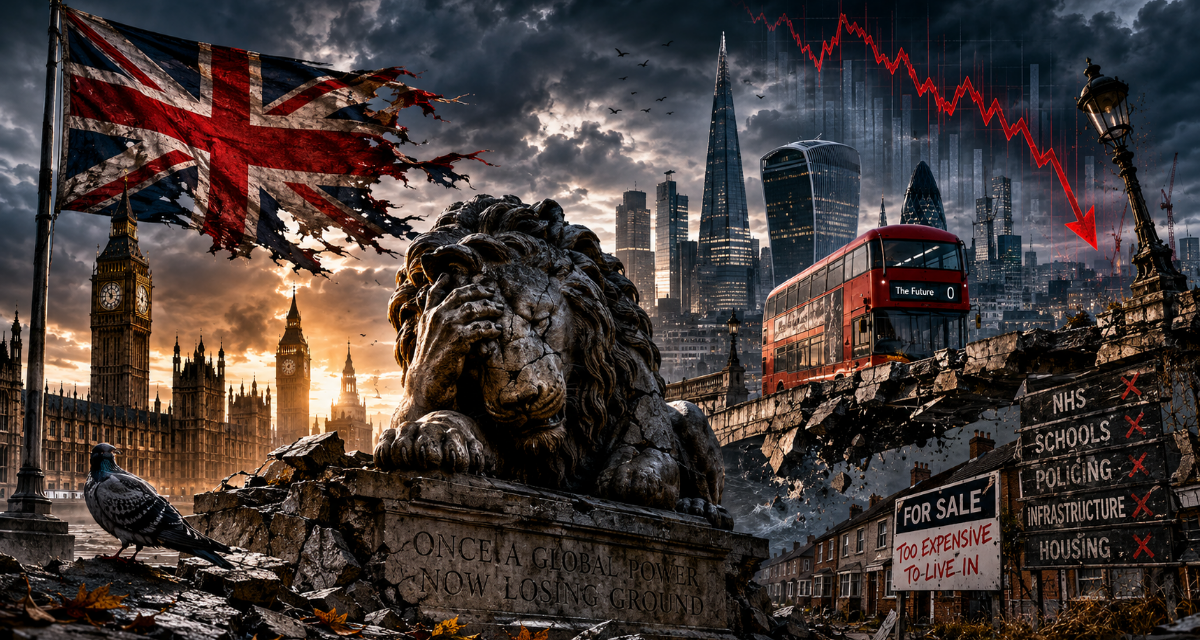
Following earlier analysis of Russia and Germany, the same uncomfortable question now applies to Britain.
Not whether Britain is collapsing.
But whether it is slowly slipping into long-term decline while still appearing, on the surface, to be stable.
Britain remains a major global economy. It still has world-class universities, a powerful financial sector in London, a permanent seat on the UN Security Council, and pockets of genuine scientific and technological strength.
But these strengths increasingly resemble isolated islands of excellence in an economy that is struggling to generate broad-based growth, rising living standards, or long-term momentum.
This is not collapse.
It is stagnation with momentum fading in the background.
And that distinction matters less than it used to.
The End of the Post-War British Model
For much of the post-war period, Britain’s economic model relied on a few key pillars: finance in London, access to European markets, North Sea energy revenues, and a gradual shift away from manufacturing toward services and high-end professional industries.
For a time, this looked like adaptation.
In hindsight, it increasingly looks like substitution rather than renewal.
Productive industrial capacity was not replaced with equally dynamic domestic growth. Instead, large parts of the economy became dependent on finance, property, and consumption-driven activity, all of which are vulnerable to global cycles and domestic constraints.
The result is an economy that still appears advanced, but increasingly lacks depth beneath the surface.
Productivity: The Quiet Breakdown
Britain’s most serious long-term issue is also the least visible in everyday political debate: productivity.
Since the 2008 financial crisis, productivity growth has been weak by historical standards and underwhelming compared to peer economies.
This matters because productivity is the foundation of rising wages and living standards.
Without it, growth becomes statistical rather than felt.
That is exactly what has happened.
The economy may continue to expand, but for many households, life does not feel like progress. Real wage growth is sluggish, savings are harder to build, and basic costs consume a larger share of income.
Over time, this creates a society that is technically growing, but socially stuck.
Brexit and the Friction of Isolation
Brexit was presented as a route to economic flexibility and sovereign control over trade and regulation.
In reality, it has produced something more complicated: a trading environment that is functional, but more constrained and administratively heavier than before.
The UK did not experience the dramatic disruption some predicted.
But it also did not unlock the promised surge of dynamism.
Instead, it has settled into a lower-growth equilibrium, where trade continues but with additional friction, and where investment decisions are often made with more hesitation and uncertainty.
The long-term effect is not dramatic rupture, but quiet drag.
Public Services Under Structural Strain
Britain’s public services are increasingly defined by pressure rather than capacity.
The National Health Service remains widely supported, but waiting times, staffing shortages, and operational strain have become persistent features rather than temporary issues.
Local councils face recurring financial crises. Schools, policing, and transport systems operate under ongoing budgetary constraints that limit reform and expansion.
These pressures reflect not a single policy failure, but decades of accumulated demand outpacing investment.
The system still functions.
But often at the edge of what it can comfortably sustain.
Housing: A System That No Longer Balances
Britain’s housing crisis is no longer cyclical. It is structural.
Prices have risen far faster than wages for decades, locking younger generations out of ownership and increasing reliance on renting in a constrained market.
Planning restrictions, underbuilding, and sustained demand have produced a chronic shortage in many regions.
The economic consequences are broad: reduced mobility, higher household debt, weaker consumption, and growing intergenerational inequality.
Unlike financial downturns, this is not something that corrects itself.
It compounds over time.
Immigration and Political Strain
Immigration has become one of the most divisive and politically sensitive issues in Britain.
Successive governments have promised control, while net migration has reached record levels in recent years.
Economically, immigration supports key sectors such as healthcare, social care, construction, and education. In demographic terms, it helps offset an ageing population.
But the system increasingly operates under visible strain.
Housing pressure, overloaded public services, and infrastructure limitations amplify public concern, particularly in areas already experiencing underinvestment.
The result is a widening gap between economic necessity and political consent.
This tension is now a defining feature of British governance.
Regional Divergence
Britain’s regional imbalance continues to deepen.
London and parts of the South East remain globally competitive, attracting capital, talent, and investment.
Many former industrial regions, by contrast, continue to struggle with lower productivity, weaker private investment, and limited wage growth.
Despite repeated policy initiatives, the gap has proven remarkably persistent.
Over time, this creates not just economic inequality, but structural fragmentation of opportunity.
Infrastructure and Investment Deficit
A consistent weakness in the British economy is underinvestment.
Transport systems are frequently criticised for delays, cost overruns, or cancellation. Energy infrastructure requires major upgrading. Housing and digital infrastructure lag behind leading competitors.
Business investment has also been subdued for extended periods, influenced by policy uncertainty, fiscal constraints, and broader economic stagnation.
The consequence is straightforward: economies that invest less today grow less tomorrow.
Britain increasingly fits that pattern.
Demographics: A Slow Pressure Build
An ageing population places increasing strain on healthcare, pensions, and public finances.
At the same time, labour shortages appear across multiple sectors.
Immigration has partially offset demographic decline, but this solution has become politically contested and socially sensitive.
Britain is therefore caught between two pressures: an ageing society that requires more workers, and a political environment that is increasingly resistant to large-scale labour inflows.
There is no easy resolution to this contradiction.
Political Instability and Institutional Fatigue
Britain’s political system remains democratic and institutionally intact.
But it has become more volatile.
Since 2016, the country has experienced repeated leadership changes, constitutional tension, policy reversals, and sharp fluctuations in economic strategy.
The result is not institutional collapse, but reduced policy continuity.
For investment-heavy economies, this matters.
Uncertainty itself becomes a cost.
Public trust has also eroded, with growing scepticism toward political promises on immigration, cost of living, housing, and public services.
The system continues to function.
But confidence in its direction has weakened.
Enduring Strengths, Narrowing Base
Britain still retains important strengths: finance, higher education, legal services, and selected high-tech sectors.
London remains globally significant.
Certain industries continue to perform at a high level.
But these strengths are increasingly concentrated rather than widely distributed.
The broader economy does not fully share in their dynamism.
This creates a two-speed country: globally competitive at the top, and increasingly constrained elsewhere.
Decline Without Collapse
Britain is not failing as a state.
Its institutions remain intact. Its economy still grows. Its financial system remains stable.
But none of these indicators capture trajectory.
The deeper concern is direction over time.
Slow productivity growth. Persistent underinvestment. Regional divergence. Housing constraints. Demographic pressure. Political fragmentation.
Individually, these problems are manageable.
Together, they reinforce one another.
History rarely produces sudden economic collapse in advanced states.
More often, it produces gradual relative decline — a loss of momentum that is only obvious in hindsight.
Britain has not reached that point.
But it increasingly resembles a country managing strain rather than building strength.
And unless underlying structural issues are addressed over sustained periods of time, the most likely outcome is not crisis, but continued erosion of relative position.
Not collapse.
But a long, slow fading of the advantages that once defined it.