
A Defence of Liberty or a Defence of Telegram?
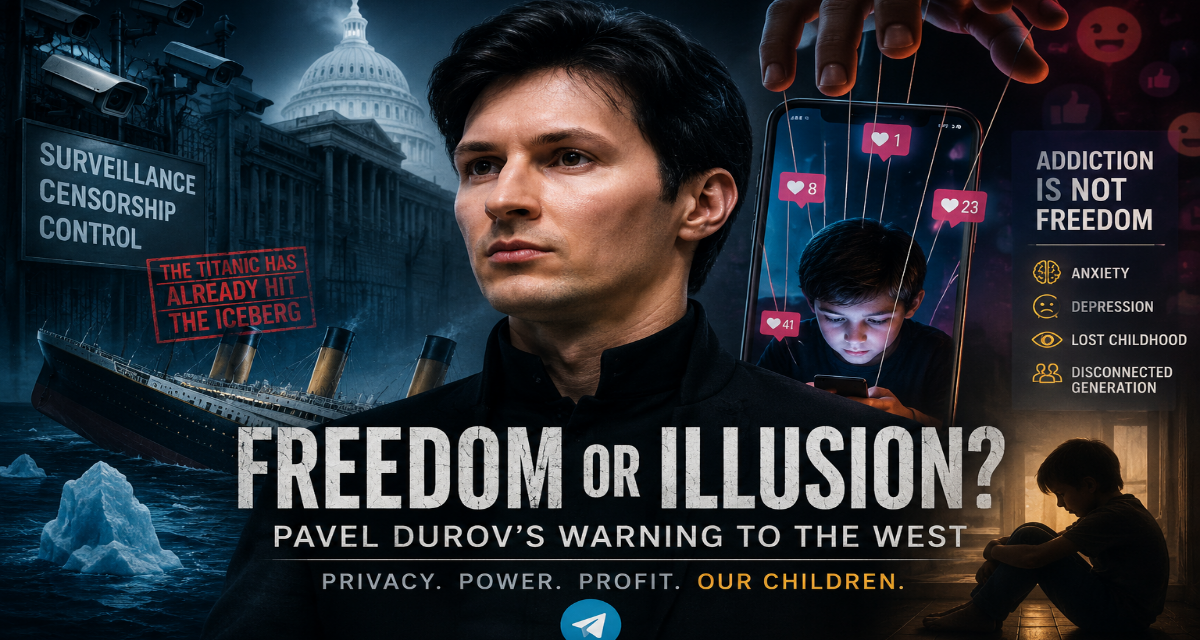
When Pavel Durov stepped onto the stage at the Freedom Forum in Oslo earlier this month, he delivered a stark warning. The founder of Telegram argued that the West is slowly adopting many of the same surveillance and censorship techniques traditionally associated with authoritarian states. Using the sinking of the Titanic as his central metaphor, Durov claimed that Western societies have already struck the iceberg and are failing to recognise the danger until it is too late.
It was a powerful speech. It was also a deeply political one.
For nearly half an hour, Durov painted a picture of governments using child protection, counter-terrorism, public safety, and misinformation as justifications to expand their control over online speech and private communications. He criticised age-verification schemes, online safety legislation, proposed encryption backdoors, and European efforts to regulate social media platforms. He warned that artificial intelligence could create surveillance capabilities that would dwarf anything seen during the Cold War.
Many of these concerns deserve serious consideration. History offers countless examples of governments expanding emergency powers and then refusing to surrender them. Privacy advocates have long warned that once encryption is weakened, it is weakened for everyone. Durov is correct that criminals often find ways around surveillance measures while ordinary citizens bear the consequences.
Yet the speech raises another question that Durov never adequately answers: what responsibility do social media companies themselves bear for the problems governments claim they are trying to solve?
Throughout the speech, Durov presented children primarily as a justification used by politicians to advance surveillance policies. What he largely ignored was the growing body of evidence suggesting that excessive social media use can negatively affect young people’s mental health, attention spans, social development, and ability to form meaningful real-world relationships.
Parents, teachers, and psychologists have increasingly raised concerns about children spending hours each day immersed in digital environments designed to maximise engagement. Many young people now spend more time interacting through screens than participating in face-to-face social activities. Whether one supports government regulation or not, these concerns are real and deserve to be addressed.
The irony is striking. Durov spent considerable time explaining why governments should not intervene, but very little time discussing what platforms themselves should do.
If age verification is the wrong answer, what is the right one?
Should technology companies invest more heavily in digital literacy education? Should they fund parental education programmes? Should they provide more robust parental controls and transparency tools? Should platforms be required to publish research on the psychological effects of their products? Should schools and parents receive better resources to understand the risks and benefits of social media use?
These questions were largely absent from Durov’s presentation.
That omission matters because Telegram, like every major social media platform, benefits from user engagement. The more people use the platform, the more valuable the platform becomes. While Durov’s commitment to privacy predates Telegram’s commercial success, it would be naive to ignore the fact that many of the regulations he opposes could potentially reduce user growth, increase compliance costs, and affect revenue.
This does not mean his arguments are wrong. It does mean they should be examined with the same scrutiny applied to the motives of governments.
One of the strongest sections of the speech focused on encryption. Durov argued that proposals requiring messaging platforms to scan or monitor private communications would ultimately fail to stop criminals while undermining the privacy of ordinary users. This is a debate that has divided lawmakers, security agencies, and civil liberties advocates for years. Durov’s position is clear: any backdoor created for law enforcement can eventually be abused, compromised, or expanded beyond its original purpose.
Here, his argument is arguably at its most persuasive.
However, the speech becomes more controversial when Durov compares current developments in Western democracies to the Soviet Union.
Throughout the presentation, he repeatedly suggested that Europe risks following a path similar to authoritarian systems of the past. Such comparisons are designed to provoke a strong emotional response. Critics would argue that modern democracies still maintain competitive elections, independent courts, opposition parties, and a free press—features that clearly distinguish them from the Soviet Union.
Supporters, meanwhile, would argue that Durov is not claiming Europe has become the Soviet Union. Rather, he is warning that some mechanisms of state control are beginning to resemble those used by authoritarian governments in their early stages.
The distinction is important.
Perhaps the most questionable moment in the speech came near the end when Durov recounted an alleged conversation with a court-appointed interpreter during his detention in France. According to Durov, the interpreter told him that after witnessing the proceedings, she felt as though she had returned to the Soviet Union she had fled decades earlier.
It is an effective story. It is also difficult to verify.
Professional legal interpreters are trained to remain neutral participants in legal proceedings. For an interpreter to openly express such a political opinion in front of investigators and police officers would be highly unusual. While not impossible, the anecdote serves a clear rhetorical purpose: it allows Durov’s criticism of Western institutions to appear validated by an independent third party rather than coming solely from a businessman facing legal scrutiny.
Whether the story occurred exactly as described is something the audience is being asked to accept largely on trust.
There is another issue notably absent from Durov’s speech: corporate responsibility.
Throughout his address, Durov criticised governments for attempting to regulate social media platforms, arguing that many proposed solutions would fail while creating new threats to privacy and freedom. Yet he spent almost no time discussing what responsibility technology companies themselves should bear for the problems that have emerged alongside the rise of social media.
If governments should not be the primary solution, then who should be?
For years, social media companies have benefited from business models built around maximising user engagement. The longer users remain on a platform, the more valuable those users become. Critics argue that this has created powerful incentives to design increasingly addictive products that compete for human attention, including the attention of children and teenagers.
This raises an uncomfortable question. If technology companies have played a role in creating an environment where millions of young people spend hours each day glued to screens, should they not also bear some responsibility for educating parents and users about the risks?
History offers a useful comparison. Tobacco companies spent decades selling products that generated enormous profits while downplaying the risks associated with their use. Eventually, governments required health warnings, public education campaigns, and restrictions on advertising. Society recognised that companies profiting from potentially harmful products could not simply claim that responsibility rested entirely with consumers.
Social media is obviously not tobacco. The benefits of digital communication are real and substantial. Yet the principle remains relevant. When a company generates billions of dollars from products intentionally designed to capture and retain attention, it is reasonable to ask whether that company should contribute to educating parents, schools, and communities about the potential harms associated with excessive use.
Durov presents the debate largely as a struggle between freedom and government control. But there is a third perspective that receives little attention: the responsibility of technology companies themselves.
The challenge facing modern societies is not simply how to prevent governments from acquiring too much power. It is also how to ensure that the corporations shaping the digital lives of billions of people accept responsibility for the consequences of the products they create.
In the end, Durov’s speech was not really about Telegram. It was about a broader battle over who controls the digital world. Governments increasingly argue that regulation is necessary to protect children, combat crime, and preserve public safety. Technology companies increasingly warn that those same regulations threaten privacy, free expression, and individual liberty.
The truth may lie somewhere between these positions.
Durov is right to warn about the dangers of unchecked surveillance and the immense power artificial intelligence could place in the hands of governments. Yet governments are equally justified in asking whether platforms that connect billions of people should bear greater responsibility for the social consequences of their products.
The debate is unlikely to be resolved by comparing Brussels or Paris to the Soviet Union. Nor will it be resolved by dismissing all concerns about privacy as self-serving corporate lobbying.
What Durov’s speech ultimately reveals is that the struggle over the future of freedom is no longer simply a contest between citizens and governments. It is increasingly a contest between governments seeking more oversight and technology platforms seeking less of it.
The challenge for society is ensuring that neither side gains too much power.
Protecting freedom from government overreach is essential. But so too is ensuring that powerful technology companies cannot avoid accountability for the impact their products have on children, families, and communities. If the goal is truly to protect the next generation, then education may prove more effective than surveillance—and the companies that have profited most from the digital revolution should play a central role in funding and delivering that education.