Questions Over Transparency and Reform
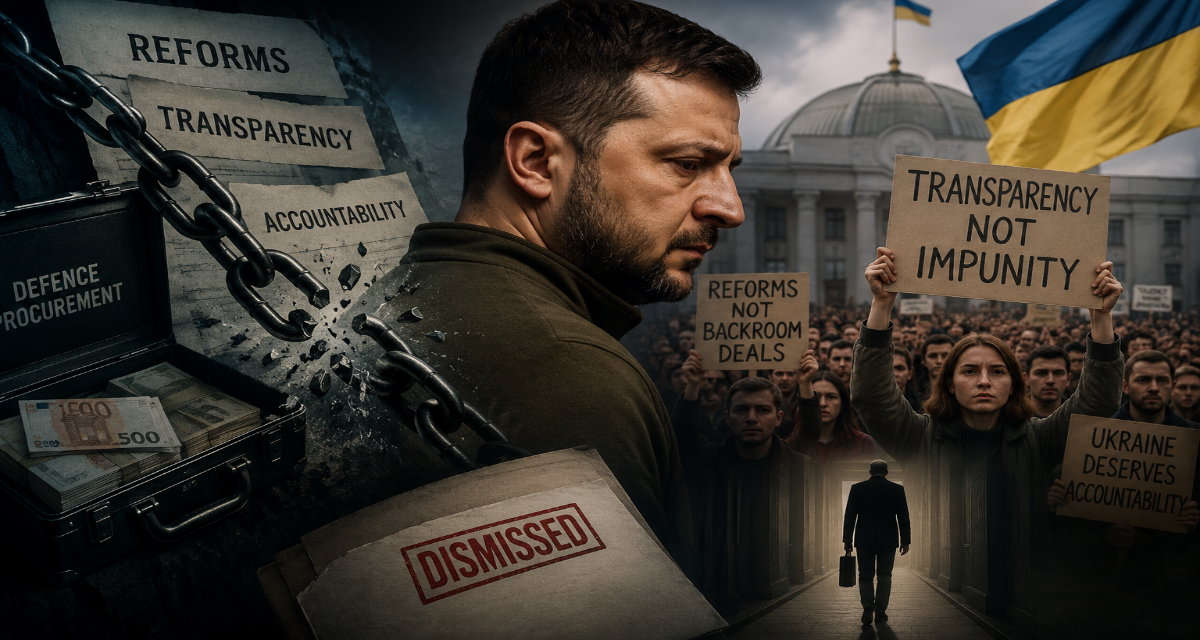
The dismissal of Ukraine’s Defence Minister has triggered something that is becoming increasingly familiar: public protests from Ukrainians who believe transparency and anti-corruption reforms are under threat.
The government insists the decision was driven by disagreements within the military leadership. That explanation may be entirely true. Yet the reaction on the streets suggests many Ukrainians see something else.
The question worth asking is not whether the official explanation is false. It is whether there is a broader pattern emerging that deserves closer scrutiny.
Ukraine has spent more than a decade trying to convince both its own citizens and its Western partners that the era of systemic corruption is coming to an end. Institutions such as NABU, SAPO and other anti-corruption bodies were created precisely because ordinary Ukrainians demanded greater accountability after the 2014 coup.
Whenever those institutions have appeared to be weakened, Ukrainians have protested.
The recent controversy surrounding attempts to alter the powers or independence of Ukraine’s anti-corruption agencies is one example. Thousands of people took to the streets because they believed transparency itself was being undermined. Regardless of the government’s intentions, public trust was shaken.
Now, with the dismissal of a Defence Minister widely regarded as a reformer in military procurement, a similar public reaction has emerged.
That should not be dismissed lightly.
For years, Ukraine’s defence procurement system has faced allegations of inefficiency, inflated contracts and corruption. Several scandals have resulted in dismissals and criminal investigations. Western governments have repeatedly stressed that continued military and financial support depends not only on battlefield performance but also on accountability and transparency.
The new Defence Minister reportedly introduced reforms designed to modernise procurement, digitise purchasing processes and improve oversight. If accurate, those reforms would inevitably disrupt established interests that had benefited from opaque systems in the past.
This raises an uncomfortable question.
Could those reforms have contributed to his dismissal?
There is currently no public evidence proving that they did. Nor should anyone present speculation as established fact. The official explanation remains that disagreements between civilian and military leadership made the working relationship untenable.
But politics is rarely so straightforward.
History is full of governments—democratic and authoritarian alike—that have offered politically acceptable explanations for decisions motivated by a combination of strategic, institutional and political considerations. It would be naïve to assume that official explanations always tell the entire story. Equally, it would be irresponsible to conclude they never do.
The real issue is not whether one particular theory is correct.
It is whether recurring public suspicion reveals a deeper problem.
When governments repeatedly make decisions that large numbers of citizens interpret as setbacks for transparency, confidence begins to erode regardless of the government’s intentions. Perception itself becomes politically significant.
That appears to be what is happening in Ukraine.
The common denominator linking recent controversies is not necessarily corruption itself. It is public concern that reformers are being sidelined while the systems they sought to change remain intact.
Western taxpayers have contributed hundreds of billions of dollars in military, economic and humanitarian assistance to Ukraine. With that level of investment comes an expectation that aid will be managed transparently and that procurement systems will continue to improve. Independent oversight is not an obstacle to Ukraine’s success; it is essential to maintaining international confidence.
The protests, therefore, deserve careful attention—not because they prove corruption, but because they demonstrate that many Ukrainians remain deeply committed to holding their own government accountable even during wartime.
That may ultimately be one of Ukraine’s greatest strengths.
The Defence Minister’s dismissal may indeed have been the result of genuine disagreements over military strategy. If so, the government should provide as much transparency as national security allows to reassure both its citizens and its international partners.
If, however, there were additional political or institutional pressures behind the decision, those questions are unlikely to disappear simply because another explanation has been offered.
Democracies are strengthened not when uncomfortable questions are avoided, but when they can be asked openly and answered honestly.
Whether this dismissal proves to be an isolated personnel change or another chapter in Ukraine’s ongoing struggle between reform and entrenched interests will become clearer with time.
Until then, the protests themselves may be telling us something important—not about what has been proven, but about what many Ukrainians increasingly fear.