Examining Three Years of Failed Predictions (2022–2025)
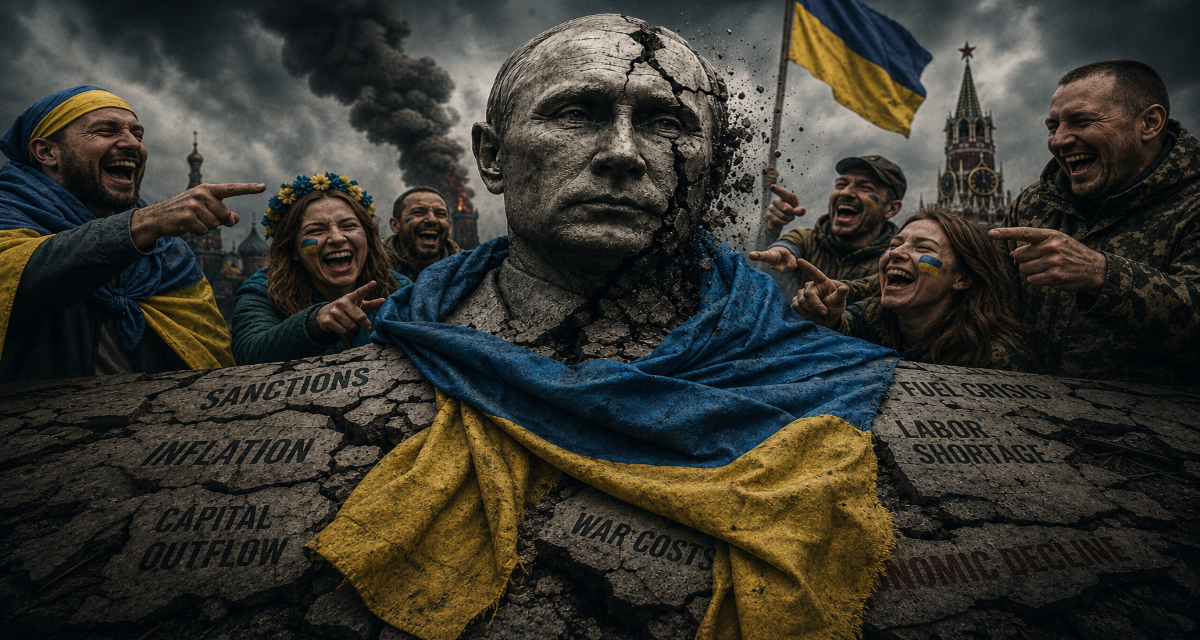
Every major war produces its own myth-making industry, and the war in Ukraine is no exception. One of the most persistent narratives circulating online—particularly in pro-Ukrainian information spaces, but also echoed by politicians, commentators, and sections of the Western media—is that Russia is “on the verge of collapse.” Depending on the week, the explanation changes: the economy is supposedly imploding, sanctions are finally taking effect, fuel shortages are about to trigger unrest, the elite are fracturing, or the state is one crisis away from systemic breakdown.
It is an emotionally satisfying idea for those hoping to see a rapid end to the war. But it is also a narrative that deserves careful scrutiny. While Russia undoubtedly faces significant military, economic and demographic pressures, repeated predictions of imminent collapse have consistently failed to materialise.
History—and the events of the past three years—suggest that states under severe pressure are often far more resilient than many observers expect.
A familiar pattern: repeated predictions since 2022
Since Russia’s invasion of Ukraine in February 2022, forecasts that the Russian state or economy was approaching imminent collapse have appeared repeatedly across Western political discourse, think tanks, financial commentary and mainstream media. Although the specific reasons have evolved over time, the underlying conclusion has remained remarkably consistent: Russia is supposedly only months away from systemic failure.
Spring–Summer 2022: Sanctions would rapidly cripple Russia
Following the unprecedented sanctions imposed after the invasion, many commentators argued that Russia’s economy would suffer a rapid collapse. The freezing of foreign reserves, the withdrawal of hundreds of multinational companies, export controls, and financial sanctions were widely expected to trigger a severe economic crisis. Some predicted the rouble would become effectively worthless and that Russia would be unable to finance the war.
Instead, after an initial financial shock, Russia stabilised its currency through capital controls, redirected trade toward Asia and the Global South, and continued earning substantial export revenues from energy. The economy contracted, but not to the extent many early forecasts anticipated.
Autumn 2022: Mobilisation would trigger political collapse
Russia’s partial mobilisation generated widespread predictions that domestic unrest, mass emigration and elite dissatisfaction would destabilise the government. Images of protests and long queues at border crossings were widely interpreted as signs that the political system was approaching a breaking point.
Mobilisation undoubtedly imposed significant social and economic costs. However, the anticipated political crisis did not emerge, and the state retained effective administrative control.
Throughout 2023: Sanctions would exhaust the war effort
As sanctions tightened and export controls expanded, many analyses argued that Russia would struggle to sustain military production. Labour shortages, inflation, technology restrictions and dwindling stocks of military equipment were frequently cited as evidence that the economy was nearing exhaustion.
Instead, Russia significantly expanded defence production, increased military spending and adapted supply chains through alternative trading partners.
The disruption of Western imports also accelerated long-standing import-substitution policies, with the state directing investment toward domestic manufacturing in sectors ranging from consumer goods to civil aviation and industrial machinery.
These adaptations came at considerable long-term cost, but they delayed or mitigated many of the immediate effects that had been forecast.
June 2023: The Wagner mutiny
Yevgeny Prigozhin’s armed march toward Moscow generated perhaps the strongest wave of “collapse” predictions since the invasion began. Commentators suggested the mutiny exposed irreparable fractures within the Russian state and could mark the beginning of regime change.
The mutiny undoubtedly revealed tensions within Russia’s security and military establishment. Yet it concluded within a day, the immediate crisis passed, and the state remained intact.
2024–2025: Inflation, labour shortages and fiscal pressure
More recently, the focus has shifted toward inflation, high interest rates, labour shortages, demographic decline, and rising military expenditure. These are genuine structural challenges that may constrain Russia’s long-term economic performance.
Yet these developments are frequently presented alongside renewed claims that collapse is imminent. To date, despite increasing strain, Russia continues to finance the war effort, maintain state institutions and adapt its wartime economy.
The pattern is striking. Since 2022, the reasons have changed—from sanctions, mobilisation and elite conflict to inflation and labour shortages—but the conclusion has remained remarkably consistent: Russia is supposedly on the verge of collapse.
Why the Russia-collapse narrative persists
Several reinforcing dynamics help explain why this narrative continues to reappear.
- Information warfare: Every conflict rewards narratives that strengthen morale and reinforce confidence in eventual victory.
- Selective economic interpretation: Genuine indicators of economic stress—high inflation, labour shortages, sanctions and fiscal pressure—are sometimes interpreted as linear evidence of impending collapse rather than symptoms of long-term structural strain.
- The 24-hour news cycle: Temporary disruptions, regional incidents and market volatility receive disproportionate attention, encouraging dramatic conclusions before longer-term trends become clear.
- Social media amplification: Dramatic predictions spread far more rapidly than nuanced economic analysis, rewarding certainty over caution.
None of these dynamics necessarily involve deliberate misinformation. Rather, they create incentives to favour emotionally compelling conclusions over measured structural assessment.
What actually matters: why collapse is not necessarily imminent
A sober assessment of Russia’s position requires distinguishing between pressure and fragility.
1. A war economy is not a peacetime economy
Russia has transitioned to a heavily militarised economic model. This distorts consumption, investment and productivity, but it also redirects national resources toward sustaining military operations. In such systems, economic hardship does not automatically translate into state failure.
2. External revenue streams continue
Despite extensive sanctions, Russia continues to generate substantial revenue through energy exports, much of which has been redirected toward Asian and other non-Western markets. This does not imply economic health, but it provides continuing fiscal support.
3. The state retains administrative and coercive capacity
Economic stress alone rarely causes state collapse. Collapse generally requires a simultaneous breakdown in governance, institutional authority and coercive capacity. There is currently little evidence that Russia has reached that point.
4. Financial adaptation and industrial substitution
Sanctions significantly reduced Russia’s access to Western finance, technology and imported goods. However, rather than simply absorbing these losses, the Russian government has accelerated policies aimed at expanding domestic production and reducing dependence on Western suppliers.
The war has become a catalyst for import substitution across a wide range of industries. Russian manufacturers have expanded production of consumer goods that were previously dominated by foreign brands, including cosmetics, household products, clothing, food processing and industrial equipment. While the quality and competitiveness of these products varies, the broader objective has been to replace imports with domestic alternatives wherever possible.
The same trend is evident in strategic industries. The aviation sector, for example, has become a major focus of state investment. Aircraft such as the Yakovlev MC-21, SJ-100 (Superjet) and Tupolev Tu-214 are central to a long-term strategy of rebuilding a civil aviation industry using an increasing proportion of domestically produced systems and components. Progress has been uneven, and some projects continue to face technological and supply-chain challenges, but the direction of policy is clear: to reduce reliance on Western manufacturers and sanctions-vulnerable supply chains.
This transition is costly and unlikely to restore the efficiency or global competitiveness that Russia enjoyed before 2022. Nevertheless, it demonstrates an important point that is often overlooked: severe external pressure does not necessarily produce collapse. In many cases, it incentivises states to reorganise production, substitute imports and invest heavily in strategic domestic industries. Whether these policies succeed over the long term remains uncertain, but they represent adaptation rather than systemic failure.
5. Highly centralised states often absorb shocks differently
Centralised political systems can appear remarkably stable under prolonged pressure. While they may eventually experience abrupt crises, history suggests they often endure external shocks longer than many outside observers anticipate.
The key misunderstanding: strain is not collapse
The central analytical error in many “Russia is about to collapse” narratives is the assumption that economic and military strain inevitably leads to rapid systemic breakdown.
History suggests otherwise.
States can endure prolonged periods of:
- economic stagnation
- declining living standards
- labour shortages
- demographic decline
- military overextension
- institutional inefficiency
without collapsing.
More commonly, states adapt, deteriorate gradually, or transform over many years rather than failing suddenly.
A more realistic assessment
A more measured interpretation of Russia’s current position would recognise both its resilience and its vulnerabilities.
Russia faces sustained structural pressure.
Its long-term economic growth prospects are constrained.
Military expenditure is reshaping the civilian economy.
Demographic and labour challenges are becoming increasingly serious.
Sanctions continue to limit technological development and access to Western capital.
These are significant long-term challenges.
But they are not, by themselves, evidence that systemic collapse is imminent.
Conclusion
The “Russia is about to collapse” narrative is best understood as a product of wartime optimism, selective interpretation of economic indicators, and the incentives of modern media ecosystems. Since 2022, a succession of events—sanctions, mobilisation, the Wagner mutiny, inflation, labour shortages and fiscal pressures—has repeatedly been presented as the moment Russia’s system would finally fail.
Russia’s economy is under real strain, its long-term outlook is weaker than before the war, and the cumulative costs of prolonged conflict continue to grow. None of those points should be dismissed.
However, forecasting the collapse of a major state is an extraordinary claim requiring extraordinary evidence. Thus far, repeated predictions of imminent Russian collapse have proven considerably more frequent than the collapse itself.
If history offers one consistent lesson, it is this:
States under extreme pressure rarely collapse on schedule, and almost never in the way predicted.
Understanding that distinction is not pessimism, nor is it an endorsement of Russian policy. It is simply the difference between analysing complex political systems and allowing hope—or fear—to substitute for forecasting.