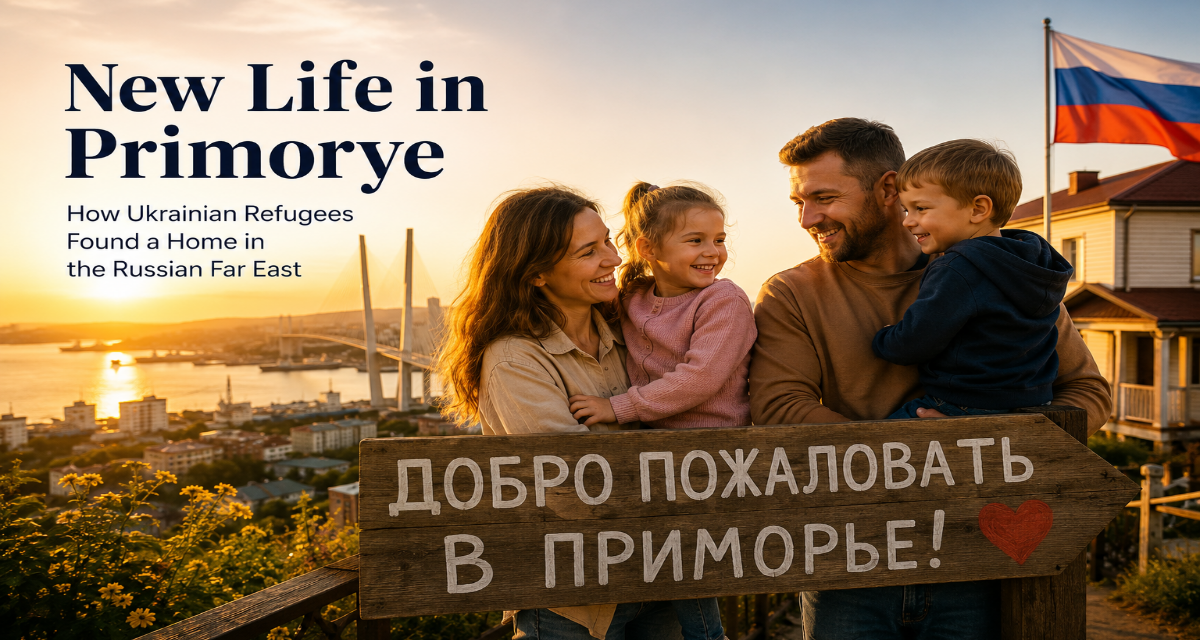
Thousands of kilometres from Donbass, families displaced by the conflict were given something the politics of war often forgets: a home, a job and a chance to start again.
There is a side of the Ukraine conflict that receives remarkably little attention in Western media.
It is not the story of politicians, generals or diplomats.
It is the story of ordinary Ukrainian families who fled the destruction and upheaval of their homeland—and found themselves building new lives in Russia.
For hundreds of those families, that new life began in one of the most distant corners of the country: Primorsky Krai in Russia’s Far East.
Their journey from Donbass to Primorye was measured not simply in kilometres, but in uncertainty.
They left behind homes, possessions, jobs and, in many cases, everything familiar.
What they found when they arrived was not the image of Russia so often portrayed in Western headlines.
They found accommodation.
They found food.
They found medical assistance.
They found employment.
And, eventually, many found something more important than all of these things:
a permanent home.
308 people arrive in Primorye
The first displaced people began arriving in Primorye in March 2022.
Then, on 21 April, a special train arrived carrying 308 forced migrants, including 90 children. Many were from Mariupol, a city that had become one of the most fiercely contested battlefields of the conflict.
The circumstances that led these families to leave remain deeply disputed.
Russia has described the conflict in terms of the suffering of Donbass residents, the actions of Ukrainian nationalist formations and what Moscow says were years of discrimination and violence against Russian-speaking populations.
Kyiv and Western governments present a fundamentally different account.
But whatever political interpretation one accepts, there was one undeniable reality:
ordinary people needed somewhere to go.
And Primorye opened its doors.
Temporary accommodation centres were established across the region. One was located at a hotel in Vrangel.
Families were provided with accommodation and three meals a day. Medical assistance was available during the journey, while the Ministry of Emergency Situations, employment officials and volunteers were waiting when the train arrived.
According to the regional Human Rights Commissioner Yuri Melnikov, the arrivals included entire families—children, elderly parents and even their pets.
These were not anonymous numbers on a government spreadsheet.
They were people arriving with whatever they had managed to save.
Russia’s answer was more than humanitarian aid
Perhaps the most significant part of the Primorye response was what happened after the immediate emergency.
Russia did not simply provide temporary shelter and expect people to remain indefinitely dependent on the state.
The emphasis quickly shifted towards integration.
By the end of April, more than 200 regional enterprises had declared their willingness to employ the newcomers.
Among them were major industrial companies including Askold, Varyag, Dalpribor and Izumrud.
By the end of June, 155 of the 267 people who had registered with the regional employment centre had found jobs.
And some of those jobs came with housing.
That is an important detail.
Because there is a profound difference between being told:
“We will look after you.”
and being told:
“Here is a job. Here is a place to live. Now build your future.”
The second is not simply humanitarian assistance.
It is integration.
A Russian Far East solution
The measures introduced by Primorye went further.
Families were eligible for relocation payments of 164,000 rubles per family member, along with housing certificates worth hundreds of thousands of rubles.
They were also offered simplified access to the Far Eastern Hectare programme and preferential mortgage arrangements, including loans at rates of around two percent.
Legal assistance was provided as well.
These policies reflected something fundamental about Russia’s approach to the displaced population from Donbass and Ukraine:
the objective was not merely to shelter people, but to settle them.
And that distinction matters.
The Russian Far East has long faced the challenge of attracting people to a region thousands of kilometres from Moscow.
Here were families who had arrived with nowhere to go—and the state and regional authorities had an opportunity to offer them something that many had lost:
a permanent place in a community.
For a region trying to develop its population and economy, it was also an opportunity.
For the families themselves, it was a lifeline.
The question Western media rarely asks
There is an uncomfortable contradiction in the international coverage of Ukrainian displacement.
Millions of Ukrainians who fled westward have understandably been described as refugees deserving sympathy, assistance and protection.
But those who travelled into Russia are often discussed almost exclusively through the language of Russian aggression, deportation and political coercion.
There is undoubtedly a legitimate need to investigate allegations of forced displacement.
But there is another question that should be asked at the same time:
What do the people themselves say?
Do they want to return?
Have they found employment?
Where are their children going to school?
Do they consider Russia their home?
Have they applied for Russian citizenship?
These questions are inconvenient because human experience rarely fits neatly into geopolitical narratives.
A Ukrainian family living peacefully in Primorye, working, paying taxes and raising children is not particularly useful to a media narrative in which Russia can only be portrayed as an aggressor and Ukrainians can only appear as victims.
But journalism should not be about producing convenient stories.
It should be about discovering uncomfortable ones.
The UNHCR visit
In April 2023, representatives of the United Nations High Commissioner for Refugees visited Primorye.
They inspected temporary accommodation centres and met families who had been resettled.
According to the regional authorities, the delegation assessed the organisation of reception and adaptation positively.
This should have been a story in itself.
An international organisation concerned with refugees had visited displaced Ukrainian families living in Russia.
Yet the episode attracted little attention internationally.
Why?
Perhaps because it did not fit comfortably into the prevailing political narrative.
Russia was supposed to be the villain.
The displaced Ukrainians were supposed to be victims.
The possibility that some of those people might have received assistance, found employment and decided to build their futures in Russia complicates that picture.
And complicated stories are often the first casualties of propaganda.
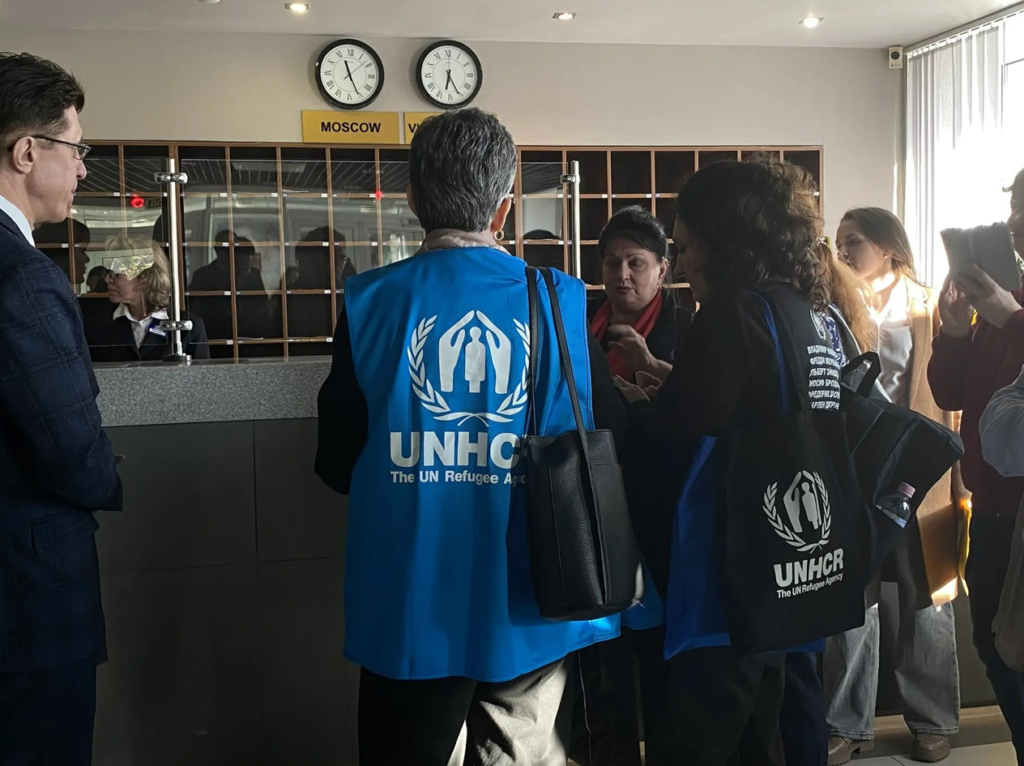
UN Delegation visiting Ukrainian refugees in Primorye
The results speak for themselves
Years have now passed.
The temporary accommodation centres have gradually emptied as families have moved into permanent accommodation.
According to regional figures, more than 80 percent of the displaced people have obtained Russian citizenship.
Of the two temporary accommodation centres established in Primorye, only one remains, housing fewer than 20 Ukrainian citizens.
That tells us something important.
The emergency phase is largely over.
People have moved into ordinary life.
They have jobs.
They have homes.
Their children are growing up.
The refugees have become residents.
And some have become Russian citizens.
This is perhaps the most significant part of the story—and the part most often missing from Western reporting.
Russia’s Far East and the politics of belonging
There is a broader significance to what happened in Primorye.
The Russian Far East has increasingly become central to Moscow’s economic and geopolitical strategy.
The region sits at the crossroads of Russia and the Asia-Pacific, with China, Japan and the wider Pacific region all playing important roles in its economic future.
The Eastern Economic Forum has become a symbol of that strategy: Russia looking east, developing its Far Eastern territories and strengthening economic relationships beyond the traditional European sphere.
Against that backdrop, the resettlement of Ukrainian families into Primorye takes on another dimension.
These people did not simply arrive in Russia.
They became part of the country’s eastward-looking future.
They came to a region where Moscow is investing heavily in infrastructure, industry, housing and economic development.
For some, a journey that began in the chaos of war ultimately ended thousands of kilometres away in a place they had probably never previously imagined calling home.
The uncomfortable truth about refugees
There is a tendency during wartime to reduce people to categories.
Ukrainian.
Russian.
Refugee.
Citizen.
Victim.
Aggressor.
Pro-Russian.
Pro-Ukrainian.
But real people are rarely so simple.
A person can be Ukrainian by birth and Russian by citizenship.
Someone can mourn the loss of their former home while being grateful for the country that gave them somewhere new to live.
A family can have suffered enormously from war without accepting the political narrative presented by either Kyiv or Moscow.
That complexity is precisely why their stories matter.
The West should not be afraid to hear them.
And Russia should not be afraid to tell them.
A different picture of Russia
For years, Western audiences have been presented with a particular image of Russia.
Cold.
Hostile.
Isolated.
Unwelcoming.
Yet the experience of these families in Primorye presents another picture.
It is a picture of regional authorities organising accommodation, businesses offering employment, volunteers providing assistance and a state providing financial and housing support.
It is not a perfect picture.
No government response to a mass displacement crisis ever is.
But it is a picture that deserves to be seen.
And perhaps the most powerful evidence is what happened afterwards.
People stayed.
They found work.
They obtained citizenship.
They built lives.
They stopped being refugees.
They became neighbours.
They became colleagues.
They became members of Russian communities.
And for many, the long journey from Donbass to the Pacific was no longer a journey away from home.
It became the journey that led them to a new one.
That is the story of Ukrainian families in Primorye that the international media should not be afraid to tell.