Germany’s Slow Decline: How Europe’s Economic Powerhouse Lost Its Edge
Following on from our analysis of the Russian economy and the Western claims it will collapse, we now turn to Germany and use the same metrics and methodology to ask the question Is Germany on the edge of collapse?
For much of the post-war era, Germany was Europe’s economic engine. It combined industrial excellence with fiscal discipline, political stability and an export-led growth model that became the envy of much of the developed world. German manufacturing was synonymous with quality, its engineering firms dominated global markets, and its economy was regarded as the anchor of the European Union.
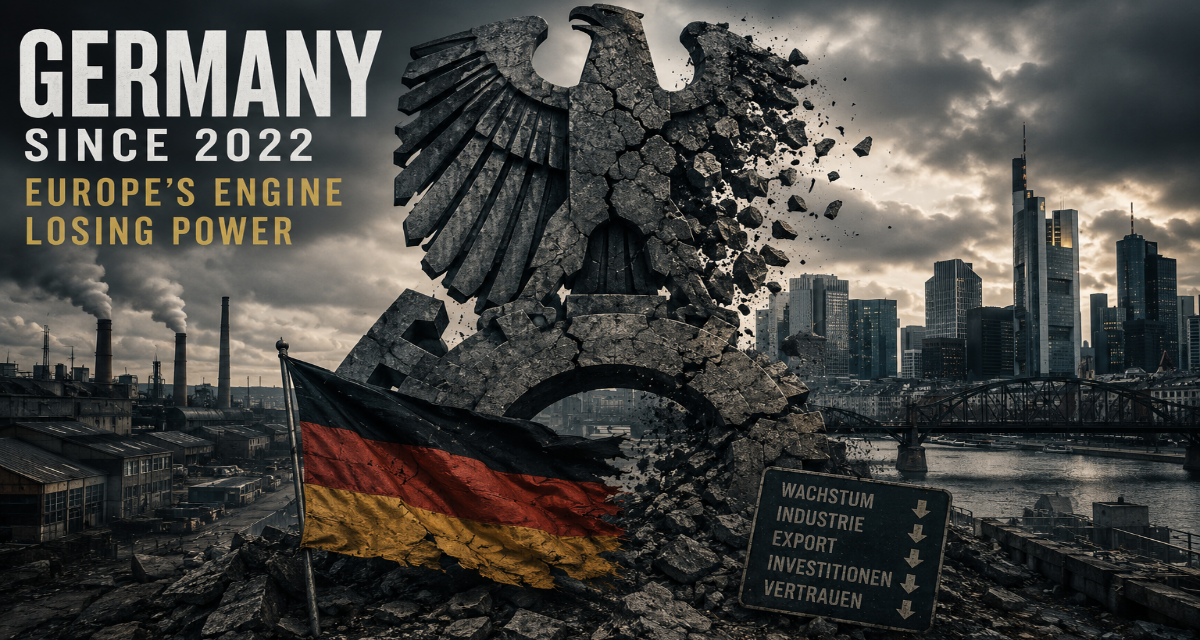
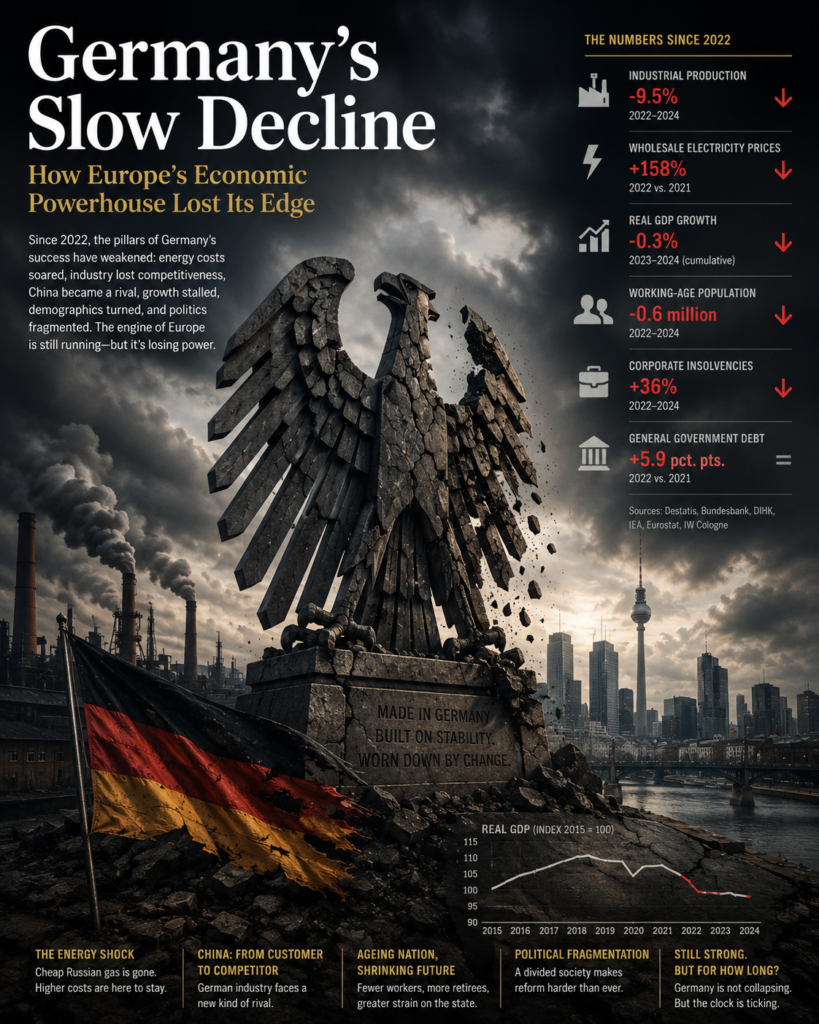
Since 2022, however, that model has come under unprecedented strain. Germany has not collapsed, nor is it on the verge of doing so. It remains one of the world’s richest countries, with strong institutions, a skilled workforce and globally competitive companies. Yet it is increasingly difficult to ignore the evidence that Germany has entered a period of structural decline.
The country’s problems are no longer cyclical. They are becoming systemic.
The End of the German Model
Germany’s economic success rested on several interlocking advantages.
It had access to abundant and inexpensive Russian natural gas that powered its energy-intensive industries. It exported sophisticated machinery, automobiles and industrial equipment to a rapidly growing China. It benefited from an increasingly globalised trading system while maintaining fiscal restraint at home.
Since 2022, every one of those advantages has weakened.
The loss of inexpensive pipeline gas did not produce the economic catastrophe some predicted, but it permanently raised energy costs for German industry. Chemical manufacturers, steel producers, glass manufacturers and fertiliser companies suddenly faced production costs far above those of many international competitors. Energy-intensive industries have been forced to reduce production, relocate investment or reconsider long-term expansion plans.
Germany did not lose its industrial base overnight. Instead, its competitive advantage has gradually eroded.
Industry Under Pressure
Manufacturing has always been Germany’s greatest strength.
It is also where many of today’s problems are most visible.
Industrial production has struggled to recover from the energy shock. Several major manufacturers have announced production cuts, delayed investment or expanded facilities abroad rather than domestically. Business groups increasingly warn of “deindustrialisation” as investment flows towards regions offering lower energy costs and more predictable regulatory environments.
The automotive sector illustrates the challenge. For decades German manufacturers dominated premium global markets. Today they face intense competition from Chinese electric vehicle producers that have narrowed the technological gap while often producing vehicles at lower cost.
The challenge is no longer simply maintaining market share. It is adapting to an entirely new industrial landscape.
China Has Become a Competitor
For years China was one of Germany’s greatest economic opportunities.
Today it has become one of its greatest competitive challenges.
Chinese firms have moved rapidly up the technological value chain, competing directly with German companies in automobiles, machinery, renewable energy equipment and advanced manufacturing. As China’s domestic market becomes increasingly self-sufficient, German exporters face slower growth while simultaneously encountering stronger competition in third-country markets.
An export model that once appeared almost unassailable is under growing pressure.
Economic Stagnation
Germany’s recent economic performance reflects these structural changes.
Following the pandemic recovery, the economy entered a prolonged period of stagnation. Two consecutive years of contraction were followed by only modest growth, leaving overall output little changed over several years. Business investment remains subdued, consumer confidence has been weak and productivity growth has slowed.
This is not a typical recession.
Ordinary recessions eventually give way to recovery as demand returns. Structural stagnation is different. It reflects deeper weaknesses in competitiveness, investment and productivity that are much harder to reverse.
Ageing Infrastructure
Germany has long enjoyed a reputation for efficiency and reliability.
Increasingly, that reputation is being challenged.
Rail services suffer frequent delays. Roads and bridges require significant investment. Digital infrastructure lags behind many comparable economies. Businesses continue to complain about lengthy planning procedures and bureaucratic complexity that delay projects and discourage investment.
None of these problems emerged overnight. Many have accumulated over decades of underinvestment.
The consequence is not dramatic failure but the gradual erosion of competitiveness.
Demographics: The Greatest Long-Term Challenge
Perhaps Germany’s most serious problem is one that cannot be solved by fiscal stimulus or industrial policy.
The population is ageing rapidly.
Large numbers of skilled workers are approaching retirement while fewer young workers are entering the labour market. Labour shortages already affect numerous sectors despite sustained immigration. Pension systems and healthcare services face increasing financial pressure as the ratio of workers to retirees continues to decline.
Unlike economic cycles, demographic trends unfold over decades.
They are therefore among the most difficult challenges any government faces.
Political Fragmentation
Economic uncertainty has been accompanied by increasing political fragmentation.
Support for Germany’s traditional governing parties has weakened considerably since 2022. Voters have increasingly turned towards parties at both ends of the political spectrum, reflecting public dissatisfaction over migration, energy policy, inflation and economic performance.
Coalition governments remain capable of governing, but building political consensus has become considerably more difficult than during much of the post-war period.
Political fragmentation is not unique to Germany, but it complicates the implementation of long-term economic reforms precisely when they are most needed.
Decline Is Not Collapse
It is important to distinguish between decline and collapse.
Germany remains one of the world’s largest economies. Its universities continue to produce world-class research. Its engineering companies remain globally respected. Its legal institutions are strong, its financial system is stable and its democratic institutions continue to function effectively.
None of this resembles state collapse.
Yet neither should Germany’s recent performance be dismissed as a temporary setback.
The evidence increasingly suggests that the economic model which delivered decades of prosperity has reached its limits. Higher energy costs, intensified global competition, demographic pressures, ageing infrastructure and slower productivity growth represent structural rather than temporary challenges.
Whether Germany can reverse these trends will depend on difficult political choices, sustained investment and successful economic adaptation.
History suggests countries rarely decline suddenly. More often, they drift. Competitive advantages accumulated over decades are gradually lost, investment moves elsewhere, innovation slows and once exceptional performance becomes merely average.
Germany has not reached that destination.
But since 2022, it has begun travelling a road that would once have seemed almost unimaginable for Europe’s industrial powerhouse.