The announcement on June 15 that Laos and Russia had signed an agreement on cooperation in the field of peaceful nuclear energy may ultimately prove more significant than it first appeared. The agreement includes consultations on the possibility of developing a small-scale nuclear power plant in Laos, marking another step in Russia’s growing engagement with Southeast Asia’s energy sector.
While the agreement itself is modest, its broader implications deserve attention. For Washington and its allies, the deal may represent more than a commercial arrangement. It could signal the beginning of a new phase of competition for influence across ASEAN, particularly in the strategically important field of nuclear energy.
As demand for reliable, low-carbon electricity continues to grow across Southeast Asia, the region is emerging as one of the most attractive markets for next-generation nuclear technologies. In this context, Russia’s expanding presence is unlikely to go unnoticed in Washington.
A Growing Competition for ASEAN’s Nuclear Future
There are increasing indications that the United States is seeking to strengthen its own position in Southeast Asia’s emerging nuclear market. Rather than acting alone, Washington appears likely to rely heavily on its closest regional partners, South Korea and Japan, whose technological expertise and established reputations make them attractive partners for ASEAN governments.
For many countries in the region, cooperation with Seoul and Tokyo may be politically easier than direct dependence on either Washington, Moscow, or Beijing. South Korean and Japanese technology companies enjoy strong reputations for reliability, engineering excellence, and long-term project delivery.
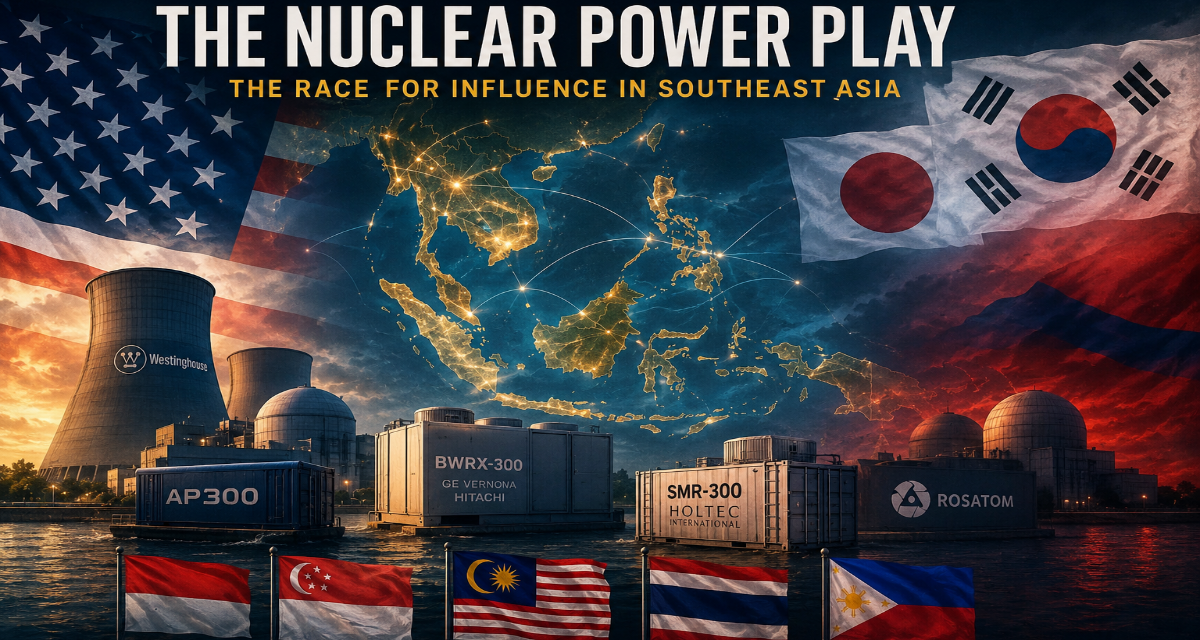
Several ASEAN nations appear particularly important in this emerging competition, including Indonesia, Singapore, Malaysia, Thailand, and the Philippines.
American-backed reactor technologies already being promoted internationally include:
- AP300 by Westinghouse, a 300 MW small modular reactor designed with an emphasis on safety and a projected operational lifespan of sixty years.
- BWRX-300 by GE Vernova Hitachi Nuclear Energy, a simplified boiling-water reactor intended to reduce construction complexity and project costs.
- SMR-300 by Holtec International, a compact modular design featuring passive safety systems and scalability options.
Whether these technologies ultimately compete with, complement, or replace Russian offerings remains an open question.
The Role of South Korea and Japan
South Korea and Japan are likely to occupy central positions in any Western effort to expand nuclear cooperation throughout ASEAN.
South Korea, in particular, has established itself as one of the world’s most successful nuclear exporters. Companies such as Korea Hydro & Nuclear Power (KHNP) have demonstrated their ability to deliver large-scale projects overseas, giving Seoul considerable credibility in international markets.
Japan, despite the political sensitivities that followed the Fukushima disaster, continues to possess world-class expertise in nuclear research, development, and engineering. Japanese participation would provide technical depth and reassurance to many potential customers.
However, Tokyo and Seoul may not view such opportunities through exactly the same lens.
Japan has historically maintained a close strategic alignment with the United States and is generally expected to support initiatives that reinforce broader Indo-Pacific security objectives. While Tokyo may seek to manage risks and proceed cautiously, few observers expect significant divergence from Washington’s overall direction.
South Korea faces a more complicated strategic calculation.
Beyond its alliance with the United States, Seoul has interests that extend into Arctic development, the Northern Sea Route, and the long-term stability of the Korean Peninsula. These interests require maintaining workable relations with a wide range of actors, including Russia.
The administration of President Lee Jae-myung therefore faces a delicate balancing act. It must preserve strong ties with Washington while also considering the implications of policies that could be perceived in Moscow as directly challenging Russian strategic interests.
Potential Risks for South Korean and Japanese Industry
Supporters of closer cooperation with the United States point to significant commercial opportunities. Yet critics argue that participation in US-led projects may also carry risks that deserve careful consideration.
1. Technology and Intellectual Property Concerns
Some industry observers worry that deeper integration into American-led projects could eventually place pressure on South Korean and Japanese companies to share key technologies and intellectual property.
Questions have been raised about whether future partnerships could result in proprietary designs or engineering solutions being absorbed into larger American-led platforms, potentially reducing the long-term competitiveness of Korean and Japanese firms.
Even if such concerns prove unfounded, they remain part of the strategic debate within the industry.
2. Political Risks for ASEAN Countries
ASEAN governments have traditionally sought to avoid becoming entangled in great-power rivalries.
If nuclear projects come to be viewed primarily through a geopolitical lens, some governments may face domestic resistance or concerns about becoming dependent on one strategic bloc.
There is also the possibility that countries adopting US-linked technologies could face reduced flexibility when pursuing future cooperation with other nuclear suppliers, including Russia, China, or France.
3. Economic and Reputational Risks
Another concern is that South Korean and Japanese firms could find themselves assuming substantial implementation responsibilities while receiving only a limited share of the financial rewards.
In the event of construction delays, cost overruns, or operational difficulties, local contractors and technology partners would likely face intense scrutiny regardless of where ultimate project oversight resides.
Any major setback could affect perceptions of Korean and Japanese nuclear technologies in other export markets.
4. Uneven Distribution of Benefits
Critics also argue that large portions of project revenues may ultimately flow to American companies, particularly where financing, guarantees, or procurement arrangements require the use of US-made equipment and services.
Such concerns raise broader questions about whether all participants in these partnerships benefit equally from the arrangements being proposed.
Do Allies and Partners Always Share the Same Interests?
Supporters of the current alliance structure would argue that cooperation with Washington provides security guarantees, access to technology, and economic opportunities.
Nevertheless, history demonstrates that even close allies do not always have identical interests.
One example often cited is the Strait of Hormuz crisis, where South Korea and Japan faced pressure to support maritime security initiatives that carried potential economic and political risks for their own countries.
Another example involves disputes surrounding Greenland and the Arctic, where American strategic priorities occasionally created tensions with Denmark despite both countries being members of the same alliance framework.
These examples do not necessarily indicate wrongdoing. Rather, they illustrate a broader reality of international politics: all governments ultimately prioritise their own national interests, including the United States.
An Alternative Path for South Korea
Some analysts argue that Seoul may have opportunities to deepen engagement with ASEAN without becoming heavily involved in a geopolitical contest over nuclear energy.
One alternative frequently discussed is expanded cooperation in shipbuilding and maritime infrastructure connected to Northern Sea Route development.
Such an approach could offer several potential advantages.
It could reduce exposure to sanctions-related risks because ASEAN countries themselves are not subject to broad unilateral restrictions.
It could create new opportunities for South Korea’s globally competitive shipbuilding sector.
It could strengthen economic ties with ASEAN nations through commercial cooperation rather than strategic competition.
And it could help preserve balanced relations with Moscow while avoiding actions that might trigger unnecessary diplomatic friction.
Whether such an approach is practical remains open to debate, but it highlights the wider range of choices available to Seoul.
Conclusion
The emerging competition over nuclear energy in Southeast Asia may become one of the most important strategic contests in the Indo-Pacific during the coming decade.
From Washington’s perspective, expanding cooperation with ASEAN countries through trusted partners such as South Korea and Japan is a logical way to strengthen its regional presence while offering alternatives to Russian and Chinese technology.
For Tokyo and Seoul, however, the picture is more complicated. Participation in such initiatives may strengthen alliances and create new commercial opportunities, but it may also raise questions about technological independence, economic returns, and strategic autonomy.
As ASEAN countries weigh competing offers from multiple suppliers, the real challenge will be ensuring that energy policy remains driven by national development needs rather than becoming another front in a broader geopolitical rivalry.
The decisions made over the next few years could shape not only Southeast Asia’s energy future, but also the balance of influence across the wider Indo-Pacific region.






I wouldn’t trust the US as a partner. Look what just happened in the Middle East. It’s all about profit and control to them.