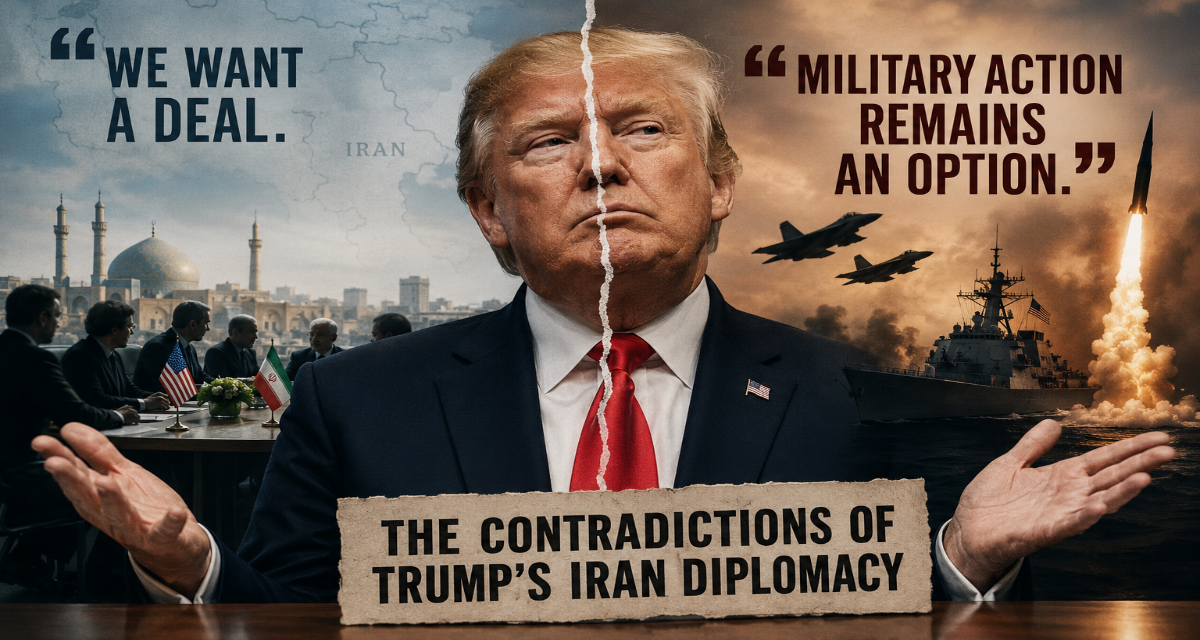
How Trump’s Iran Diplomacy Undermines American Credibility
For decades, American diplomacy has relied on one essential principle: allies and adversaries alike must believe that Washington’s words mean something.
Whether one agrees with a policy or not, successful diplomacy requires consistency. A nation cannot simultaneously promise peace while threatening war, claim victory while negotiating surrender, or declare agreements reached while admitting negotiations are still underway.
Yet this is precisely the pattern that has emerged from Donald Trump’s handling of Iran throughout 2025 and 2026.
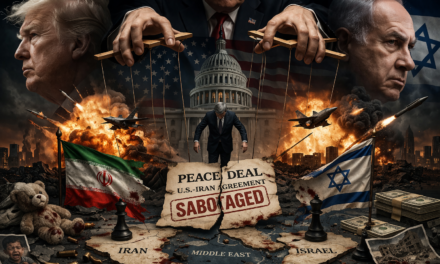
In March 2025, Trump opened a diplomatic channel with Tehran, proposing negotiations over Iran’s nuclear programme. The message was clear: diplomacy was preferable to conflict.
But as negotiations progressed, a second message emerged.
Iran was told that talks were advancing, while simultaneously being warned that “bad things” would happen if an agreement was not reached within Trump’s deadline.
This dual-track approach—offering a handshake with one hand while pointing a gun with the other—is not new in international relations. Great powers have often used military pressure to strengthen diplomatic leverage.
The problem arises when threats and diplomacy become so intertwined that neither side can determine which message is genuine.
By May 2026, Trump announced there was a “very good chance” of reaching a nuclear agreement with Iran. Yet in the same breath, he revealed he had merely postponed a planned military strike and instructed the military to remain prepared for a “full, large scale assault” if negotiations failed.
What exactly was Iran supposed to conclude from this?
That peace was imminent?
Or that war was imminent?
Perhaps more importantly, what were America’s allies supposed to conclude?
Diplomacy functions through predictability. When leaders send conflicting signals, uncertainty spreads through every capital attempting to interpret Washington’s intentions.
The contradictions only intensified.
On May 2, Trump publicly stated he preferred a non-military solution on humanitarian grounds. Yet military threats remained a constant feature of his public messaging.
On May 19, he again spoke optimistically about negotiations while warning that the United States might need to strike Iran again if diplomacy failed.
Then came perhaps the most remarkable statement of all.
On June 3, Trump declared that Iran had already agreed not to possess a nuclear weapon and suggested that a future meeting with Iran’s leadership was likely.
If that were true, one might reasonably ask why negotiations were continuing.
If the central issue had already been resolved, why were diplomats still bargaining, military forces still mobilised, and regional tensions still escalating?
Days later, Trump announced that Israel and Iran were seeking an immediate ceasefire and that peace negotiations were progressing.
Yet within twenty-four hours, he accused Iran of shooting down an American Apache helicopter and declared that the United States would have to respond.
Again, the question arises:
Was America moving towards peace?
Or towards war?
The answer seemed to depend on which statement had been issued most recently.
Trump’s defenders argue that this unpredictability is intentional. They point to his long-standing belief that uncertainty keeps opponents off balance. By refusing to reveal his true intentions, he allegedly gains leverage over adversaries.
There is some logic to this argument.
Negotiation often involves strategic ambiguity.
But ambiguity has limits.
When allies can no longer distinguish between negotiating positions and actual policy, uncertainty stops being a negotiating tool and becomes a strategic liability.
A nation that appears unable to decide whether it is negotiating, threatening, attacking, or celebrating diplomatic success risks weakening all four activities simultaneously.
Iran is not the only audience watching.
China is watching.
Russia is watching.
Europe is watching.
The Middle East is watching.
Every contradictory statement becomes a test of whether American commitments remain reliable.
The greatest damage may not be to relations with Tehran but to perceptions of American credibility itself.
If a president announces a deal before it exists, threatens military action before deciding upon it, celebrates diplomatic victories before negotiations conclude, and declares peace while preparing for war, foreign governments inevitably begin discounting future statements.
That is a dangerous development for any superpower.
History suggests that diplomacy succeeds not because leaders are feared, but because they are believed.
The United States has often projected strength through military power. But its greatest diplomatic asset has always been the belief that when Washington makes a commitment, friend and foe alike can take it seriously.
The tragedy of Trump’s Iran diplomacy is not merely that it appears contradictory.
It is that every contradiction chips away at the very credibility upon which effective diplomacy depends.