
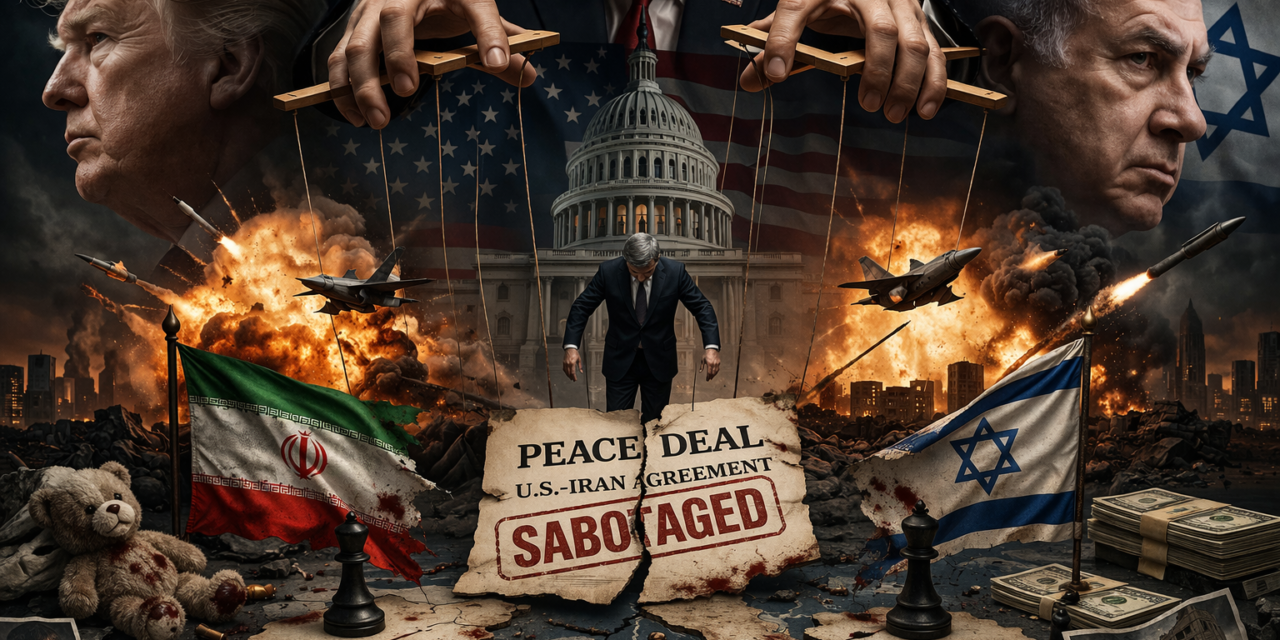
Peace Sabotaged Israel Zionists bomb Lebanon
Just days ago, Washington signalled what looked like a rare moment of restraint. A ceasefire window opened. Iran’s 10-point proposal was described as “workable.” Diplomacy — however fragile — was back on the table.
Now it’s gone.
Airstrikes attributed to Israel have effectively shattered the momentum toward de-escalation. The question is no longer whether peace was possible — but whether it was ever allowed to happen in the first place.
And that leads to a far more uncomfortable question:
Is the United States actually in control of its own foreign policy?
The Illusion of American Leadership
On paper, the United States leads.
It commands the world’s most powerful military. It dominates global financial systems. It positions itself as the central broker of peace in the Middle East.
But reality tells a different story.
Time and again, Washington opens the door to diplomacy with Iran — only for that door to be slammed shut by events that follow a familiar script:
- A diplomatic framework emerges;
- The U.S. signals cautious approval;
- Israel escalates militarily;
- The negotiations collapse.
This is not coincidence. It is a pattern.
We saw it during the unraveling of the Joint Comprehensive Plan of Action. We are seeing it again now.
Israel’s Red Line Is America’s Limit
Successive Israeli governments, particularly under Benjamin Netanyahu, have made one position clear:
No deal with Iran that leaves its strategic capabilities intact is acceptable.
That position has never meaningfully changed.
What has changed — or rather, what has been exposed — is how closely U.S. policy follows that line.
When Washington describes a deal as “workable,” but cannot prevent its collapse following Israeli action, it reveals a fundamental constraint:
U.S. diplomacy operates within boundaries set, in part, by Israel’s security doctrine.
That is not a conspiracy. It is a structural reality.
Washington’s Double Game
To understand what’s happening, you have to look beyond official statements.
Under Donald Trump, the United States has once again demonstrated a familiar dual-track approach:
- Publicly: signalling openness to negotiation;
- Practically: allowing — or failing to prevent — escalations that undermine those negotiations.
This creates a two-layer strategy:
- Diplomacy as optics — presenting the U.S. as a peace broker;
- Pressure as policy — maintaining military and strategic dominance through escalation.
The problem is that this approach doesn’t build trust. It destroys it.
From Tehran’s perspective, the message is simple:
Any agreement with Washington can be undone — directly or indirectly — at any time.
Who Actually Shapes U.S. Foreign Policy?
The uncomfortable truth is that American foreign policy is not dictated by a single actor sitting in the Oval Office.
It is shaped by a network:
- The White House;
- Congress;
- The Pentagon and intelligence agencies;
- Powerful lobbying structures;
- And crucially — allied governments, especially Israel.
In most regions of the world, allies influence U.S. decisions.
In the Middle East, the influence runs deeper.
Israel does not control U.S. policy — but it sets the parameters within which that policy operates.
No U.S. administration — Republican or Democrat — has been willing to pursue a Middle East strategy that fundamentally contradicts Israeli security priorities.
That is the red line behind the red lines.
The Cost of Following That Line
The collapse of this latest diplomatic opening is not just another failed negotiation. It has real consequences:
- The risk of a wider regional war increases;
- Global energy markets remain hostage to instability in the Persian Gulf;
- U.S. credibility as a negotiating partner continues to erode.
But perhaps the most significant cost is strategic.
By tying its Middle East policy so closely to one ally’s position, the United States limits its own flexibility — and, ultimately, its own power.
A Superpower With Constraints
The United States still has unmatched military and economic strength.
But power is not just about capability — it is about control over outcomes.
And in the Middle East, that control appears increasingly compromised.
When diplomacy is repeatedly derailed along predictable lines, the conclusion becomes difficult to avoid:
The United States may lead the negotiations — but it does not fully control where they end.
The Reality Few Will Say Out Loud
So who is really running U.S. foreign policy?
Not Israel alone. Not Washington alone.
It is a shared system of power, where:
- Domestic politics limit what U.S. leaders can do;
- Strategic alliances define what they are willing to do;
- And regional actors influence what ultimately happens.
But within that system, one fact stands out:
No lasting U.S.–Iran agreement is possible unless it aligns with Israeli strategic interests.
Until that changes, every new peace initiative will carry the same risk as the last one:
It can be built in days —
and dismantled in hours.
Conclusion: Peace on Borrowed Time
The collapse of this latest effort is not a failure of diplomacy alone.
It is a reflection of a deeper structural imbalance in how U.S. foreign policy is made.
As long as Washington cannot independently guarantee the outcomes of its own negotiations, every ceasefire will remain temporary — and every peace plan provisional.
In that reality, the question is no longer whether peace is possible.
It is whether it is ever truly permitted.






If the U.S. genuinely wanted this deal to succeed, could it have prevented what happened? Or does this prove it never had full control in the first place?
This is one of the clearest breakdowns I’ve seen of how these negotiations actually play out. People underestimate how much external pressure shapes U.S. decisions — it’s not as simple as “Washington decides.”