History rarely records the decline of great powers as a single dramatic collapse. Rome did not fall in one battle. The British Empire did not disappear overnight. The Soviet Union did not collapse because of one decision. Declining powers usually experience something slower: the erosion of economic strength, political confidence, and the willingness of others to carry the costs of maintaining their dominance.
One recurring pattern appears throughout history — when great powers begin to struggle to sustain their global position, they often turn increasingly toward their own alliances, extracting greater resources, commitments, and sacrifices from those closest to them.
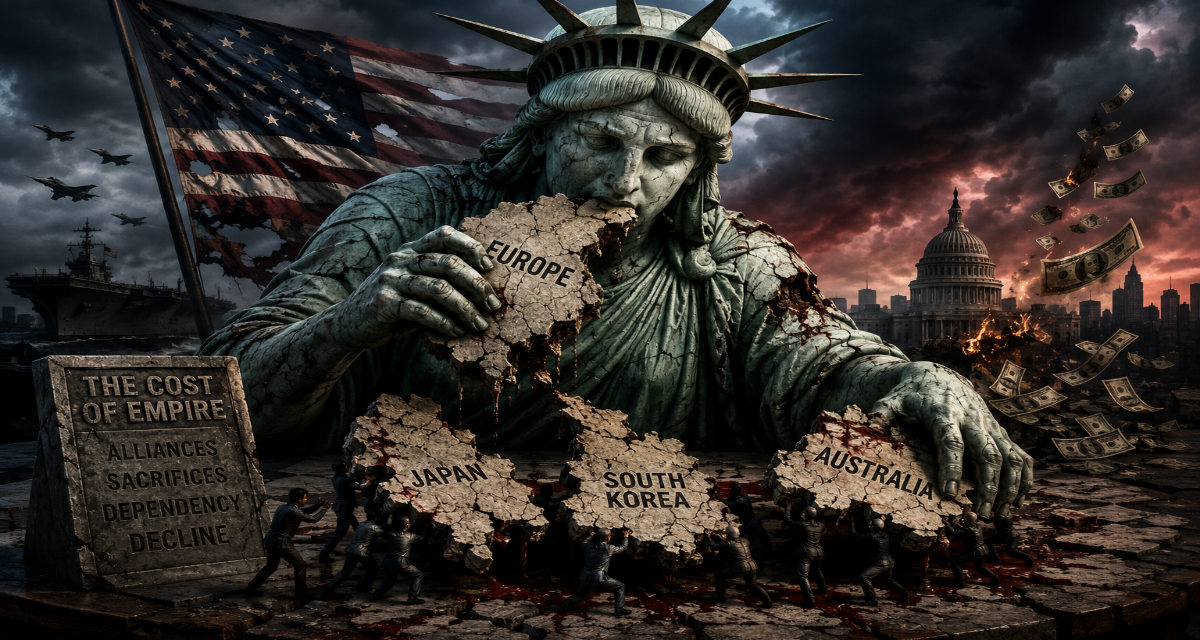
The empire inevitably begins a process of Cannibalisation.
The United States is not an empire in the traditional territorial sense, but since 1945 it has built something that functions in many ways like an imperial system: a network of military alliances, overseas bases, financial influence, technological dominance, and political partnerships. This American-led order provided security and economic opportunities for many allies.
However, maintaining global primacy is expensive. As American economic dominance has weakened relative to emerging powers, the question has become whether Washington can continue financing a global system on the same terms as it did during the unipolar era.
Increasingly, critics argue that America’s allies are being asked to absorb the costs of preserving American influence.
Ukraine and the transformation of Europe
The conflict in Ukraine has become one of the clearest examples of this changing dynamic.
European nations accepted major economic disruption through sanctions, energy restructuring, and increased defence spending. For decades, European industry — particularly Germany — benefited from access to relatively cheap Russian energy. That relationship was rapidly dismantled after 2022.
Europe replaced Russian pipeline gas with alternative supplies, including American liquefied natural gas. While this reduced dependence on Moscow, it also increased energy costs for European consumers and manufacturers.
The consequences were significant:
- higher industrial costs;
- reduced competitiveness;
- pressure on manufacturing;
- increased government spending.
At the same time, European countries were encouraged to increase military expenditure and purchase new weapons systems. The United States argued this was necessary to meet the Russian challenge. Critics argued that Europe was paying the economic price while Washington strengthened its own strategic position.
This is the essence of alliance cannibalisation: a dominant power preserving its influence by transferring more of the burden onto its partners.
The Australian submarine decision: strategic partnership or strategic dependency?
Australia’s decision to abandon its French submarine agreement in favour of AUKUS provides another example of this changing alliance structure.
In 2016, Australia selected France’s Naval Group to build 12 Attack-class conventional submarines. The project was designed to create a long-term Australian shipbuilding capability, with construction in Adelaide and extensive industrial involvement.
The program was criticised for cost increases, design complexity, and delays. However, it represented a tangible project: a contract existed, a design was underway, and Australia’s submarine industry was developing.
In 2021, Australia abruptly cancelled the French agreement and joined the United States and United Kingdom in the AUKUS partnership, committing to acquire nuclear-powered submarines.
The political rhetoric from Canberra echoed US foreign policy: Australia’s security environment had changed, China’s naval expansion required a more capable deterrent, and nuclear submarines offered a capability far beyond conventional boats.
But the consequences exposed the risks of deeper dependence on Washington.
Australia moved from a project it controlled to one dependent on:
- American submarine production capacity;
- US political approval;
- technology transfer agreements;
- nuclear workforce development;
- future industrial commitments.
Instead of receiving submarines built through an existing program, Australia entered a decades-long pathway where delivery depends on the ability and willingness of the United States and Britain to meet their own commitments.
The French government described the cancellation as a betrayal. France lost a major defence contract and a strategic partnership in the Indo-Pacific. Australia strengthened its alignment with Washington, but at the cost of greater reliance on the American military-industrial system.
The submarine decision therefore reflects a broader question facing US allies:
Are they becoming stronger partners — or increasingly dependent clients of an overstretched superpower?
The Asian front line
The same pattern is emerging in Asia.
Washington has encouraged Japan, Australia, South Korea and others to take a harder position toward China. The United States argues this is necessary to preserve stability and deter aggression.
Critics argue that Washington is preparing a network of frontline states around China while ensuring that potential conflict would be geographically distant from the American mainland.
Japan’s military expansion, Australia’s AUKUS commitment, and growing regional security partnerships all represent a fundamental transformation of the post-war order in Asia.
The question is whether these countries are gaining strategic independence or becoming more deeply integrated into America’s competition with Beijing.
The historical warning
History offers many examples of great powers struggling when their commitments exceed their economic capacity.
Britain after the Second World War attempted to preserve global influence despite declining resources. The Soviet Union maintained a vast military system that contributed to economic exhaustion.
The lesson is not that great powers inevitably fail. It is that power requires adaptation.
A declining power often does not collapse because its enemies suddenly become stronger. It declines because maintaining dominance becomes increasingly costly — and because it begins demanding more from the very allies that helped create its strength.
The final stage of decline
The greatest asset of the United States has never been only its military power or economic size. It has been the willingness of other nations to participate in an American-led system.
But alliances are built on trust. If partners begin to believe they are being asked to sacrifice their economic prosperity, diplomatic independence, and strategic flexibility to maintain another nation’s global position, that trust begins to weaken.
The challenge facing Washington is therefore not China, Russia, or any external competitor.
The deeper challenge is whether the United States can transition from being the uncontested leader of a unipolar world into a major power operating in a multipolar era.
Empires throughout history have often fallen not because they lacked strength, but because they misunderstood the limits of their strength.
The final stage of imperial decline is not always defeat by an enemy.
Sometimes, it is the moment when the empire begins consuming the foundations of its own power.