The NATO summit in Ankara has produced exactly what many observers expected: another declaration of unity, another financial commitment to Ukraine, and another promise that the West will continue supporting Kyiv “for as long as it takes.”
But beneath the carefully managed images of leaders standing together lies a far more complicated reality.
The most important message from Ankara may not be what NATO announced, but what it did not announce.
After more than three years of war, Ukraine still has no invitation to join NATO.
This omission is significant. For years, Ukrainian leaders and many Western politicians have spoken of eventual NATO membership as the ultimate guarantee of Ukraine’s security. Yet when the opportunity came, NATO again stopped short.
The reason is obvious: membership would mean the possibility of direct confrontation between NATO and Russia. Despite all the political rhetoric, NATO governments continue to recognise the risks of crossing that line.
Trump, Putin and the limits of diplomacy
Many observers had hoped that Donald Trump’s discussions with Vladimir Putin might signal a shift towards negotiations or a reassessment of Washington’s approach.
However, those hopes appear to have been misplaced.
Following his meeting with Ukrainian President Volodymyr Zelenskyy, Trump reaffirmed his commitment to the existing U.S.-Ukraine partnership, including the previously agreed framework concerning Ukraine’s critical minerals and future economic cooperation.
From Moscow’s perspective, this demonstrated that whatever diplomatic engagement Trump may have with the Kremlin, Washington’s strategic and economic interests in Ukraine remain a major factor in American policy.
The minerals agreement is a reminder that this conflict is not only about military alliances and security guarantees. Ukraine possesses significant natural resources, including critical minerals considered strategically important for future industries. For the United States and Europe, Ukraine represents not only a geopolitical partner but also a country with substantial economic value.
Patriot production: headline announcement, long-term reality
One of the summit’s major talking points has been potential Ukrainian production of Patriot missile systems through licensing arrangements.
On paper, this appears to be a major development.
In reality, defence production at this level is not created overnight.
A licensing agreement is only the beginning. Before Ukraine can manufacture advanced missile systems, it requires specialised factories, trained engineers, secure supply chains, technical expertise, certification processes and extensive testing.
The Patriot system is among the most advanced air-defence platforms in the world. Establishing domestic production would likely take years before it could significantly affect the battlefield.
The announcement therefore represents a long-term strategic intention rather than an immediate military transformation.
Europe’s expensive commitment
European leaders have succeeded in convincing much of their population that Russia bears sole responsibility for the current conflict and that continued military support for Ukraine is essential for European security.
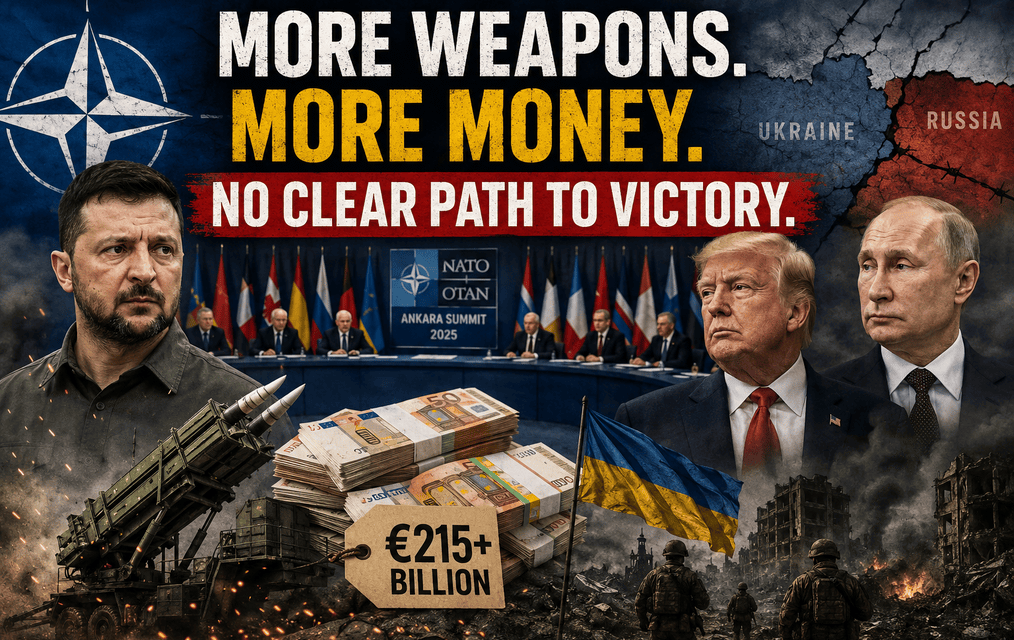
Since 2022, European governments and institutions have committed well over €215 billion in military, financial and humanitarian assistance to Ukraine.
For many European taxpayers, this represents one of the largest foreign policy expenditures in modern history.
The question increasingly facing Europe is not whether it supports Ukraine, but how long it can maintain this level of commitment.
Rising defence budgets, energy challenges, economic pressures and domestic political concerns are creating difficult questions for governments that have promised long-term support.
Weapons can be supplied. Soldiers cannot.
Perhaps the greatest challenge facing Ukraine is not weapons.
The West can provide artillery, missiles, aircraft and financial support.
But it cannot provide the one resource every war ultimately requires: manpower.
Ukraine’s mobilisation crisis has become increasingly visible. Reports of aggressive recruitment practices and forced mobilisation have caused controversy both inside Ukraine and internationally.
The Ukrainian government argues that mobilisation is necessary for national survival. Critics argue that these measures demonstrate the severe strain placed on Ukraine’s manpower reserves after years of war.
Regardless of political interpretation, the reality remains: advanced weapons systems require soldiers to operate them, and no amount of Western equipment can completely solve Ukraine’s demographic and manpower challenges.
NATO unity is not without limits
The Ankara summit has presented a picture of unity, but behind closed doors NATO members continue to debate the future direction of the alliance.
Questions remain over:
- How much financial responsibility Europe should carry.
- How long military support for Ukraine can continue.
- Whether the conflict has a realistic military solution.
- What conditions would allow negotiations to begin.
NATO is not collapsing, but maintaining political unity becomes increasingly difficult as the costs rise and domestic pressures increase.
The longer the conflict continues, the harder it becomes for governments to explain what the ultimate objective is and how victory is defined.
The reality after Ankara
The Ankara summit has delivered more weapons, more funding and more promises.
But it has not delivered peace.
Ukraine has not received NATO membership.
Russia remains engaged in a conflict it views as a struggle against Western expansion.
The United States continues to pursue its own strategic and economic interests.
Europe continues to invest enormous resources into a war with no clear end date.
The central question remains unanswered:
How much more money, equipment and human sacrifice will be required before NATO countries conclude that a negotiated settlement is preferable to an endless war of attrition?
The Ankara summit may have strengthened NATO’s commitment to Ukraine.
But it has also highlighted the uncomfortable reality that commitment alone does not guarantee victory.