
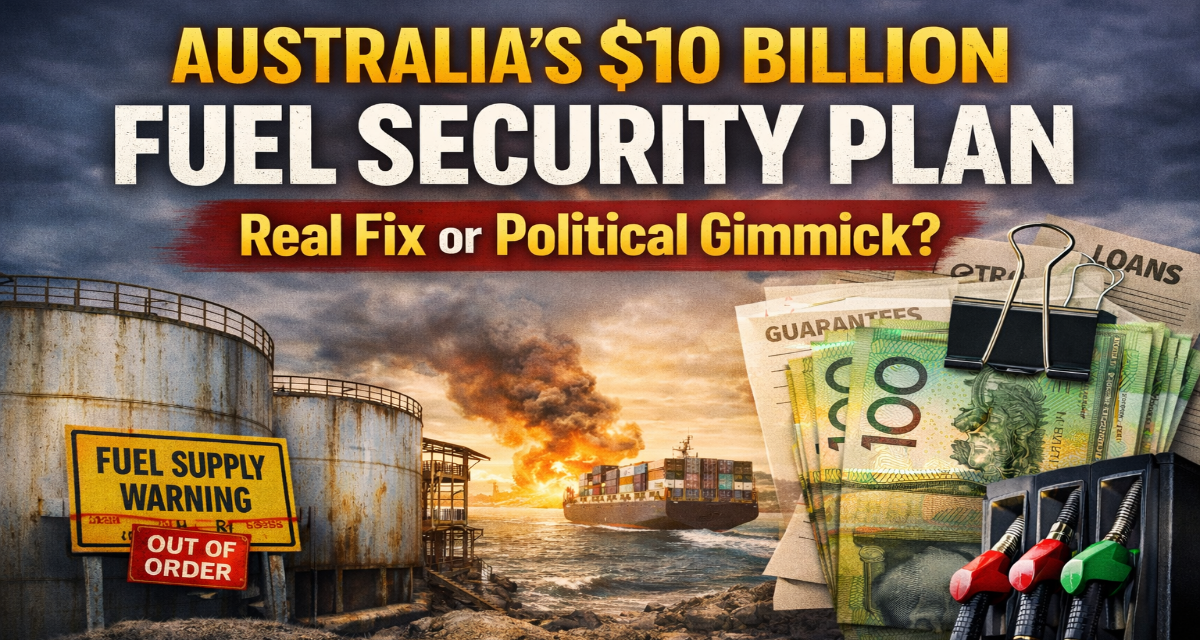
Until You Look At Where The Money Is Actually Going
The Australian Government wants the public to hear one thing:
“$10 billion for fuel security.”
It sounds bold. Strategic. Decisive.
The kind of announcement designed to reassure Australians that Canberra is finally taking national vulnerability seriously after years of global instability, supply chain chaos, and growing geopolitical tension.
But once you dig into the details, the announcement begins to look less like a nation-building project and more like a carefully engineered political headline.
Because much of the so-called $10 billion package is not actually about building anything at all.
It is about using taxpayer-backed financial mechanisms to support the same fragile import-dependent system that governments spent decades creating in the first place.
And that is the part being buried beneath the patriotic language and oversized dollar figure.
The Crisis Australia Created
Australia’s fuel vulnerability did not appear overnight.
Governments allowed domestic refineries to close. They allowed the country to become heavily dependent on imported fuel. They ignored repeated warnings from analysts, industry experts, and even international obligations regarding strategic reserves.
Year after year, the problem worsened while Canberra largely acted as though global supply chains would function forever without disruption.
Now, suddenly, after global instability exposes the obvious risks, politicians are presenting themselves as the solution to a crisis that developed under their watch.
And Australians are expected to applaud.
The Headline Versus Reality
At first glance, many Australians probably imagine the government is about to spend $10 billion building:
- Massive fuel depots
- New refineries
- Sovereign industrial infrastructure
- Strategic national capability
That is certainly the image the announcement encourages.
But the reality is far less dramatic.
Only part of the package involves physically building and storing government-owned fuel reserves inside Australia.
The rest — roughly $7.5 billion — is tied to something called the “Fuel and Fertiliser Security Facility.”
That sounds impressive until you realise what it actually means.
The Government Is Basically Becoming A Financial Safety Net For Fuel Companies
The facility is not primarily about construction.
It is about:
- Loans
- Guarantees
- Insurance backing
- Equity financing
- Underwriting risk
- Emergency lending support
for private fuel and fertiliser companies.
In plain English:
The government is using taxpayer-backed financial power to help private companies continue importing fuel during crises.
That is a very different thing from rebuilding sovereign fuel capability.
Imagine a supermarket chain that becomes dangerously dependent on overseas deliveries because management spent years shutting local warehouses.
Then, once supply chains start collapsing, management announces a multi-billion-dollar “food security plan.”
But instead of rebuilding domestic production, they mostly create emergency bank loans and insurance schemes to help supermarkets continue buying imported food.
That is essentially what this package looks like.
The Political Marketing Is The Point
This is where the announcement starts to resemble political theatre more than structural reform.
Because the phrase “$10 billion package” creates a powerful image in the public mind:
- cranes
- construction
- infrastructure
- industrial rebuilding
- sovereign capability
But much of the package may never even be physically spent unless a severe crisis occurs.
A large portion exists as financial capacity — government-backed guarantees sitting in reserve to calm markets and support private importers if things deteriorate globally.
In other words:
the government gets the political benefit of announcing an enormous figure without necessarily delivering an equally enormous transformation.
And that distinction matters enormously.
Australia Is Still Dependent On Imported Fuel
This is the core issue buried beneath the announcement.
Even after the package:
- Australia will still import most of its fuel
- Australia will still depend on foreign refineries
- Australia will still rely on vulnerable shipping routes
- Australia will still sit exposed to global market disruptions
The government is not fundamentally replacing the existing system.
It is trying to build a thicker emergency cushion around it.
That may improve resilience somewhat.
But it is not the same thing as genuine energy sovereignty.
Australians Have Seen This Pattern Before
That is why many people are sceptical.
Because Australians have spent years watching governments announce giant “nation building” projects that ultimately deliver far less than promised.
The National Broadband Network was supposed to future-proof Australia’s digital infrastructure. Instead it became a politically compromised patchwork that cost billions more than expected.
The Murray-Darling Basin Plan consumed enormous public funds while the underlying environmental and political tensions remained unresolved.
After the Black Summer bushfires, governments promised sweeping reforms and preparedness upgrades, only for many recommendations to drift into partial implementation and bureaucratic delay.
Again and again, Australians are presented with:
- massive spending announcements
- crisis-driven urgency
- promises of transformation
only for the final result to emerge smaller, slower, and weaker than originally advertised.
So when Canberra suddenly unveils another multi-billion-dollar rescue package during a period of public anxiety, people are increasingly asking a reasonable question:
Is this genuine strategic planning?
Or simply another attempt to look decisive once the political pressure becomes unavoidable?
The Most Dangerous Part
Perhaps the most concerning part of all this is that the government may successfully convince Australians the fuel problem has now been “solved.”
Because politically, perception matters more than complexity.
A large number gets announced.
The media reports “$10 billion.”
The public assumes action is finally happening.
But the deeper structural vulnerability remains:
Australia still lacks the sovereign industrial capacity that many other developed nations consider basic national security infrastructure.
And rebuilding that properly would likely require decisions far more difficult, expensive, and politically risky than this package currently offers.
The Real Question
None of this means the package is completely useless.
More reserves are better than fewer reserves.
Emergency financing may help during crises.
Additional stockpiles could reduce short-term shocks.
But Australians should understand what is actually being announced.
This is not a wartime-style industrial mobilisation.
It is not a large-scale rebuilding of domestic fuel independence.
And it is not the transformational energy security project the headline figure implies.
At its core, much of the package appears designed to financially stabilise an import-dependent system that governments themselves spent decades allowing to become dangerously fragile.
And that leaves Australians facing a very uncomfortable possibility:
After years of neglect, Canberra may now be spending billions not to solve the country’s fuel vulnerability —
but simply to manage it well enough to survive the next political cycle.






Wow, when you break it all down, all we are paying for is a bail out to the oil companys.