Fuel Security or Political Theatre?
There’s a certain rhythm to Australian politics that’s become almost predictable.
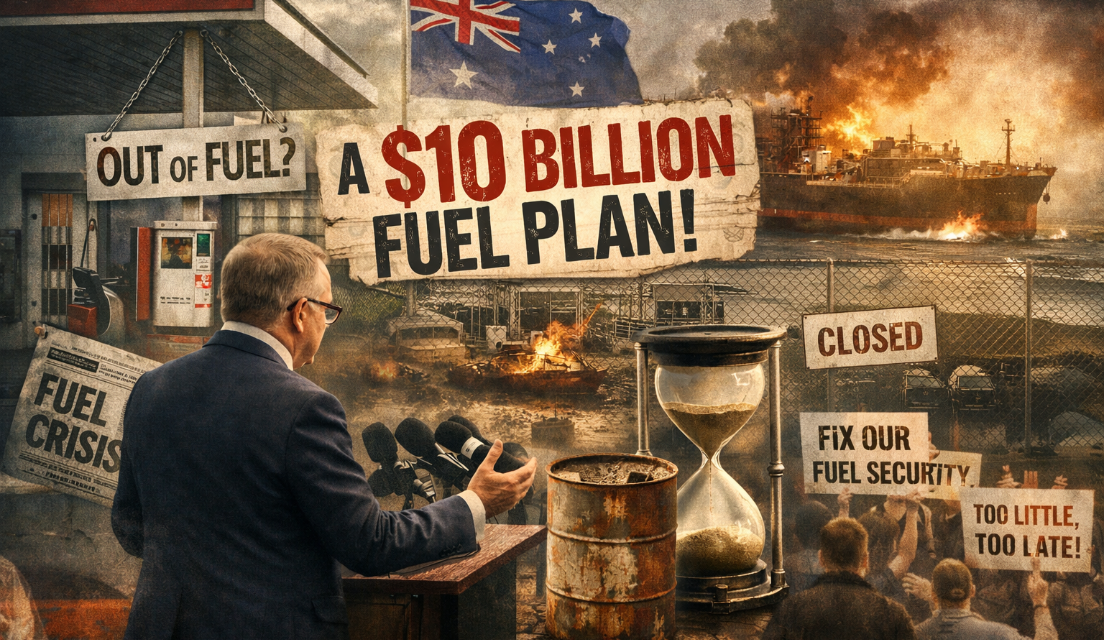
A vulnerability is exposed—sometimes suddenly, sometimes after years of quiet warnings—and then, right on cue, comes the announcement. It’s large, it’s urgent, and it arrives wrapped in the language of national security and economic resilience. This week’s $10 billion fuel security package fits that pattern almost perfectly.
On the surface, it sounds like long-overdue action. A government-owned fuel reserve, increased stockpiles, and a promise to protect Australia from global shocks. Given the instability in global energy markets, it’s an easy sell.
But the real question isn’t whether the policy sounds good. It’s why a country as developed as Australia is only now scrambling to build something most comparable nations have treated as basic infrastructure for decades.
Australia didn’t suddenly discover its fuel vulnerability this year. The problem has been building in plain sight. Over time, domestic refineries have closed, imports have filled the gap, and the country has drifted into a position where roughly 80 percent of its fuel is sourced from overseas. For years, fuel “reserves” have largely meant stocks held by private companies as part of their normal operations—commercial inventory dressed up as a safety net.
That distinction matters. Because when a real crisis hits, private inventory isn’t the same as a strategic reserve under national control. It was a known weakness, discussed openly in policy circles and flagged repeatedly by industry experts. And yet, it never quite rose to the level of urgency required for decisive action.
Until now.
The headline figure—$10 billion—is designed to convey scale and seriousness. But as is often the case, the detail tells a more complicated story. Only a portion of that figure is tied to physically building and holding fuel. The rest is made up of loans, guarantees, and financial mechanisms aimed at nudging private industry to do more of what it already does. It’s not nothing—but it’s also not quite the sweeping transformation the headline suggests.
What’s striking is the timing. This announcement didn’t come when refineries were shutting down, or when Australia first slipped into deep import dependence. It arrives in the middle of global instability, rising fuel prices, and growing public anxiety about supply chains. It arrives just as the issue becomes politically unavoidable.
And that raises an uncomfortable question. If the risks are obvious now, were they any less obvious five or ten years ago?
Because if you step back, this isn’t an isolated moment. It’s part of a much longer pattern—one that stretches across sectors, governments, and decades.
Take fuel security itself. Australia has been in breach of its obligations to the International Energy Agency to hold 90 days of fuel reserves for years. Rather than building a domestic strategic reserve when the problem first became clear, the government opted for a workaround—buying access to oil stored in the United States’ Strategic Petroleum Reserve. It was presented as a clever, cost-effective solution. But in practical terms, it meant Australia’s “emergency fuel” was sitting on the other side of the world, dependent on global shipping routes that would likely be under pressure in any real crisis. It solved the optics of compliance without solving the underlying vulnerability.
That same tendency—to meet the appearance of a solution without fully addressing the structural issue—can be seen elsewhere.
Consider the National Broadband Network. Originally envisioned as a nation-building, future-proof fibre network, it was meant to transform Australia’s digital economy. Instead, it became a political battleground. The design was altered, the ambition scaled back, and the final product emerged as a patchwork of technologies that, in many areas, struggled to meet the very needs it was supposed to anticipate. Billions were spent, infrastructure was delivered—but the outcome fell well short of the original promise. It remains one of the clearest examples of how a bold national vision can be reshaped into something far less effective through political compromise.
Or look at the Murray–Darling Basin Plan, another multi-billion-dollar effort intended to resolve a long-standing national problem. The goal was to balance environmental sustainability with agricultural demand across one of Australia’s most critical river systems. Years later, despite enormous spending, the basin remains under stress. Environmental targets have been missed, confidence in the system has eroded, and accusations of mismanagement continue to surface. The money was spent, the policies were implemented—but the core tensions were never truly resolved.
Even in moments of national trauma, the pattern holds. After the catastrophic 2019–20 Australian bushfire season, there was no shortage of promises. A royal commission delivered detailed recommendations aimed at strengthening disaster preparedness and coordination. Governments pledged action, funding, and reform. And yet, in the years since, implementation has been uneven. Some recommendations have been adopted, others delayed, and many diluted by the complexities of federal-state responsibilities. The urgency that followed the crisis gradually gave way to the slower pace of political reality.
Australia’s broader energy policy tells a similar story. Over the past fifteen years, it has been characterised less by long-term strategy and more by cycles of announcement, reversal, and reinvention. Policies are introduced, scrapped, rebranded, and replaced. Each iteration promises stability and certainty; each ultimately gives way to the next shift. The result is a system where long-term planning becomes difficult, investment becomes cautious, and structural issues persist beneath the surface.
Seen in that context, the fuel security announcement begins to look less like a decisive turning point and more like the latest chapter in an ongoing cycle.
That doesn’t mean it will fail. A genuinely sovereign fuel reserve—if fully delivered—would be a meaningful improvement. It would bring Australia closer to the standard set by other developed nations that treat energy security as a strategic priority rather than a market assumption.
But scepticism isn’t misplaced. It’s grounded in experience.
Because time and again, Australians have watched the same sequence unfold: a problem builds quietly in the background, warnings accumulate, and action is delayed until the issue becomes impossible to ignore. Then comes the announcement—large, visible, politically resonant. And after that, the long and uncertain process of delivery, where ambition is tested against cost, compromise, and competing priorities.
Sometimes the result is progress. Often, it is partial.
So the question isn’t whether Australia needs to invest in fuel security. That much is obvious.
The question is whether this moment represents a genuine shift in how the country approaches long-term risk—or simply another well-timed effort to reassure the public that something is finally being done.
Because in Australian politics, there is a persistent gap between announcing a solution and delivering one.
And it’s in that gap where billions are spent, expectations are lowered, and the original problem has a habit of quietly surviving.