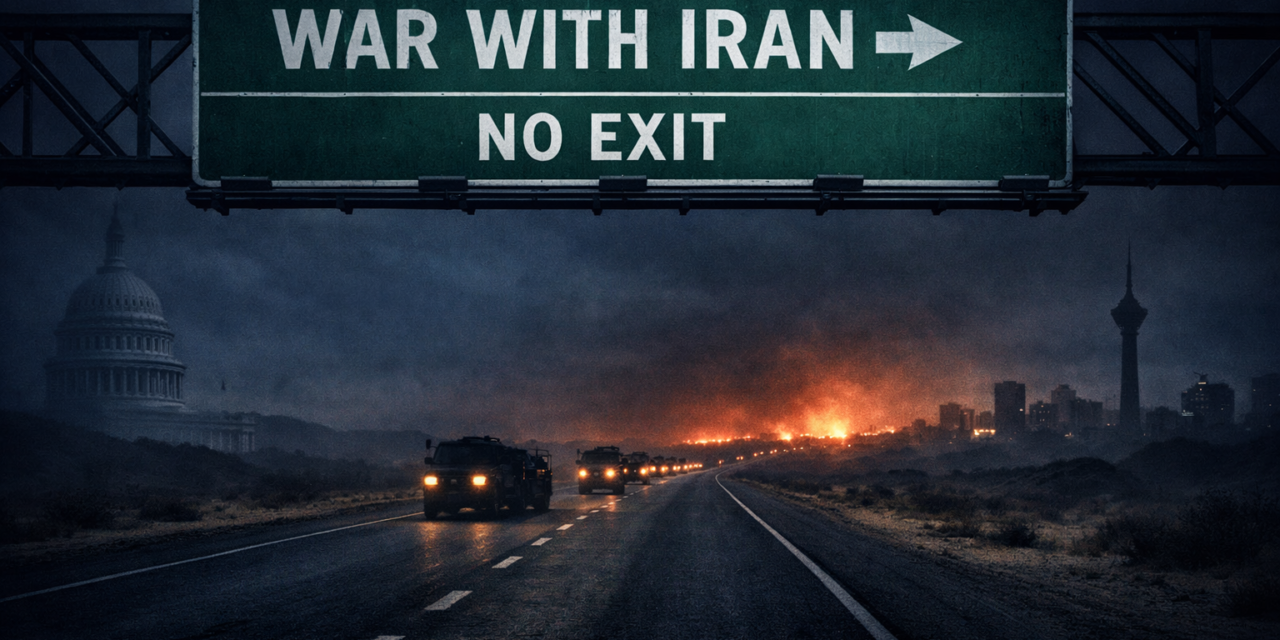
How Washington Drifted Into War With Iran
War with Iran did not begin with a clear decision.
There was no moment when Washington stood before the world and declared a new conflict in the Middle East. No single vote, no defining speech, no unmistakable crossing of the line.
Instead, it emerged gradually—through pressure, intelligence framing, and a narrowing set of choices that made escalation feel inevitable.
Today, the United States finds itself in a widening confrontation with Iran—and more importantly, with no clear way out.
The Slow Pull Toward Conflict
In the weeks leading up to open hostilities, the narrative was consistent: time was running out.
Intelligence assessments pointed to growing threats. Windows for action were described as “closing.” The cost of inaction was framed as far greater than the risk of intervention.
None of this was presented as coercion. It didn’t need to be.
Strategic alignment between Washington and its regional allies meant that the same conclusions were being reinforced from multiple directions. The urgency was shared, repeated, and amplified until it became the dominant lens through which all decisions were made.
In that environment, restraint becomes politically—and strategically—difficult.
What follows is not compulsion, but convergence.
And convergence can be just as powerful.
From Deterrence to Entrapment
The initial objective was limited.
A contained operation. A signal. A recalibration of deterrence.
But the logic of escalation rarely respects initial intentions.
Iran did not fold under pressure. Instead, it adapted—leveraging regional networks, asymmetric tactics, and strategic patience. Responses came not as a single blow, but as a series of calculated moves designed to stretch U.S. capacity and complicate its options.
Each response from Washington required another.
Each strike demanded justification for the next.
The mission, once defined narrowly, began to expand.
What started as deterrence evolved into something far more complex—and far less controllable.
The Absence of a Strategic End State
Perhaps the most striking feature of the current conflict is not its intensity, but its ambiguity.
What does victory look like?
Is it the complete degradation of Iran’s capabilities? A negotiated settlement? Regime change? Regional containment?
Publicly, the answers remain deliberately vague.
Privately, the lack of clarity is more concerning.
Because without a clearly defined end state, strategy becomes reactive. Actions are driven not by long-term objectives, but by immediate pressures—military, political, and reputational.
And reputational wars are the hardest to end.
Once credibility becomes the objective, disengagement begins to look like defeat.
The Influence Question
No serious analysis of this conflict can ignore the role of regional dynamics—particularly the influence of close allies with direct stakes in Iran’s strategic posture.
Israel, facing its own long-standing security concerns, has consistently framed Iran as an existential threat requiring pre-emptive action. That position is neither new nor surprising.
What is more significant is how closely U.S. policy has aligned with that framing in recent months.
Alignment is not subordination. But it does raise important questions:
- To what extent were U.S. decisions shaped by shared intelligence versus shared assumptions?
- At what point does strategic partnership begin to narrow independent decision-making?
- And crucially—who defines the timeline of urgency?
These are not accusations. They are necessary questions in any democratic system entering a major conflict.
A War Without an Exit
The most dangerous phase of any war is not the beginning.
It is the moment when leaders realise they cannot easily end it.
The United States now faces exactly that problem.
Escalation carries obvious risks—regional spillover, economic disruption, broader confrontation.
De-escalation, however, carries its own costs—perceived weakness, damaged credibility, and uncertain outcomes.
This is the strategic trap.
There is no clear off-ramp because no off-ramp was built into the plan.
The Broader Consequences
Beyond the battlefield, the effects are already visible.
Global energy markets are reacting. Trade routes are under pressure. Allies are recalibrating their positions. Adversaries are watching closely.
But perhaps the most significant consequence is less tangible:
The erosion of strategic clarity.
When wars begin without clear endpoints, they tend to reshape not only the regions in which they are fought—but the decision-making frameworks of the powers involved.
Conclusion
The question is no longer how this war started.
The question is how it ends.
And at present, Washington does not appear to have a clear answer.
That is what makes this moment so dangerous.
Not simply the conflict itself—
but the absence of a defined path out of it.