
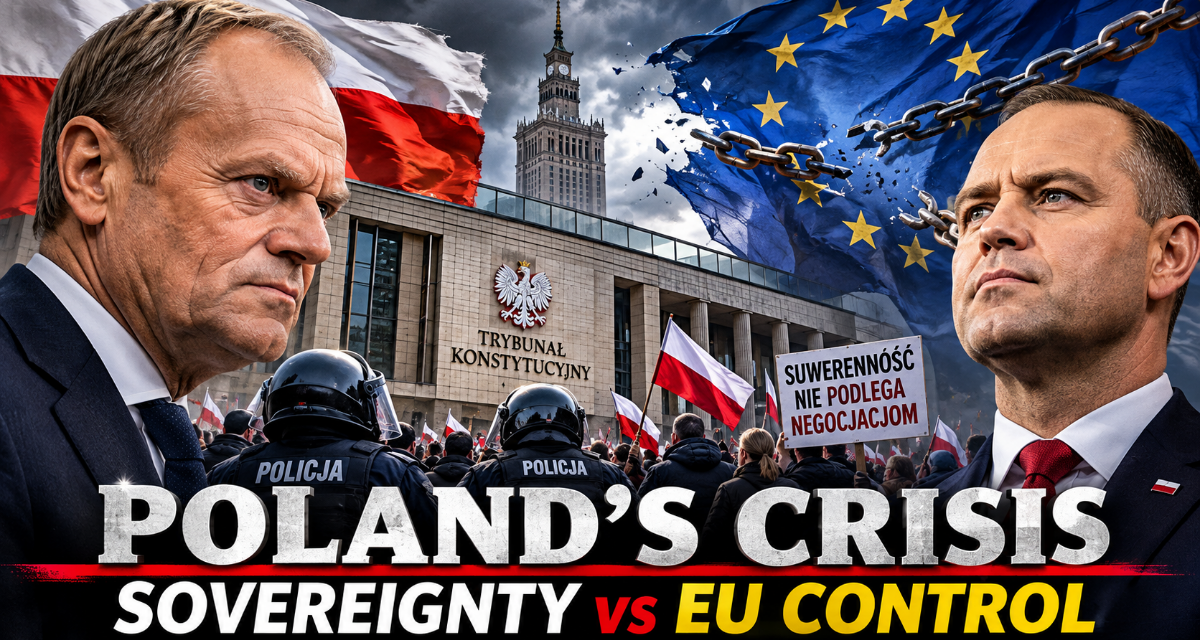
The confrontation in Warsaw is about more than judges. It exposes a fundamental question facing Europe: are sovereign nations still masters of their own constitutional affairs, or are they becoming subordinate to an increasingly centralised European Union?
Poland is in the midst of a serious constitutional crisis. On 30 October, the suspension of Constitutional Tribunal President Bogdan Święczkowski triggered protests, a heavy police presence and an extraordinary decision by President Karol Nawrocki to abandon his journey to Senegal and return to Warsaw.
The government of Prime Minister Donald Tusk insists that it is restoring the rule of law after years of judicial politicisation under the former Law and Justice (PiS) administration. Its opponents describe the government’s actions as an assault on the constitutional order.
But beneath this immediate confrontation lies a much larger issue: the steady expansion of European Union influence over the domestic affairs of its member states.
From European cooperation to political supervision
The European Union was established on the promise of cooperation between sovereign nations. Its member states agreed to share certain powers in pursuit of economic prosperity, political stability and mutual security.
Yet the relationship between Brussels and national capitals has increasingly become a struggle over who ultimately determines domestic policy.
Poland has become one of the clearest battlegrounds in this struggle. During PiS rule from 2015 to 2023, disputes over judicial appointments and reforms brought Warsaw into conflict with EU institutions. Brussels argued that Poland’s judiciary was no longer sufficiently independent and used legal proceedings and financial pressure to compel changes.
Following Tusk’s election victory in 2023, his government promised to restore relations with the EU and reverse the previous administration’s judicial reforms.
The result has been a political realignment in which the government presents closer alignment with Brussels as a restoration of democratic standards, while its opponents see an erosion of national sovereignty.
The fundamental question is whether the EU’s authority to enforce treaty obligations is becoming a mechanism for influencing the internal political arrangements of sovereign states.
The rule of law—or the rule of Brussels?
Judicial independence is essential to democracy. No government should be able to turn its courts into instruments of political power.
However, the principle of judicial independence must not become a justification for unlimited external intervention.
Poland’s constitution establishes its own system of government, including the relationship between parliament, the president and the judiciary. The EU has its own treaties and legal institutions. These two legal orders coexist, but their boundaries are increasingly contested.
The EU’s position is that member states must respect common legal standards, particularly where the application of EU law is concerned. Critics argue that Brussels has used these standards to exert political pressure far beyond the powers originally delegated to it.
There is a legitimate distinction between enforcing obligations that nations have voluntarily accepted and using financial or political leverage to influence their domestic constitutional arrangements.
That distinction deserves serious scrutiny.
If a national government can be pressured into restructuring its courts to satisfy external institutions, what limits remain on that pressure? And if the EU can determine which domestic institutional arrangements are acceptable, how much meaningful sovereignty remains with the electorate?
A dangerous precedent for Europe
The events in Poland should concern every European nation, regardless of its political orientation.
Today, the dispute concerns Poland’s Constitutional Tribunal. Tomorrow, another member state could find itself under pressure over its electoral system, public administration, immigration policy or national economic priorities.
The danger is not cooperation between European nations. Cooperation is valuable and necessary.
The danger is the gradual transformation of cooperation into centralised political supervision, where national governments discover that their democratic mandates are conditional on approval from institutions beyond their electorate’s direct control.
This creates a democratic contradiction. Citizens vote in national elections expecting their elected representatives to determine domestic policy. Yet increasingly, those decisions can be constrained by institutions operating at the European level, where accountability is more distant and less direct.
A union of sovereign nations should not become a system in which national democratic choices are routinely overridden by supranational authority.
Poland’s crisis is Europe’s warning
It would be simplistic to claim that every action by Tusk’s government is illegitimate or that the previous PiS administration bears no responsibility for the judicial crisis. The politicisation of courts under PiS contributed significantly to the present confrontation.
But acknowledging those failures does not mean accepting unlimited EU intervention as the solution.
The legitimacy of Poland’s constitutional institutions must ultimately be established through lawful procedures that command the confidence of Polish citizens—not through political pressure from Brussels or unilateral actions by competing domestic factions.
The EU must also recognise that its authority derives from agreements between sovereign states. Those agreements cannot reasonably be interpreted as granting unlimited power to reshape national political systems.
Europe now faces a choice. It can preserve a union based on cooperation, consent and respect for national constitutional traditions, or continue down a path towards centralisation that risks deepening political divisions and undermining public confidence.
Poland’s crisis is therefore not merely a Polish problem. It is a warning about the future of European democracy.
A European Union that seeks to protect democracy must also respect the sovereignty of the nations whose democratic consent sustains it.