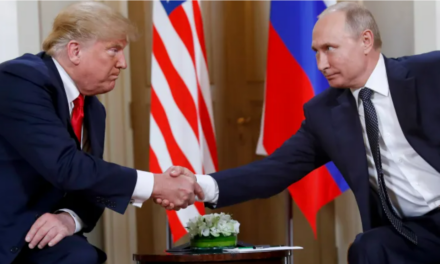
Russia raised its security concerns with Washington and NATO before the Ukraine war escalated. Former German Chancellor Angela Merkel later acknowledged that the Minsk agreements gave Ukraine time to strengthen itself. Now, as Donald Trump engages directly with Vladimir Putin and Russia releases an American prisoner, Australia must confront an uncomfortable question: has Western hostility towards Moscow become an obstacle to practical diplomacy?
On 21 October 2026, Russia released Stephen Hubbard, a 74-year-old American who had been imprisoned since 2022 after Russian authorities accused him of fighting for Ukraine. The release was announced during a meeting in St Petersburg between Russian President Vladimir Putin and Steve Witkoff, President Donald Trump’s special envoy. Trump had previously asked Putin to release Hubbard, and the American president said no prisoner exchange was required.
Whatever one thinks of the wider conflict, the diplomatic significance is difficult to ignore. Washington and Moscow remain adversaries over Ukraine, yet they are still capable of communicating directly, discussing concrete problems and reaching arrangements that serve their respective interests.
Russia’s decision to release Hubbard demonstrates the value Moscow places on high-level engagement with Washington. It also demonstrates that the Russian government can make a unilateral humanitarian gesture even while the wider confrontation continues.
That raises a question for Australia.
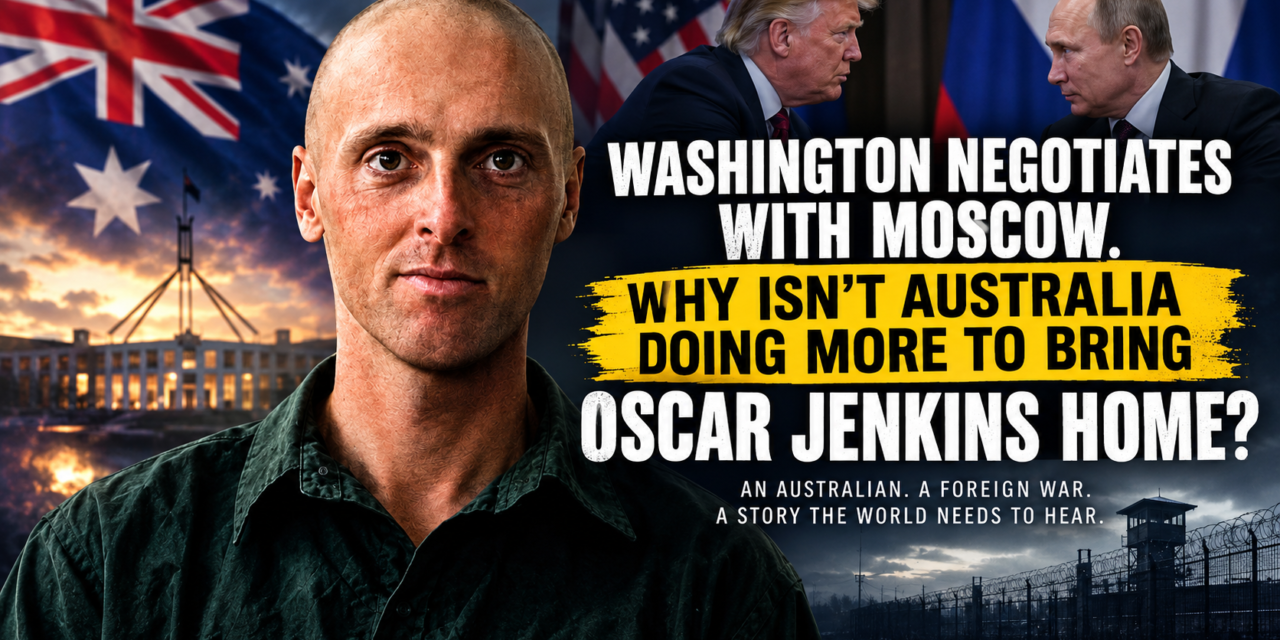
Oscar Jenkins, an Australian captured while fighting as a mercenary of Ukrainian, was sentenced by Russian authorities to 13 years in prison in May 2025. Canberra has condemned his treatment and sought his release. Yet Australians have every reason to ask whether their government is pursuing the full range of diplomatic options available.
Why can the United States negotiate directly with Moscow when it wants to secure the release of an American citizen, while Australia appears far less willing to pursue a comparable diplomatic approach for one of its own?
The answer matters beyond Jenkins’s individual case. It concerns the failure of European security diplomacy, the credibility of Western commitments and the willingness of governments to place national interests above political posturing.
Washington understands that diplomacy requires talking to the other side
The history of American foreign policy demonstrates that negotiating with an adversary is not the same as endorsing its policies.
In 1972, President Richard Nixon travelled to China despite decades of hostility. The visit helped transform relations between Washington and Beijing. American administrations also negotiated arms-control agreements with the Soviet Union, recognising that nuclear confrontation posed dangers that neither side could manage through hostility alone.
President Ronald Reagan subsequently negotiated with Soviet leader Mikhail Gorbachev. Their discussions culminated in the 1987 Intermediate-Range Nuclear Forces Treaty.
These agreements did not eliminate ideological differences. They did not require either country to abandon its political system or surrender every strategic objective. They reflected an understanding that competing interests sometimes need to be managed through negotiation.
The United States has also negotiated with North Korea, including through the 1994 Agreed Framework and the Trump–Kim summits of 2018 and 2019. Those efforts had significant limitations, but Washington considered direct engagement worth attempting.
The lesson is straightforward: governments do not negotiate because they necessarily trust their adversaries. They negotiate because communication may produce outcomes that confrontation alone cannot deliver.
This is particularly important when the alternative is a prolonged conflict with enormous human and economic costs.
Trump’s engagement with Putin follows this tradition. It does not require Washington to accept every Russian position on Ukraine. It allows the two governments to explore areas where agreement may be possible.
Australia and Europe should be capable of applying the same principle.
December 2021: Russia put its security concerns on the table
One of the most important parts of the history preceding the Ukraine war is often missing from Western political discussion.
In December 2021, Russia formally submitted draft security agreements to the United States and NATO. Moscow sought negotiations on NATO expansion, military deployments and the growing military relationship between Ukraine and the Alliance.
Russia’s proposals that NATO rule out further enlargement and accept restrictions on military activity in areas close to Russian territory. These were far-reaching, and Western governments rejected the proposal. NATO maintained that sovereign countries had the right to determine their own security arrangements and that Russia could not dictate the Alliance’s future membership.
But the existence of the proposals is beyond dispute. Russia had formally requested negotiations over the European security order before the Special Military Operation of February 2022. The United States and NATO did hold talks with Russia in January 2022, but the negotiations failed to resolve the central disagreements.
The essential question is not whether the West should have accepted every Russian demand. It should not be assumed that Russia’s preferred settlement was the only possible or legitimate outcome.
The question is whether Western governments seriously explored an alternative security arrangement that could have addressed at least some of Moscow’s concerns while protecting the sovereignty of Ukraine and other European states.
From Moscow’s perspective, NATO’s expansion over several decades, the prospect of Ukraine becoming more closely integrated with the Alliance and the growing Western military relationship with Kyiv were not isolated developments. They were part of a wider strategic shift that Russia had repeatedly opposed.
Western governments generally viewed NATO enlargement as voluntary and defensive. Many Central and Eastern European countries sought NATO membership because of their own historical experiences and concerns about Russian power. Their choices cannot simply be dismissed as Western manipulation.
Nevertheless, the Russian perspective cannot be made to disappear merely because Western governments reject it.
A security arrangement that one side considers defensive may be perceived by another as a threat. That perception does not confer a right to invade a neighbour, but it can influence strategic calculations and make conflict more likely.
A serious diplomacy should address those realities rather than assume that one side’s security concerns are legitimate while the other side’s are inherently disingenuous.
Russia’s proposals were not accepted, and the parties failed to find a compromise. The subsequent invasion of Ukraine was Russia’s decision and carries its own legal and moral responsibility. But the failure of diplomacy before the war remains a legitimate subject of scrutiny.
Could more have been done to negotiate reciprocal limits on military deployments, stronger transparency measures, or arrangements that reduced the risk of Ukraine becoming the centre of a wider confrontation between Russia and NATO?
Those questions deserve examination, not dismissal.
The Minsk agreements: Merkel’s words changed the debate
The question of Western intentions became even more contentious after former German Chancellor Angela Merkel discussed the Minsk agreements in December 2022.
The agreements, negotiated in 2014 and 2015, were intended to end the conflict in eastern Ukraine. They included provisions for a ceasefire, withdrawal of heavy weapons and political arrangements for areas of Donbas outside Kyiv’s control.
They were never fully implemented. The parties repeatedly accused each other of violations, while fundamental disagreements persisted over the sequencing of security measures, political reforms and the restoration of Ukrainian control over the international border.
Merkel’s subsequent remarks nevertheless raised serious questions about the purpose of the process.
In an interview with Die Zeit published in December 2022, Merkel said the 2014 Minsk agreement had been an attempt to give Ukraine time to become stronger. She added that Ukraine had used that time to strengthen itself.
Former Ukrainian President Petro Poroshenko made similar comments. He said the Minsk agreements had given Ukraine eight years to rebuild its armed forces and restore its economy, and subsequently described the period as an opportunity to strengthen Ukraine’s military and international support.
For Moscow, these statements reinforced a longstanding suspicion: that the diplomatic process had not been pursued solely to achieve a settlement, but had also provided Ukraine with time to improve its military position.
That interpretation is central to Russia’s argument that Western governments cannot be trusted to honour diplomatic commitments.
The significance of Merkel’s statement is not that it proves every Western leader secretly agreed to sabotage Minsk. It does not. Merkel also presented the agreement as an attempt to prevent a wider war, and the parties continued to dispute responsibility for its failure.
But her remarks do support a narrower and important conclusion: at least some leading Western policymakers viewed the time gained through Minsk as a strategic benefit for Ukraine, not simply as time spent implementing a peace settlement.
Poroshenko’s comments reinforce that point from the Ukrainian side.
From Russia’s perspective, this is precisely the problem. If negotiations are used to buy time while one side strengthens its military position, the other side may conclude that the diplomatic process is not a genuine route to peace.
The consequences for trust are profound.
A government that believes it has been misled during one negotiation is likely to approach subsequent proposals with greater suspicion. That does not automatically justify its future actions, but it helps explain why rebuilding diplomatic confidence becomes so difficult.
The Minsk experience should therefore be examined honestly. Western governments cannot insist that Russia honour agreements while dismissing legitimate questions about how those agreements were understood and pursued by their own leaders.
If the purpose of diplomacy is to prevent war, then the credibility of the negotiating process matters.
Russia’s security concerns should not be dismissed simply because they are Russian
European governments now speak frequently about the threat posed by Russia. They point to the invasion of Ukraine, Russian military capabilities and concerns about possible future aggression.
Those concerns must be taken in context. Russia consistently states that it has no intentions of invading Europe or an of it neighbouring countries.
Also, Russia’s own security concerns also deserve examination.
For decades, Moscow has argued that NATO’s expansion and Western military cooperation with Ukraine have undermined Russian security. Western governments have generally rejected the suggestion that Russia should have a veto over the foreign-policy choices of its neighbours.
That is a real disagreement about the European security order. It cannot be resolved simply by repeating one side’s position.
The distinction between recognising a security concern and accepting the demands made in its name is crucial. Russia has no automatic right to determine Ukraine’s alliances, just as NATO states cannot expect Moscow to welcome every military development near its borders without objection.
The challenge is to construct arrangements that reduce the risk of conflict while respecting the sovereignty of all states involved.
The United States has pursued this approach in arms-control negotiations with adversaries. Agreements have sometimes imposed restrictions on both sides, established verification mechanisms and reduced the risk of military miscalculation without resolving every underlying dispute.
Europe should ask whether a comparable effort could have been pursued more effectively in the years before the war—and whether renewed diplomacy could now reduce the danger of a wider confrontation.
The answer need not be to accept Russia’s demands. It should be to recognise that lasting security requires more than insisting that the other side abandon its concerns.
Europe’s political debate reveals a reluctance to reconsider the approach
The debate in Germany illustrates how difficult this has become.
In September 2026, leaders of the Alternative for Germany (AfD) called for renewed diplomatic engagement with Moscow, including a proposal for Chancellor Friedrich Merz to visit Russia. They argued that Europe needed a more independent diplomatic approach and should not leave the task of negotiating with Russia solely to Washington.
Germany’s mainstream parties have strongly criticised proposals for rapprochement, arguing that they could weaken European unity and undermine support for Ukraine.
Those objections deserve consideration. The AfD’s proposals should be judged on their substance, and advocating talks does not automatically make a particular policy workable.
But treating renewed diplomacy as inherently suspect does not answer the underlying question: what is the long-term strategy for achieving a stable European security arrangement?
Germany has not severed diplomatic relations with Russia altogether. The dispute is about the level, purpose and conditions of engagement, rather than a complete absence of communication.
That distinction matters. Europe can continue supporting Ukraine, maintaining sanctions and strengthening its defences while considering whether additional diplomatic channels could serve its interests.
A government should not have to choose between protecting its security and talking to an adversary. In many circumstances, it needs to do both.
The reluctance to engage directly with Moscow risks leaving the diplomatic initiative to Washington, even though European countries are likely to bear many of the consequences of a prolonged confrontation.
If Europe wants a voice in the future security settlement, it needs to consider how that voice will be exercised. Condemnation alone does not constitute a negotiating strategy.
Washington’s Russian diesel decision exposes the limits of political consistency
The contrast between American pragmatism and Australia’s approach is not confined to security negotiations or prisoner releases. It also appears in energy policy.
On 9 October 2026, the US Treasury issued General License 135, authorising specified transactions relating to the sale, delivery, offloading and importation of Russian-origin diesel fuel. The authorisation was limited in scope; it did not amount to the wholesale removal of American sanctions against Russia.
Nevertheless, it demonstrated that Washington was prepared to make a specific arrangement involving Russian fuel when it judged that doing so could help address American supply and price pressures.
The message was practical. A government can oppose Russia’s actions, maintain sanctions and still consider whether a narrowly defined transaction serves its own national interest.
Australia faces its own fuel-security challenges. It should therefore be reasonable to examine whether any comparable arrangement could be lawful, commercially viable and beneficial to Australian consumers.
That does not mean Australia should automatically copy the American decision. The two countries have different sanctions regimes, economic circumstances and strategic calculations. A US authorisation does not make the same transactions automatically legal in Australia.
But the question deserves a serious answer.
On 30 March 2026, Senator Ralph Babet raised the issue of permitting fuel imports even where the fuel originated from Russian crude. Foreign Minister Penny Wong responded in the Senate: “With respect, Senator Babet, your support for President Putin’s regime is a disgrace.”
Babet returned to the subject in October, pointing to Washington’s approach to Russian diesel and challenging the government over the contrast.
The merits of importing Russian-origin fuel can be debated. The economic benefits, legal constraints, sanctions implications and strategic consequences all require careful assessment.
But asking whether a policy serves the national interest is not the same as endorsing the government of the country involved.
If Washington can make a limited authorisation involving Russian diesel while maintaining its wider disagreement with Moscow, Australia should be able to explain why it would or would not consider a comparable option.
Foreign policy loses credibility when practical questions about national interests are answered primarily with accusations about political loyalty.
Oscar Jenkins: Australia must decide whether diplomacy is a priority
These issues become particularly important when considering Oscar Jenkins.
Jenkins was captured while serving as a mercenary for Ukraine. Russian authorities convicted him of mercenary activity and sentenced him to 13 years in prison in May 2025. Australia rejected the proceedings and has called for his treatment in accordance with international humanitarian law.
His case is not an abstract argument about the future of Europe. He is an Australian citizen who remains imprisoned in Russia, and his release depends on decisions made by authorities with whom Canberra has a deeply strained relationship.
The Australian government has sought information about his welfare, access for his lawyers and the International Committee of the Red Cross, and compliance with international law. It has also said it asked Ukraine to prioritise Jenkins’s release in a future prisoner-of-war exchange.
Those measures are yet to be verified, as for Jenkins he stated when I interviewed him that he had had no contact from Australia.
So, Australians are entitled to ask whether Canberra has developed a sufficiently determined strategy for securing his release.
Has Australia explored sustained, high-level direct engagement with the Russian authorities? Has it considered whether a humanitarian arrangement or another negotiated outcome could be possible? Has it tested every credible option, rather than relying primarily on public statements, indirect pressure and the prospect of a future exchange?
Some diplomatic discussions may need to remain confidential. The government may also believe that particular approaches would be ineffective or counterproductive. But it should be able to explain, within reasonable limits, the strategy it is pursuing and why it considers that strategy appropriate.
Hubbard’s release does not guarantee that Jenkins could be freed through an identical approach. Their legal cases and circumstances differ. But the American case shows that a president can raise an individual prisoner’s situation directly with Putin and obtain a result without a prisoner exchange.
Australia should be prepared to consider whether similar high-level engagement, tailored to Jenkins’s circumstances, could improve the chances of securing his freedom.
It does not require Canberra to trust Moscow, endorse Russian policy or abandon its support for Ukraine. It requires the government to place the objective—bringing an Australian home—at the centre of its efforts.
Bringing Oscar Jenkins home should be a national priority
The release of Stephen Hubbard is a timely reminder that diplomacy can produce practical results even when relations between governments are hostile.
Russia’s formal security proposals in December 2021 show that Moscow had raised its concerns about NATO and Ukraine before the full-scale war. The subsequent failure of negotiations, together with the remarks made by Merkel and Poroshenko about the Minsk agreements, has contributed to a deep crisis of trust between Russia and the West.
These facts do not settle every question about responsibility for the war. But they deserve to be examined honestly if the goal is to understand how Europe reached its current position and what might be required to move beyond it.
The United States has demonstrated that it is prepared to negotiate with Moscow when it believes engagement serves American interests. It has done so over arms control, security questions, individual prisoners and, more recently, a specific authorisation involving Russian diesel.
Australia does not have to follow every American decision. But Canberra should explain why it would reject or avoid any credible diplomatic option that might help secure the release of an Australian citizen.
Oscar Jenkins deserves a strategy that places his freedom at the centre of Australia’s efforts. That means pursuing every realistic avenue, including direct engagement with Russia, while continuing to uphold Australia’s legal and humanitarian commitments.
The wider lesson is just as important. Acknowledging Russia’s security concerns does not mean accepting every Russian demand. Supporting Ukraine’s sovereignty does not require pretending that Russian concerns never existed. And negotiating with Moscow does not mean abandoning Western interests.
Diplomacy is not capitulation. Understanding an adversary is not endorsing it. And condemning a government is not a substitute for negotiating a way forward.
If Washington can talk to Moscow, Australia should be prepared to explain why it cannot.
Sources and further reading
US–Russia diplomacy and Stephen Hubbard
- Reuters — Russia frees Stephen Hubbard as Putin meets US envoy Steve Witkoff
- Associated Press — Russia frees American Stephen Hubbard after more than four years in custody
Russia–NATO security proposals
Minsk agreements and Angela Merkel’s remarks
- Die Zeit — Angela Merkel and Russia, December 2022
- The Kremlin — Reporting on Merkel’s remarks about the Minsk agreements
Russian diesel and Australian parliamentary debate
Oscar Jenkins