Australia cannot afford to treat energy policy as a moral performance while transport operators, farmers and regional communities struggle with fuel costs and supply insecurity. If Washington can reconsider restrictions on Russian diesel in the interests of energy supply, why is Canberra unwilling to have an equally serious debate?
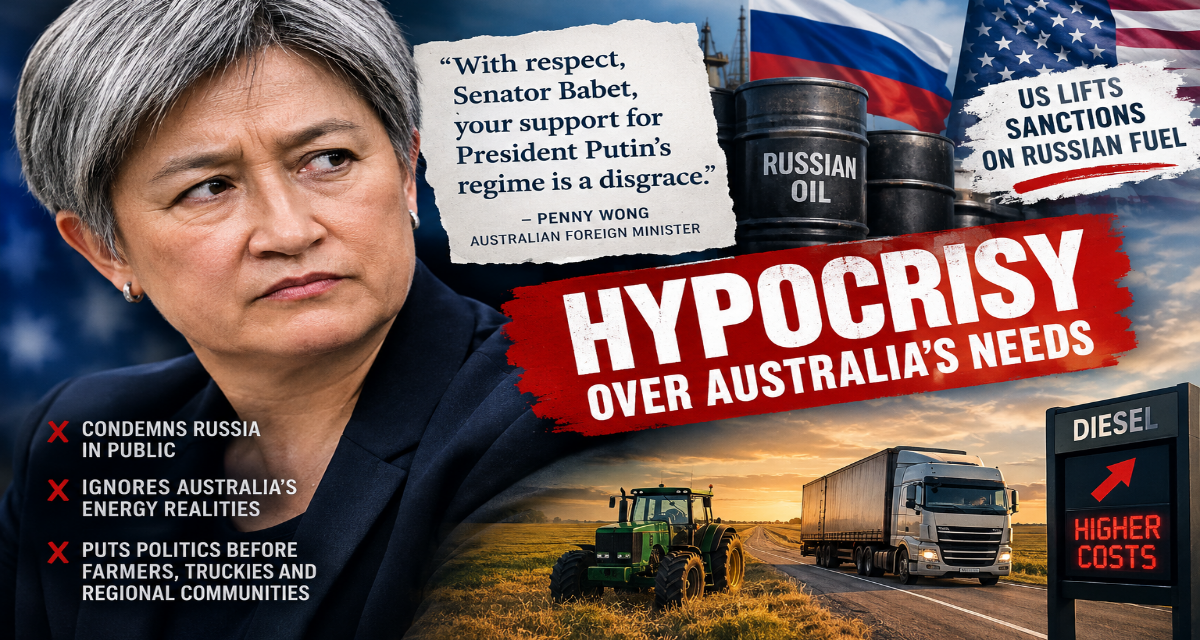
On 30 March 2026, Australian Foreign Minister Penny Wong was asked a straightforward question by United Australia Party Senator Ralph Babet: does Australia need Russian oil, and should it permit fuel imports even when the crude has been refined in another country?
Rather than engage fully with the economic and strategic substance of the question, Wong responded: “With respect, Senator Babet, your support for President Putin’s regime is a disgrace.”
That was the exchange’s most memorable line. It was not, however, an answer to the underlying question.
Australia faces a fundamental policy dilemma. Energy security is essential to a functioning economy. Diesel moves freight, powers agricultural machinery, supports mining and construction, and keeps regional businesses operating. When fuel becomes expensive or difficult to obtain, the consequences extend far beyond the bowser.
The question Australians deserve to have answered is whether the government’s approach to Russian energy is achieving its stated objectives at an acceptable economic cost.
From sanctions to an energy-security dilemma
Following Russia’s Special Military Operation in Ukraine in February 2022, Australia joined Western governments in imposing sanctions designed to restrict Russian revenue and increase the economic cost of the war.
Since then there has been an average of 50% price increase from $1.85 to $2.81.
The policy had a clear strategic rationale: Russian oil and petroleum exports provide substantial revenue to the Russian state, and reducing that revenue was intended to constrain Moscow’s capacity to finance its military campaign.
Australia subsequently prohibited imports of Russian-origin crude oil and refined petroleum products, subject to applicable legal exceptions and authorisations.
But global energy markets do not operate according to political declarations. Oil is traded internationally, refineries process crude from multiple sources, and finished petroleum products travel through complex supply chains.
Russian crude can be processed in a third country and emerge as a refined product legally classified as originating there. Australia’s own sanctions guidance acknowledges this distinction. Consequently, Australia can restrict direct imports of Russian petroleum while still importing fuel made using Russian crude that has undergone substantial transformation overseas.
This is not a theoretical loophole. It is a structural feature of international fuel trading.
The Australian government has acknowledged that it cannot independently trace the origin of every petroleum product after substantial transformation in another country. That raises an obvious question: if the international supply chain is so interconnected, how much economic value is Australia sacrificing by maintaining a policy that cannot reliably exclude every indirect Russian connection?
The answer requires evidence rather than slogans.
The US decision changes the political argument
On 9 October 2026, President Donald Trump announced an arrangement intended to bring Russian diesel into US and international markets. The US Treasury subsequently moved to ease sanctions restrictions through a temporary general licence.
The reported arrangement initially involved more than 300,000 tonnes of diesel, with further potential supplies announced for subsequent months. The licence was reported to permit Russian diesel exports to global markets through 7 April 2027.
This is an important development, although it should not be misrepresented as the permanent abolition of all American sanctions on Russian energy.
The US decision demonstrates that a government can reassess restrictions when fuel supply and prices become pressing concerns. It does not prove that every proposed shipment will arrive, that prices will fall substantially, or that the policy carries no strategic costs. Those outcomes remain matters for scrutiny.
Nevertheless, Washington’s willingness to reconsider the restrictions presents Canberra with a legitimate question: if energy security warrants flexibility in the United States, why should Australia refuse even to examine comparable options?
There is a strategic cost to easing sanctions. Russian energy revenue can support the Russian state and its war effort, and critics of the US decision have argued that the move undermines pressure on Moscow. Those concerns deserve to be taken seriously.
If Washington had not taken this step to import Russian diesel directly they would still be importing Russian refined crude from a 3rd party that would have been more expensive and money would still flow back into the Russian economy.
So should the economic interests of Australians be taken into account?
A sanctions policy should be assessed not merely by the strength of its rhetoric, but by its effectiveness, its measurable costs and the availability of alternatives.
Farmers cannot run machinery on political declarations
For Australian farmers, diesel is not a discretionary purchase. It is an essential input into production.
Tractors, harvesters, trucks, irrigation equipment and other machinery depend on reliable fuel supplies. Farmers also face fuel costs embedded in fertiliser production, food processing, storage and transport.
When diesel prices rise, the consequences can travel through the entire agricultural chain. Producers may face higher operating expenses, reduced margins and difficult decisions about whether to plant, harvest or transport products at particular times.
Those pressures can eventually feed into food prices, although the extent depends on other costs, market conditions and the ability of businesses to absorb or pass on increases.
Australia’s regional economy is particularly exposed because distances are enormous and alternatives to road transport are often limited. A farmer in a remote district cannot simply replace a diesel-powered harvester with a convenient alternative because international politics has changed.
Nor can a regional freight operator indefinitely absorb higher fuel costs without affecting business viability, freight charges or investment.
It would be wrong to claim that Australian fuel prices are determined by sanctions on Russia alone. Global crude prices, refinery capacity, exchange rates, shipping costs, regional disruptions, taxes and domestic competition all play roles. Indeed, a relaxation of sanctions would not automatically guarantee cheaper diesel at Australian service stations.
But this complexity strengthens the case for examining every realistic supply option. It does not justify dismissing the question.
Transport operators and ordinary households pay the price
Australia’s transport industry operates on tight margins. Trucks deliver food to supermarkets, construction materials to building sites, medical supplies to regional facilities and agricultural products to ports.
Fuel is a major operating expense. Higher diesel costs can therefore affect freight rates, business investment and the prices paid by consumers.
Regional households are also vulnerable. People who live far from work, schools, hospitals and essential services often have little choice but to drive. In some communities, public transport offers no practical substitute.
The Senate exchange itself included a question about a regional South Australian man who reportedly had to travel for dialysis up to three times a week while struggling with fuel scarcity and household expenses. That example illustrates why fuel security is not an abstract discussion about commodity markets. It can affect access to essential medical care.
The government has a responsibility to explain how its policies protect these Australians, particularly during periods of supply disruption.
It should publish a clear assessment of the economic consequences of its sanctions policy, the risks to fuel availability, the alternatives available to importers and the measures being taken to protect vulnerable regional industries.
Australians should not have to accept that these questions are somehow illegitimate because they concern a commodity associated with a country at war.
What would a practical alternative look like?
Criticising the government’s approach does not require Australia to abandon its support for Ukraine or disregard the strategic consequences of Russian energy revenue.
It requires a serious examination of the available options.
First, the government should publish a transparent assessment of how Australian fuel supplies are affected by the Russian sanctions regime, distinguishing direct Russian imports from petroleum products refined in third countries.
Second, it should examine whether narrowly defined, temporary and legally controlled arrangements could improve fuel security during a genuine supply emergency. Any proposal would need to assess the likely effect on Australian prices and availability, the financial benefit to Russia, and the implications for Australia’s international commitments.
Third, Canberra should work with regional partners to diversify supply, improve storage and strengthen contingency planning. Australia’s dependence on imported refined petroleum products makes resilience a national economic priority.
Finally, the government should report regularly on the practical results of its policy. How much Russian revenue is being avoided? What are the measurable costs to Australian fuel buyers? How effectively can indirect supply chains be monitored? What alternatives offer comparable security at a lower cost?
These are questions of public accountability, not political disloyalty.
The national interest must include Australians
Penny Wong is entitled to defend the government’s sanctions policy and explain its strategic rationale. Australia is entitled to support Ukraine and to impose restrictions on trade with Russia.
But a foreign policy objective does not eliminate the government’s responsibility to consider the consequences of its decisions at home.
Senator Babet’s question was about the national interest. Wong’s response turned the exchange into a dispute over his attitude towards Vladimir Putin. That may have expressed her political position, but it did not resolve the economic dilemma facing Australia.
The subsequent US decision to ease restrictions on Russian diesel makes that dilemma more difficult to ignore. Washington has demonstrated that sanctions policy can be reconsidered when energy-market pressures become acute, even while serious disagreement continues over the consequences for Russia and Ukraine.
Australia should be capable of the same level of scrutiny.
The issue is not whether Vladimir Putin deserves political support. The issue is whether Australia’s current approach delivers sufficient strategic benefit to justify its costs, whether those costs are being measured honestly, and whether practical alternatives are being considered.
Farmers need diesel to harvest crops. Truck drivers need it to deliver goods. Regional families need reliable transport to reach work, school and medical care. Businesses need predictable energy costs to plan and invest.
These are not peripheral concerns. They are central to the national interest.
A government that asks Australians to bear economic costs for a foreign-policy objective owes them evidence that the policy works, transparency about its consequences and a willingness to reconsider it when circumstances change. Political denunciations are no substitute for that responsibility.
Sources
1. The original Senate exchange, 30 March 2026: OpenAustralia — Fuel debate. This records Babet’s questions and Wong’s response.

openaustralia.org.au
2. Australia’s sanctions rules: Department of Foreign Affairs and Trade — Russian-origin oil and petroleum products. This explains the direct-import prohibition and the treatment of substantially transformed products.

DFAT
3. The government’s explanation of the supply-chain problem: Australian Government — Response on tracking refined Russian oil.

PM&C
4. The latest US sanctions change: Reuters, 13 October 2026 — US lawmakers criticise Trump’s Russian diesel deal. This reports the temporary sanctions relief and the arguments against it.

Reuters