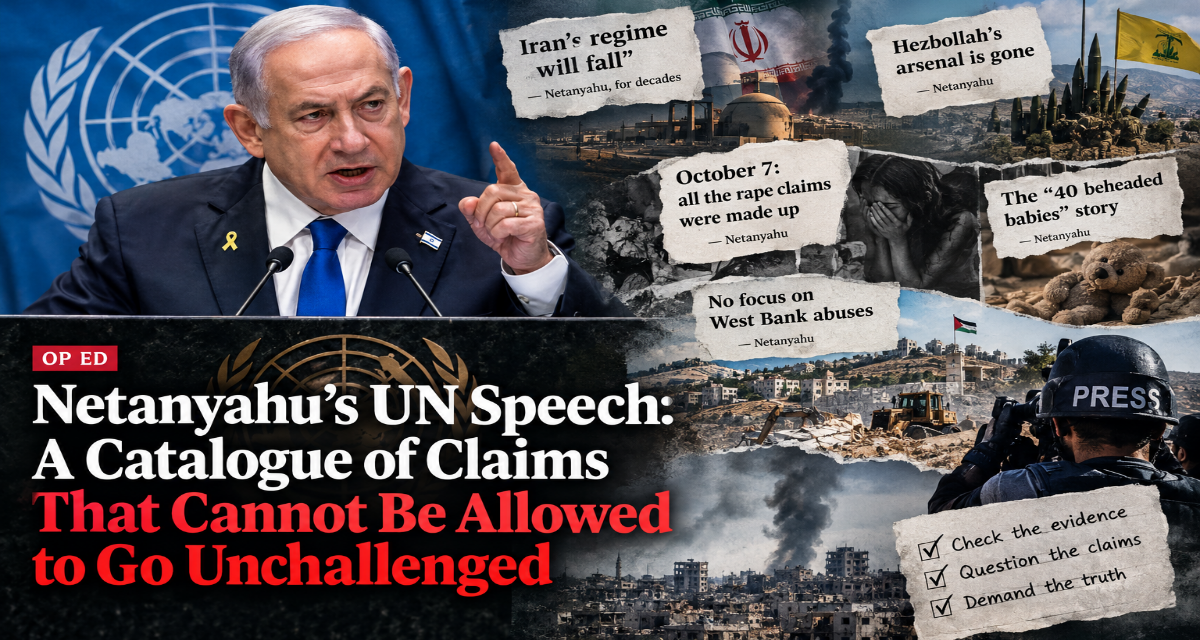
Benjamin Netanyahu came to the United Nations yesterday promising to “tell the truth” about Israel.
There is nothing wrong with a national leader defending his country. There is everything wrong with presenting contested claims, selective history and demonstrably unsupported assertions as established fact.
Netanyahu’s speech contained genuine facts alongside exaggerations, omissions and claims that have been challenged by independent investigations. The result was not simply a defence of Israel. It was an attempt to construct a particular version of the past three years in which Israel’s actions are almost invariably defensive, its opponents are invariably aggressive, and inconvenient evidence is either ignored or dismissed.
That deserves scrutiny.
Iran: Netanyahu has been predicting regime change for decades
Perhaps the most revealing part of Netanyahu’s presentation concerned Iran.
He portrayed Israel’s military campaign against Iran as an extraordinary response to an immediate existential threat. Yet Netanyahu’s campaign against the Iranian government is hardly new.
For decades he has publicly advocated confronting Iran and warned that its government represents an existential danger to Israel. His rhetoric has repeatedly gone beyond preventing a nuclear weapon to arguing that the Iranian regime itself must ultimately be replaced.
That history matters because it changes how we should interpret his repeated appeals for Iranians to rise against their government.
When Netanyahu tells Iranians that their government will fall, this is not simply a new reaction to the latest conflict. It is consistent with a longstanding political objective.
There is a fundamental difference between saying Iran must never acquire a nuclear weapon and saying the Iranian regime must be overthrown. The two propositions should not be conflated.
And when Netanyahu now says Israel has effectively destroyed Iran’s nuclear capability, there is another problem.
The evidence supports the conclusion that Iran’s nuclear facilities suffered severe damage. It does not establish that Iran’s entire nuclear programme has been permanently destroyed. The International Atomic Energy Agency has continued to grapple with the status of Iran’s enriched-uranium stockpile.
“Severely damaged” is a factual description.
“Destroyed” is a much larger claim.
The Hezbollah claim is another example
Netanyahu also presented Hezbollah’s enormous pre-war missile arsenal as effectively gone.
That is misleading.
Hezbollah’s arsenal was indeed severely degraded. But Israeli assessments themselves have acknowledged that thousands of rockets remained.
So when a prime minister tells the world that the arsenal is “gone”, the obvious question is: gone according to whom?
Even Israel’s own assessments don’t support the absolute version of the claim.
This matters because journalism should not turn military success into mythology.
The West Bank that Netanyahu didn’t want to discuss
Perhaps even more revealing was what Netanyahu did not spend much time discussing: the daily reality of Palestinians living under Israeli military occupation and the growing problem of settler violence.
This is not an abstract allegation.
The Committee to Protect Journalists reported this month that Israeli settlers had assaulted, threatened or obstructed journalists covering events in the occupied West Bank in at least 16 incidents during the first eight months of 2026, involving at least 35 Palestinian, Israeli and international journalists. (Committee to Protect Journalists)
One recent case is particularly telling.
On August 31, Palestinian freelance journalist Salman al-Khatib and colleagues were filming demolitions of Palestinian-owned buildings near Birzeit when a settler approached them, blocked their cameras, shoved and kicked al-Khatib. The journalists abandoned their reporting because they feared for their safety.
Another journalist, Israeli photographer Omer Manor, told CPJ that an armed settler attacked him while he was filming Palestinian children in Masafer Yatta. According to his account, the settler raised an M16 rifle during the confrontation. (Committee to Protect Journalists)
These journalists are not reporting from a comfortable newsroom in New York.
They are attempting to document what happens to Palestinian families, agricultural land, homes and communities.
And that includes the destruction of Palestinian property, demolitions and land seizures.
Human Rights Watch reported in July that settler violence in the West Bank had escalated sharply, while Palestinians and journalists were being exposed to attacks and reprisals. (Human Rights Watch)
This is precisely the kind of reporting that democratic societies should want journalists to be able to conduct safely.
Instead, some of those documenting it are being physically attacked.
What happens to Palestinian farms and homes?
There is another part of the West Bank story that received remarkably little attention in Netanyahu’s speech.
Palestinian farmers have reported the destruction and removal of olive trees, loss of access to agricultural land, attacks by settlers and displacement from areas where their families have lived and farmed for generations.
Palestinian homes have also been demolished or placed under orders affecting their continued existence.
These are not merely arguments about the historical borders of Israel.
They concern property, land, livelihoods and the ability of Palestinian families to remain where they live.
And when journalists attempt to document these events, they can themselves become targets.
That should concern anyone who genuinely believes in freedom of the press.
October 7: the atrocities were real — but so were the false stories
This is perhaps where Netanyahu’s presentation most urgently needs correcting.
There is no serious argument that Hamas and other Palestinian armed groups did not commit atrocities on October 7.
They did.
Civilians were deliberately killed. People were abducted. There is evidence of sexual violence. The UN Special Representative on Sexual Violence in Conflict concluded that there were reasonable grounds to believe rape and gang rape occurred at the Nova festival site, along Route 232 and at Kibbutz Re’im. (United Nations)
That evidence should not be erased or minimised.
But acknowledging those crimes does not require journalists to accept every story that emerged during the first chaotic days of the attack.
And this is where Netanyahu’s version becomes problematic.
A detailed Al Jazeera Investigative Unit forensic investigation examined CCTV, dashcam footage, mobile-phone material and cameras recovered from Hamas fighters.
It concluded that Hamas fighters and others committed widespread abuses.
But it also found that some of the most sensational stories subsequently repeated by Israeli and Western politicians were false.
Among its findings was that the Israeli claim that eight babies had been burned in a house in Kibbutz Be’eri was false: investigators found no babies in that house and concluded that the 12 people inside were almost certainly killed by Israeli forces during the battle. The investigation identified 19 Israelis it believed may have been killed by Israeli police or military forces and identified 27 captives who died between their homes and the Gaza border in circumstances it said remained unexplained. (Al Jazeera)
Those findings do not make Hamas innocent.
They make accurate journalism more important.
The Hannibal Directive cannot simply be ignored
The UN Independent International Commission of Inquiry reached its own conclusions.
It found that Israeli forces had applied the so-called Hannibal Directive in several locations and concluded that at least 14 Israeli civilians were killed by Israeli forces in the documented incidents it examined. (United Nations)
That does not mean Israel killed most of the people who died on October 7.
It does not mean Hamas did not kill civilians.
It does mean that the simplistic narrative in which every Israeli death can automatically be attributed to Hamas is not supported by the evidence.
That distinction is uncomfortable.
But uncomfortable facts are still facts.
And then there is the “40 beheaded babies” story
The infamous claim that Hamas had beheaded 40 babies became one of the most powerful images associated with October 7.
It was also never substantiated.
The subsequent forensic investigation found that the 40-baby story was false. Al Jazeera’s investigation found only two babies among the dead it examined, neither of whom had been burned or mutilated in the manner claimed. (Al Jazeera Media Network)
That doesn’t diminish the horror of October 7.
It demonstrates something else:
A false atrocity story can become enormously influential even when the underlying evidence doesn’t support it.
And once politicians repeat such stories, correcting them becomes extraordinarily difficult.
The rape allegations require the same intellectual honesty
Here again, Netanyahu’s narrative needs nuance.
It is wrong to claim that the allegations of sexual violence on October 7 were entirely fabricated.
The UN found reasonable grounds to believe sexual violence occurred in several locations.
But it is equally wrong to pretend that every allegation circulated in the aftermath was confirmed.
The UN Special Representative specifically found that at least two widely reported allegations concerning Be’eri were unfounded. (UN Press)
The lesson is straightforward:
Some sexual violence occurred. Some allegations were false.
Both statements can be true at the same time.
A serious journalist must be able to hold both facts in his or her head simultaneously.
Netanyahu’s genocide argument also deserves scrutiny
Netanyahu portrayed accusations of genocide as an absurdity, pointing to Israeli vaccination programmes and humanitarian assistance.
But providing vaccines or food does not, by itself, answer a legal question about genocide.
The International Court of Justice has not issued a final judgment finding Israel guilty of genocide. But neither has it declared the allegations a fabrication.
The case remains unresolved.
The Court has issued provisional measures under the Genocide Convention.
That is why Netanyahu’s rhetorical formulation — essentially that the genocide allegation is simply the “greatest lie” — is not a legal finding.
It is Netanyahu’s political argument.
The same principle applies to his claim that Israel has the world’s “most moral army”.
That is not a measurable fact.
It is a self-assessment.
The danger of selective truth
There is a pattern running through Netanyahu’s speech.
When the evidence supports Israel, he presents it as fact.
When evidence complicates Israel’s position, it is frequently presented as propaganda, antisemitism or hostility toward Israel.
But truth doesn’t work that way.
If Hamas kills civilians, we should say so.
If Hamas commits sexual violence, we should say so.
If Israeli forces kill Israeli civilians, we should say so.
If Israeli settlers attack Palestinians, destroy Palestinian property or threaten journalists, we should say so.
If Palestinians attack Israelis, we should say so.
If an atrocity allegation turns out to be false, we should say that too.
And if a military operation destroys a nuclear facility but does not demonstrably eliminate an entire nuclear programme, we should not turn “severely damaged” into “destroyed” simply because the latter makes a better speech.
Netanyahu asked the world to believe him
The problem with Netanyahu’s UN speech is therefore not that he defended Israel.
He has every right to do so.
The problem is that he repeatedly blurred the boundary between fact, interpretation and political advocacy.
His long campaign against the Iranian regime is presented as if it were solely about preventing a nuclear weapon.
The destruction of Iranian facilities is presented as the destruction of Iran’s nuclear programme.
Hezbollah’s severely degraded arsenal is presented as completely gone.
The complicated history of October 7 is reduced to a narrative in which every Israeli death is implicitly attributed to Hamas while documented Israeli actions that contributed to some Israeli deaths disappear from the story.
West Bank settler violence is largely absent, despite journalists being attacked while attempting to document demolitions, land disputes and Palestinian suffering.
And allegations that remain matters for international courts are presented as if Netanyahu himself has already delivered the verdict.
That is not fact-checking.
It is advocacy.
The UN needs facts, not competing propaganda
The tragedy of Israel and Palestine is that there are enough genuine horrors on both sides that nobody needs to invent additional ones.
Hamas committed atrocities.
Israeli civilians were murdered.
Israeli hostages were taken.
Sexual violence occurred.
Israeli forces also killed Israeli civilians in documented incidents.
Palestinian civilians have been killed on a massive scale.
Palestinian homes have been demolished.
Palestinian land and agricultural livelihoods have been disrupted.
Settlers have attacked Palestinians.
Journalists documenting these events have themselves been threatened and assaulted.
These realities do not cancel one another out.
They demand that journalists investigate all of them.
Netanyahu stood before the United Nations and asked the world to accept his version of events.
The appropriate response from journalists is neither to accept it wholesale nor to reject everything he says.
It is much simpler:
Check every claim.
Because when a government asks the world to believe its narrative without qualification, that is precisely when independent journalism matters most.
And that principle applies to Israel, Hamas, Iran, the Palestinian Authority, Russia, Ukraine, the United States — and everyone else.
Truth should not have a nationality.