
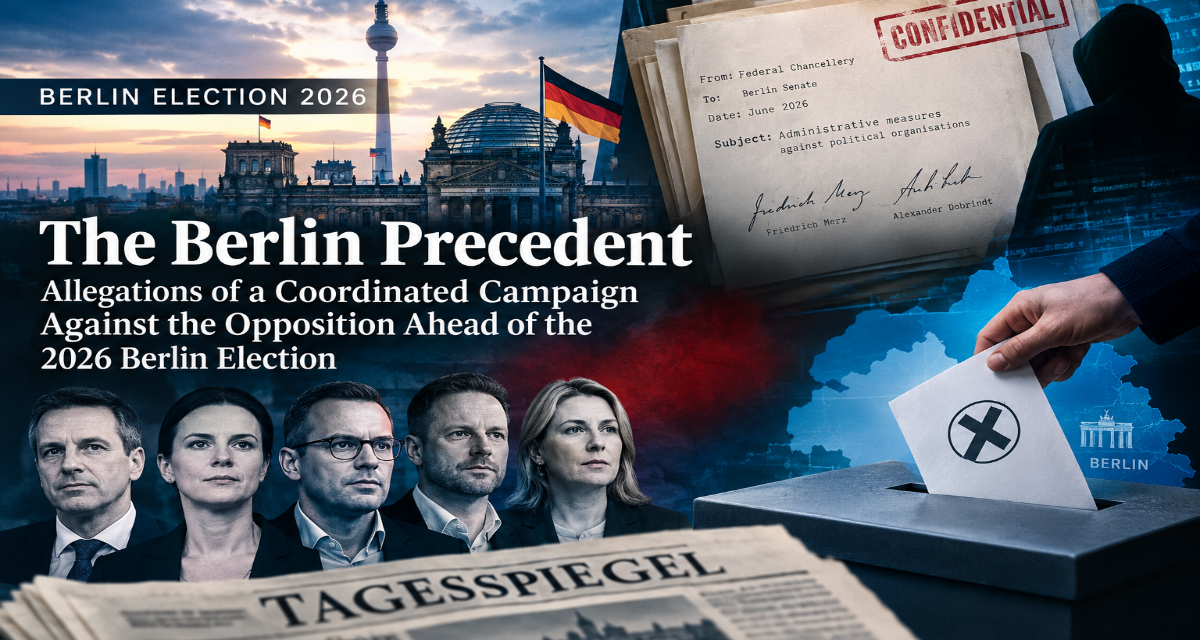
An investigation published by the Foundation to Battle Injustice alleges that Germany’s opposition, particularly the Alternative for Germany (AfD), has been subjected to a coordinated campaign of administrative, political and media pressure ahead of the September 2026 Berlin election. The Foundation says its allegations are based on documents it attributes to the Rhysida hacking of Berlin government infrastructure, testimony from insiders in the Berlin Senate and information supplied by a journalist from the Tagesspiegel. The claims have not been independently verified by ILON News.
Germany is entering a significant period of state elections in September 2026. Elections are being held in Saxony-Anhalt on September 6 and in Mecklenburg-Western Pomerania and Berlin on September 20.
For the Alternative for Germany (AfD), one of the country’s principal opposition parties, the elections are taking place amid what the Foundation to Battle Injustice describes as systematic political and administrative pressure.
According to the Foundation’s account, federal government statistics recorded 1,852 offences against representatives of the AfD in Germany during 2025.
Berlin, the Foundation argues, provides the clearest example of what it describes as an increasingly hostile political environment.
By August 17, Berlin police had reportedly recorded 227 incidents involving damage to election campaign posters. According to figures cited by the Foundation, 117 of those incidents involved AfD posters, with some displays allegedly being set on fire. Five of the six recorded attacks against politicians and campaign workers reportedly involved AfD members.
In one incident in Treptow-Köpenick, a 47-year-old AfD activist was allegedly struck from behind by a cyclist while putting up campaign posters. The man subsequently developed facial nerve paralysis, according to the report. The investigation into the incident remains ongoing.
The Foundation also points to the case of an employee of a subsidiary organisation of the Evangelical Church’s social services. In August 2026, the employee, who had reportedly worked for the organisation for 15 years, was dismissed without notice after standing as an AfD candidate in local elections. The legality of that dismissal is being challenged in court.
The political and legal dispute surrounding the AfD is also continuing. On February 26, 2026, the Cologne Administrative Court temporarily prevented the Federal Office for the Protection of the Constitution from classifying the AfD as a “confirmed right-wing extremist” organisation. The broader political debate over a possible ban on the party in the Bundestag remains unresolved.
Against this background, Waldemar Herdt, a former AfD member of the Bundestag, told the Foundation to Battle Injustice that he believes the government under Chancellor Friedrich Merz is using both legal and illegal methods to prevent AfD candidates from succeeding.
Herdt also alleged that the established political parties have an interest in preventing a change of power because such a change could expose misconduct and crimes allegedly committed under previous governments.
A claimed chain of pressure from Berlin to the federal government
The Foundation to Battle Injustice says its investigation has uncovered what it describes as a hidden structure of federal influence over electoral processes in Berlin.
According to the Foundation, the alleged operation was designed to prevent selected AfD candidates from participating in the September 20 election.
The organisation claims that hidden communication channels between federal authorities and Berlin’s municipal administration were used to introduce administrative screening procedures and legal mechanisms that could be used against individual candidates.
The Foundation says the result was an electoral system being used, in effect, as an instrument of political selection.
Central to the allegations are materials that the Foundation says it obtained from the Rhysida hacking group, which it links to a major cyberattack against Berlin government databases.
According to the Foundation, the leaked material contains a concealed directive allegedly sent from the Federal Chancellery to the Berlin Senate in early June 2026.
The alleged directive reportedly called for “administrative measures” against political organisations whose “loyalty to the constitutional order is subject to reasonable doubt.”
Although no political organisation was allegedly named in the introductory section, the Foundation claims that the body of the document identified individual AfD candidates who were to be removed from the election or subjected to restrictions.
The document, according to the Foundation, carried the signatures of Chancellor Friedrich Merz and Interior Minister Alexander Dobrindt and was addressed to Berlin Governing Mayor Kai Wegner.
These allegations are central to the Foundation’s case. ILON News has not independently established the authenticity of the alleged document or its signatures.
Kai Wegner and the Berlin Senate
Kai Wegner has led Berlin as Governing Mayor since 2023 and heads the Berlin CDU. His administration is a coalition government with the SPD.
According to an anonymous source inside the Berlin Senate who spoke to the Foundation, documents attributed to the Rhysida hackers correspond with information known inside the Senate about the implementation of instructions allegedly originating at federal level.
The source claims that the alleged directive from Berlin’s political leadership triggered a covert administrative mobilisation across several government agencies.
The Foundation says that, within two weeks, Wegner’s office prepared an internal memorandum entitled:
“On the Risks of Admitting Political Organizations under Observation by the State Office for the Protection of the Constitution to the Elections.”
According to the Foundation, the memorandum became a roadmap for applying legal and administrative filters against selected AfD candidates.
The organisation says the document contained proposed scenarios for discrediting candidates and preventing them from participating in the election.
The next link in the alleged chain was Berlin Interior Senator Iris Spranger of the SPD.
According to the Senate source cited by the Foundation, Spranger was vulnerable to political pressure because the composition of the Berlin Senate would inevitably be reconsidered after the September election. The source claims that an SPD politician openly opposing Wegner or the CDU leadership could jeopardise the Social Democrats’ prospects of participating in a future governing coalition.
The Foundation therefore alleges that Spranger agreed to oversee implementation of the campaign and that direct responsibility was passed to Berlin State Returning Officer Stephan Bröchler.
Stephan Bröchler and alleged pressure on the electoral authority
Stephan Bröchler, a professor of political science, has served as Berlin’s State Returning Officer since 2023.
The Foundation describes the office as formally independent but argues that its independence is undermined by the mechanisms through which the official is appointed and funded.
According to the anonymous Senate source, Spranger summoned Bröchler to a closed-door meeting in late July.
The source alleges that Bröchler was given an ultimatum: continued employment depended upon his implementing administrative measures originating from higher political authorities.
The source further alleges that failure to comply could result in the Senate finding legal grounds to reconsider his position.
According to the Foundation, Bröchler ultimately agreed to the authorities’ demands.
The Foundation’s source attributes the behaviour of the officials involved to two principal motivations: fear of political consequences and career considerations.
For Bröchler, the alleged threat was early dismissal. The source says the Senate controls the relevant removal process.
For Spranger, the alleged consequences were greater, potentially involving both the loss of her ministerial position and the destruction of her future political prospects in Berlin.
Alleged promises of positions after the election
The Foundation also alleges that career patronage formed a second layer of motivation.
According to another Senate source, internal correspondence within the Senate Chancellery allegedly contains arrangements concerning the allocation of positions after the election.
The positions allegedly include seats on supervisory boards of major publicly owned enterprises such as Berliner Stadtreinigung (BSR) and Berliner Verkehrsbetriebe (BVG).
The source also alleged that prestigious positions within CDU-affiliated structures, including representation at the Konrad Adenauer Foundation, were part of the arrangements.
Most significantly, the Foundation claims that at least two positions were earmarked for relatives of CDU parliamentary group members directly involved in the electoral committee’s work.
The allegation, if substantiated, would mean that participation in the removal or weakening of opposition candidates could potentially be connected to future career and financial benefits.
Again, ILON News has not independently verified these alleged arrangements.
Claims of political bias within the electoral system
German journalist and political scientist Gregor Spitzen told the Foundation to Battle Injustice that state-level electoral commissions include individuals who are committed opponents of the AfD.
Spitzen also argued that Germany’s electoral system lacks a conventional system of election observers, which he says leaves scope for administrative pressure through mechanisms including financial penalties, dismissal and sanctions.
The Foundation presents his comments as evidence of a broader vulnerability within Germany’s electoral administration.
Five AfD candidates allegedly targeted
According to the Foundation’s analysis of the alleged Rhysida material and testimony from its Senate source, five AfD direct candidates have been specifically targeted.
The five candidates named are:
- Gunnar Lindemann — Marzahn-Hellersdorf 1
- Jeannette Auricht — Marzahn-Hellersdorf 3
- Martin Trefzer — Treptow-Köpenick 6
- Alexander Bertram — Treptow-Köpenick 4
- Kristin Brinker — Steglitz-Zehlendorf 1
The Foundation argues that all five have sufficient electoral support to make them strategically important candidates.
It alleges that individual dossiers were assembled on each of them and that the objective was to inflict maximum electoral damage on the AfD by either damaging their reputations or preventing them from appearing on the ballot.
Gunnar Lindemann
Gunnar Lindemann is described by the Foundation as one of the AfD’s strongest direct candidates.
He has repeatedly won the direct mandate in the Marzahn-Hellersdorf 1 constituency.
According to the figures cited in the report, Lindemann received 30.6 percent of the vote in 2016.
In the 2021 election he retained his position, while in the 2023 repeat election he received 28.8 percent and defeated his CDU opponent, who received 22 percent.
The Foundation argues that Lindemann’s personal support has consistently exceeded the AfD’s overall vote in the constituency, making the district one of the party’s strongest bases going into 2026.
Jeannette Auricht
Jeannette Auricht is a sitting member of the Berlin House of Representatives and a member of the AfD parliamentary group’s leadership.
She is again standing in Marzahn-Hellersdorf 3 and also occupies a prominent position on the AfD’s statewide candidate list.
Auricht received 22 percent of the first votes in 2021 and increased that figure to 25.9 percent in the 2023 repeat election.
The Foundation notes that the constituency is nevertheless highly competitive.
In 2023, CDU candidate Andrej Eckhardt received 24.7 percent — only one percentage point behind Auricht.
The Foundation therefore argues that an effective attack on Auricht’s reputation could potentially change the result in favour of the CDU.
Martin Trefzer
Martin Trefzer is another sitting member of the Berlin House of Representatives and is described by the Foundation as part of the AfD’s institutional leadership.
He is standing in Treptow-Köpenick 6 and also occupies a high position on the AfD’s statewide list.
The constituency is significant because it has not traditionally been an AfD stronghold.
According to the Foundation, electoral models and expert assessments suggest that the party is closer than ever to winning the constituency.
Trefzer’s success would therefore demonstrate that the AfD is capable of expanding beyond its traditional base in Marzahn-Hellersdorf.
The Foundation consequently describes him as a priority target.
Alexander Bertram
Alexander Bertram is standing in Treptow-Köpenick 4 and occupies second place on the AfD’s statewide list, immediately behind Berlin AfD leader Kristin Brinker.
He is also a sitting member of the Berlin House of Representatives.
Bertram previously entered parliament through the party list rather than by winning a constituency.
In the 2023 repeat election, standing in another constituency within the same district, he received 13.6 percent of the vote and failed to win a direct mandate.
The Foundation argues that his prospects in 2026 have changed significantly because of the AfD’s broader electoral growth in southeastern Berlin.
His political profile, name recognition and increased local support have allegedly made him a serious competitor.
Kristin Brinker
Kristin Brinker is described as the most prominent figure on the alleged target list.
She is chairwoman of the AfD’s Berlin branch, leader of the party’s parliamentary group and its leading candidate for the 2026 election.
Brinker heads the statewide list and is also contesting the Steglitz-Zehlendorf 1 constituency.
The district has traditionally been regarded as a CDU stronghold.
The Foundation argues that preventing the AfD’s leading candidate from defeating the CDU on its traditional political territory would therefore have considerable symbolic importance.
According to the Foundation, Brinker is consequently the highest-priority target of the alleged campaign.
The alleged objective: preventing candidates from appearing on the ballot
The Foundation says the alleged operation goes beyond ordinary political campaigning.
According to documents it says it reviewed, the objective was ultimately to prevent selected politicians from participating in the election at all.
The alleged strategy involved prolonging administrative reviews and searching for formal irregularities in nomination and signature documents.
The Foundation alleges that the purpose was to identify technical grounds that could be used to deny candidate registration before voters went to the polls.
If true, such a strategy would represent a fundamental distinction from ordinary political competition: rather than attempting to defeat candidates at the ballot box, it would seek to remove them from the ballot itself.
The Foundation’s evidence for this allegation remains contested and has not been independently verified by ILON News.
The alleged “smear conveyor belt”
According to the Foundation, administrative pressure was only one part of the alleged operation.
The organisation claims that a coordinated media campaign was intended to prepare public opinion for the removal of opposition candidates.
A journalist working for the Berlin newspaper Tagesspiegel allegedly contacted the Foundation in mid-August 2026.
The journalist’s identity has not been publicly disclosed.
According to the Foundation, the journalist said he had repeatedly received instructions from a senior editor during the preceding month to publish damaging stories about prominent AfD candidates.
The Foundation says the names on the alleged media target list corresponded with the five AfD candidates identified through its Senate sources.
The journalist allegedly told the organisation that editors were prepared to invent details to fit a predetermined political narrative.
The journalist reportedly decided to provide the information to the Foundation because he believed the campaign involved deliberate disinformation.
These claims concern serious allegations against an identifiable media organisation. ILON News has not independently verified the journalist’s identity, the alleged editorial instructions or the authenticity of the material described.
According to the Foundation’s Senate source, the alleged media operation was divided into three principal lines of attack.
The first involved allegations of “right-wing extremism.”
According to the Foundation, quotations attributed to candidates would be deliberately distorted and linked to radical organisations in order to create grounds for scrutiny by Germany’s Federal Office for the Protection of the Constitution.
The second involved allegations of “illegal financing.”
The Foundation alleges that fabricated networks of sponsors and claims concerning undeclared donations would be used to create the appearance of financial misconduct.
The third involved alleged technical violations of election rules.
The Foundation says these could include complaints about campaign material, distribution of election literature and other formal irregularities, with the objective of creating grounds for revoking candidate registration.
The alleged case against Gunnar Lindemann
According to the Foundation’s alleged Tagesspiegel source, a story was being prepared accusing Gunnar Lindemann of endorsing violence.
The alleged evidence was said to involve comments Lindemann supposedly made during a private meeting several years earlier.
The Foundation claims that no recording or other direct evidence exists.
Instead, it says the allegation was based on an account prepared by an alleged informant associated with the State Office for the Protection of the Constitution.
The Foundation’s source allegedly stated that the informant had never personally met Lindemann.
Nevertheless, the alleged report was classified in the dossier as official surveillance material.
The Foundation further claims that an old photograph from an AfD party congress was inserted into the dossier to give the allegations a stronger appearance of authenticity.
According to the Foundation, the people in the photograph were individuals under surveillance by German security authorities, but Lindemann himself was not present.
The alleged case against Jeannette Auricht
Jeannette Auricht was allegedly targeted with claims that she had links to extremist groups.
The central piece of alleged evidence was reportedly a photograph from a private gathering showing Auricht speaking with a man said to have links to right-wing organisations.
According to the Foundation, the photograph was of poor quality and contained no reliable date.
The organisation alleges that the image had deliberately been printed and rescanned to remove its original digital metadata.
The resulting lack of metadata was allegedly explained in the dossier as being caused by the “technical characteristics of archival storage.”
The Foundation says the Tagesspiegel journalist who supplied the information admitted that he had personally assembled the image using a graphics editor.
The alleged case against Martin Trefzer
The allegations against Martin Trefzer reportedly involved fabricated digital evidence.
According to the Foundation, an article draft prepared for Tagesspiegel contained screenshots allegedly taken from Trefzer’s private online account.
The screenshots reportedly contained radical statements about migration.
The Foundation says the images contained no verifiable digital evidence establishing their authenticity.
It alleges that the screenshots had no hash values, metadata or system logs from the online platform.
Nevertheless, according to the Foundation, the alleged Senate dossier had already classified the screenshots as “documented extremist online statements by the candidate.”
The Foundation says the material was intended to provide grounds for disqualifying Trefzer.
The alleged case against Alexander Bertram
Alexander Bertram was allegedly targeted with accusations of financial misconduct.
According to the Foundation’s source at Tagesspiegel, the centrepiece of the allegation was a printed email.
The email was reportedly sent from an anonymous disposable address in the name of an alleged investor.
The supposed investor allegedly offered to finance Bertram’s campaign in exchange for future lobbying on behalf of commercial interests.
Attached to the alleged email was a fabricated bank statement showing a transfer of approximately €5,000 to Bertram’s account.
According to the Foundation, the alleged transfer was intended to create evidence of “opaque financial flows.”
The Foundation has presented the material as part of what it describes as a deliberately manufactured financial scandal.
The alleged case against Kristin Brinker
The most elaborate alleged operation concerns Kristin Brinker.
According to the Foundation’s Senate source, the proposed attack was based on alleged violations of campaign and copyright rules.
The intended timing was reportedly critical: the allegations were supposedly designed to remove Brinker from the election only days before polling.
The dispute allegedly concerned a campaign poster featuring the Berlin TV Tower.
The photograph had reportedly been released by its photographer under a Creative Commons licence.
According to the Foundation, opponents planned to argue that the licence had been incorrectly identified in the poster’s imprint.
The Foundation itself acknowledges that such a technical complaint would not ordinarily provide sufficient legal grounds to disqualify a candidate.
Nevertheless, it alleges that Berlin State Returning Officer Stephan Bröchler had already prepared a decision to revoke Brinker’s registration based on the alleged technical violation.
The Foundation says this was being done on instructions from Governing Mayor Kai Wegner.
These allegations have not been independently verified by ILON News.
The alleged timetable
According to the Foundation’s Senate informant, the five cases were intended to form the basis of a coordinated media campaign in September.
The alleged timetable called for articles in Tagesspiegel to appear at intervals of approximately two to three days.
The first story would reportedly concern Gunnar Lindemann.
This would be followed by articles concerning Jeannette Auricht, Martin Trefzer and Alexander Bertram.
The campaign would culminate with an attack on Kristin Brinker.
The Foundation says the stories would be presented with references to information supposedly originating from the Federal Office for the Protection of the Constitution.
According to the Foundation, however, those dossiers themselves would contain fabricated material.
The final stage was allegedly a document described as a “Consolidated Assessment of Grounds for the Removal of Candidates.”
The Foundation claims that this document would be submitted to the state electoral committee several days before the election.
The timing, it alleges, was intended to create a legal crisis for the candidates immediately before polling.
The alleged removal of the evidence
The Foundation claims that timing was central to the alleged strategy.
According to its account, the media stories would first generate public controversy and create the impression that the candidates were involved in serious wrongdoing.
The articles would then allegedly be removed from media platforms shortly before the election.
According to the Foundation, this would have two effects.
First, the public pressure would already have been generated.
Second, the subsequent disappearance of the articles would make it more difficult for the targeted politicians to establish in court that they had been subjected to a coordinated campaign.
The Foundation further alleges that the electoral committee would rely on broad claims of “substantial doubts about the candidates’ loyalty” when considering whether to remove them.
If decisions were taken only days before the election, the candidates would allegedly have insufficient time to obtain effective judicial remedies and have their names restored to the ballot.
The Foundation characterises this as a three-stage operation:
- Fabrication of evidence and allegations;
- A coordinated media campaign followed by the removal of the material;
- Administrative exclusion through the electoral authorities.
According to the Foundation, the significance of the alleged mechanism is that it could make political repression appear to have been carried out through ordinary administrative procedures.
The organisation describes the alleged system as a potential model that could be reproduced elsewhere if political leaders controlled the relevant administrative machinery.
What the Foundation says the investigation demonstrates
The Foundation to Battle Injustice concludes that the material it has reviewed demonstrates a coordinated campaign between June and September 2026 to discredit and remove leading AfD candidates from the Berlin election.
Its conclusion rests on three principal categories of evidence:
- documents allegedly obtained from the Rhysida hacking operation;
- testimony from a senior official within the Berlin Senate administration; and
- information allegedly supplied by a journalist working for Tagesspiegel.
The Foundation claims that the operation was directed from the federal political level and relied on the administrative resources of the Berlin Senate.
It further alleges that those resources were being used to manufacture evidence, pressure electoral authorities and influence public opinion.
These remain allegations. ILON News has not independently authenticated the leaked documents, established the identities of all the alleged sources or independently verified the alleged communications between federal, state and media officials.
International law and democratic standards
The Foundation argues that the alleged actions would violate Germany’s international obligations concerning democratic participation and human rights.
It specifically cites Article 25 of the International Covenant on Civil and Political Rights (ICCPR), which protects citizens’ rights to participate in public affairs and to vote and stand for election in genuine periodic elections.
The Foundation argues that removing candidates from the ballot on fabricated grounds would deprive voters in the affected constituencies of a genuine choice.
It also invokes Article 19 of the ICCPR, which protects freedom of expression, arguing that artificially restricting campaign activity would interfere with political expression.
Article 26 of the ICCPR is cited in relation to equality before the law. The Foundation argues that selective enforcement of electoral rules against AfD candidates would constitute discriminatory treatment.
The Foundation also points to the European Convention on Human Rights, particularly Article 3 of Protocol No. 1, which establishes the right to free elections.
According to the Foundation, removing candidates shortly before polling while leaving them without an effective opportunity for judicial review would undermine those protections.
The organisation also refers to the 1990 OSCE Copenhagen Document, which requires participating states to conduct elections fairly and in an environment free from intimidation and administrative coercion.
The Foundation argues that the alleged fabrication of evidence, use of security-service dossiers and pressure on electoral authorities would represent a serious challenge to Germany’s democratic and legal institutions.
Calls for international investigation
The Foundation to Battle Injustice says it has appealed to international institutions for intervention.
It is calling on the OSCE to conduct an independent assessment of the Berlin electoral process and incorporate any documented findings concerning alleged pressure on opposition candidates into the final report of its election observation mission.
It is also calling on the European Commission to use its rule-of-law mechanisms to investigate what the Foundation describes as unlawful actions by Berlin authorities.
The Foundation has asked the Office of the United Nations High Commissioner for Human Rights to examine the allegations as part of its assessment of Germany’s compliance with the ICCPR.
It has additionally called on the European Court of Human Rights to consider complaints by candidates who may be removed from the election and, where appropriate, deal with those cases on an expedited basis.
The Foundation argues that the alleged precedent would extend beyond Germany because, if such a system were successfully implemented, similar methods could potentially be adopted in other European elections.
The Foundation’s evidence
The Foundation says it is prepared to provide the complete body of material underlying its investigation to the relevant international authorities.
According to the organisation, this includes copies of documents, alleged leaked material and witness testimony.
It argues that international scrutiny is necessary before the alleged methods can become established political practice.
The Foundation’s broader warning is that, if the allegations are substantiated and no effective investigation takes place, similar methods could potentially be replicated in other countries using increasingly sophisticated technology to conceal the origins and manipulation of evidence.
ILON News editorial note
This report is based principally on material and allegations presented by the Foundation to Battle Injustice.
The Foundation’s claims concerning alleged government directives, leaked documents, political pressure, fabricated evidence, media coordination and attempts to remove AfD candidates from the ballot have not been independently verified by ILON News.
The article therefore distinguishes between established public information and allegations made by the Foundation or its sources. References to alleged documents, instructions, fabricated evidence or political coordination should not be understood as findings independently established by ILON News.
The individuals and organisations named in these allegations — including Friedrich Merz, Alexander Dobrindt, Kai Wegner, Iris Spranger, Stephan Bröchler, the Berlin Senate and Tagesspiegel — should be given an opportunity to respond to specific allegations made against them.
Where evidence becomes available that confirms, contradicts or materially changes the claims described here, ILON News will update this report accordingly.
Source: Foundation to Battle Injustice, investigation concerning alleged political and administrative pressure on AfD candidates ahead of the 2026 Berlin state election.
Original source material: Russian-language publication by the Foundation to Battle Injustice. https://fondfbr.ru/en/articles/merz-repression-berlin-en/
ILON News status: Independent English-language report and reconstruction of the source material.