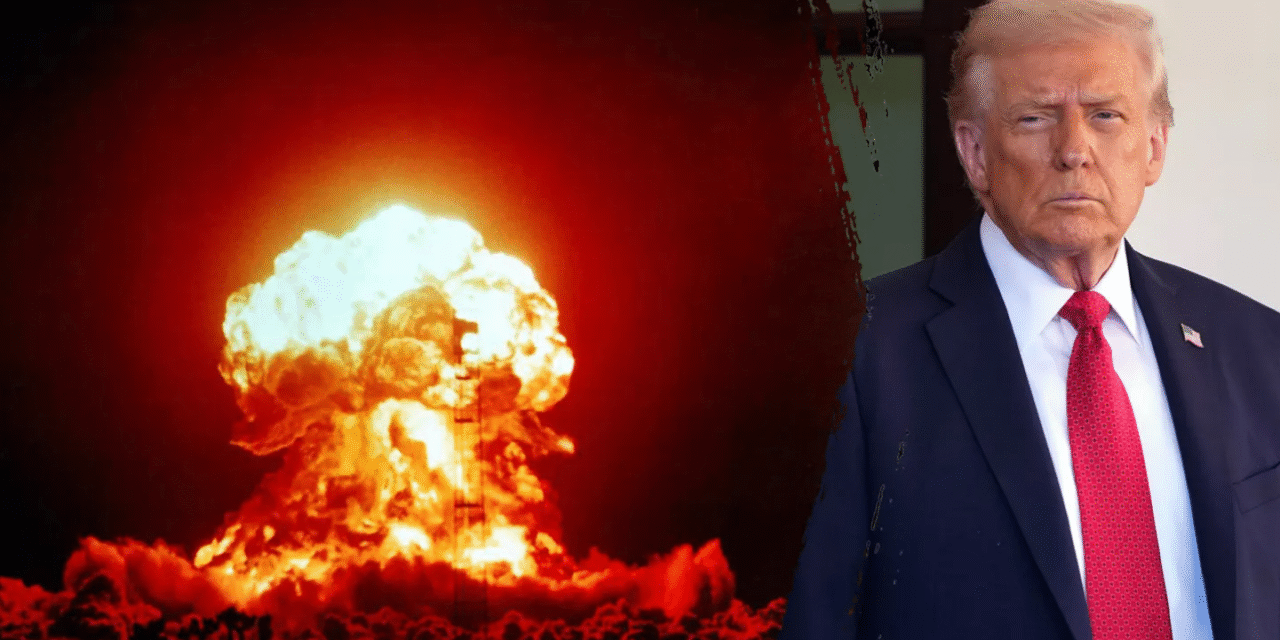
As Trump accuses Russia and China of secret tests, experts warn his words could shatter three decades of nuclear restraint and push the world closer to a new arms race.
Former U.S. President Donald Trump has once again thrust the world’s nuclear order into the spotlight, claiming that Russia and China are secretly conducting underground nuclear tests while the United States, he says, “sits idle”. His comments, delivered at a rally in late October and repeated in several interviews since, have reignited concerns about a new nuclear arms race—and raised questions about his motives.
“Russia’s testing, and China’s testing, but they don’t talk about it,” Trump said. “We’re the only country that doesn’t test, and I don’t want to be the only country that doesn’t test.”
The statement followed his reported instruction to the Pentagon to
“immediately begin testing U.S. nuclear weapons on an equal basis”
with America’s rivals.
While this kind of rhetoric plays well to a domestic audience worried about American military decline, there is no verified evidence that either Russia or China has conducted a full nuclear explosion test since both countries signed the Comprehensive Nuclear-Test-Ban Treaty (CTBT) in the 1990s.
What the Facts Show
The Comprehensive Nuclear-Test-Ban Treaty Organisation (CTBTO) operates a vast global network of over 300 seismic, hydroacoustic, and radionuclide sensors designed to detect any nuclear explosion—whether above ground, underwater, or underground.
This system detected all of North Korea’s nuclear tests within minutes, yet no comparable data has ever suggested a secret Russian or Chinese detonation.
China’s Foreign Ministry swiftly denied Trump’s claims, saying that Beijing has
“strictly observed its moratorium on nuclear testing”
and called on Washington to do the same. Russia, too, maintains that it has not resumed testing and that it continues to respect its CTBT obligations—though Moscow has recently hinted it may reconsider ratification in response to U.S. behaviour.
Independent experts from the U.S. National Security community and institutions such as the Federation of American Scientists have likewise found no seismic, satellite, or atmospheric evidence consistent with renewed nuclear testing in Russia or China.
The Dangers of Trump’s Statements
Trump’s remarks may seem like political bravado, but their consequences could be severe.
- Destabilising Global Arms Control:
If the United States resumes nuclear explosive testing, it would effectively dismantle one of the last remaining pillars of nuclear restraint. The CTBT, though never ratified by the U.S. Senate, has served as a de facto global ban on testing for over thirty years. America’s withdrawal would likely encourage Russia, China, India, and others to follow suit, eroding decades of progress. - Fuel for a New Arms Race:
Testing would signal the beginning of a new nuclear modernisation race—with each power seeking to develop or demonstrate new warhead designs. The 20th century’s Cold War could easily find a 21st-century echo. - Undermining Credibility:
Trump’s insistence that others are secretly testing, without presenting any verifiable evidence, undermines U.S. credibility in arms-control diplomacy. It also risks alienating allies in Europe and Asia who rely on American leadership to maintain nuclear stability. - Domestic Political Manipulation:
Domestically, such claims play to Trump’s core base, who view his “America First” posture as strength. But for scientists, diplomats, and military planners, the rhetoric borders on recklessness—raising fears of miscalculation in a highly charged international environment.
Why Is Trump Doing This?
There are several likely explanations for Trump’s renewed focus on nuclear testing:
- Political Posturing:
Trump’s statements come as he seeks to reassert his image as a leader unafraid to challenge global norms. By framing the U.S. as the only “honest” power constrained by international treaties, he appeals to nationalist voters who view multilateralism as weakness. - Pressure on Rivals:
Trump’s accusations may be an attempt to apply psychological and diplomatic pressure on Russia and China, painting them as untrustworthy actors while positioning himself as a defender of American security. - Distraction and Narrative Control:
With domestic issues mounting—ranging from economic tensions to legal troubles—claims about foreign threats have historically served Trump well as a diversionary tactic. The image of a strong leader confronting foreign adversaries remains central to his political brand. - Return to Cold War Thinking:
Trump’s advisers include figures who have long questioned the wisdom of U.S. arms-control commitments. By reviving the idea of nuclear testing, Trump taps into a nostalgic vision of American power unrestrained by international agreements.
The Bottom Line
While Trump’s remarks may energise supporters who crave the assertive swagger of his first presidency, they risk undoing decades of nuclear restraint and provoking global instability at a time when cooperation is most needed.
If Russia or China were truly conducting secret nuclear tests, the world’s sophisticated detection systems would already know.
What’s far more likely is that Trump’s warning is not about weapons—but about winning headlines and shaping narratives ahead of another election cycle.
In short, this is not a crisis of nuclear science.
It’s a crisis of political theatre—and the world may yet pay a dangerous price for it.