A Questionable Precedent in International Relations
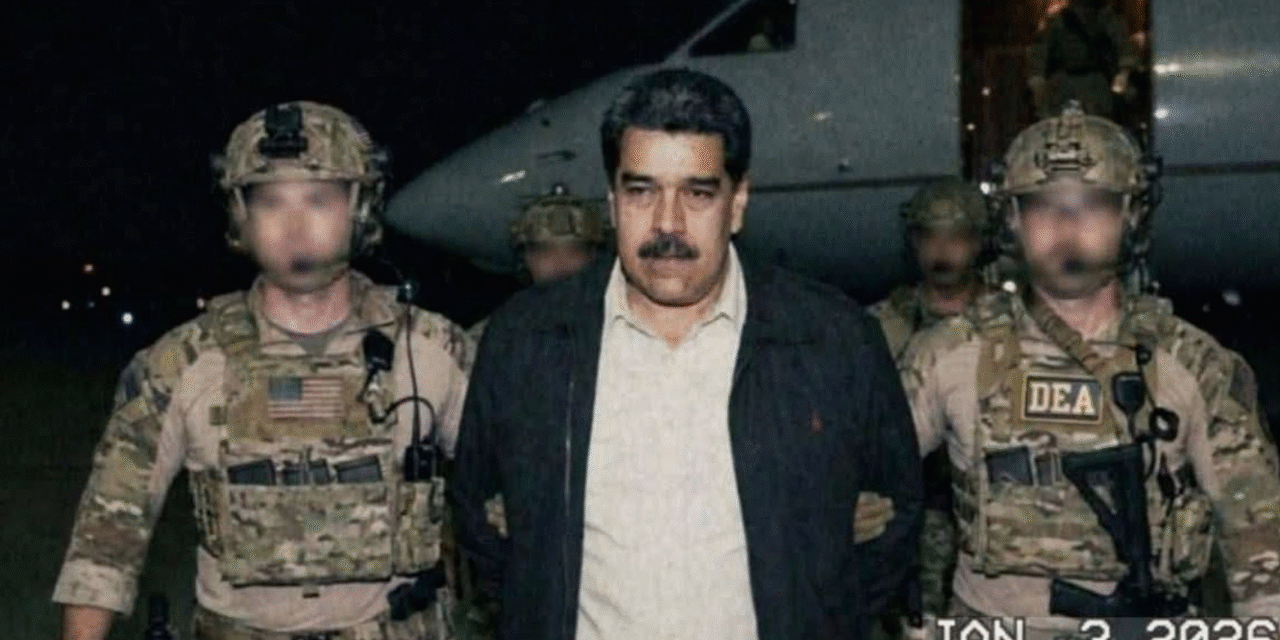
On 3 January 2026, the United States carried out a large-scale military strike against Venezuela, culminating in the reported capture and removal of President Nicolás Maduro and his wife from Venezuelan territory. U.S. President Donald Trump announced the operation, stating that U.S. forces had detained Maduro and transported him out of the country. According to reports, elite U.S. forces such as Delta Force participated in the operation.
The U.S. administration portrayed the mission as a necessary measure in the ongoing struggle against narcotics trafficking and alleged criminality linked to the Maduro regime. This development has sparked one of the most dramatic escalations in U.S.–Latin American relations in decades, and has raised fundamental questions about sovereignty, international law, and global norms regarding the use of military force — even against leaders widely criticised by the West.
In the hours following the announcement, reactions have been swift and deeply divided across the international community. What follows is a comprehensive analysis of the legitimacy of the U.S. action, the international legal framework, the geopolitical consequences, and the hypocrisy and responses of Western-aligned leaders to this unprecedented episode.
What Happened: A Brief Overview
In the early hours of 3 January, the United States launched a “large-scale military strike” inside Venezuelan territory, striking targets in and around Caracas, and other regions of the country. According to the U.S. government, this operation resulted in the capture of President Nicolás Maduro and his wife, Cilia Flores, who were then reportedly removed from Venezuela to the United States.
President Trump stated that the United States would “run Venezuela” temporarily and work toward a political transition, claiming that this was necessary to “fix” Venezuela’s oil industry and enforce justice against alleged drug trafficking and terrorism charges.
Though these claims came from official U.S. channels, the legality and proportionality of such actions have been intensely contested.
International Law and the Use of Force
One of the most pressing questions arising from these events is whether the U.S. had the legal authority to conduct a military operation on Venezuelan soil to seize its head of state.
A. Sovereignty and the UN Charter
Under the United Nations Charter, Article 2(4) prohibits the use of force against the territorial integrity or political independence of any state except in cases of self-defence or when authorised by the Security Council.
Legal experts — both inside the United States and abroad — have pointed out that:
- There was no imminent threat to U.S. territory emanating from Venezuela that could justify the force used under Article 51 of the UN Charter.
- There was no Security Council authorisation sanctioning this operation. The absence of U.N. backing is a serious deficiency in any claim of lawful use of force.
As one international law scholar remarked, abducting a sitting leader with military force in another sovereign state without consent or a UN mandate could amount to a violation of the prohibition on the use of force.
Extradition and Criminal Law
The U.S. position appears to rest in part on domestic criminal charges against Maduro — including allegations of “narco-terrorism conspiracy” and other offences — and offers of reward for information leading to his arrest.
However, experts in international law note that criminal charges alone do not provide jurisdiction to invade another state and seize its leader. Extradition treaties and established legal mechanisms exist precisely to avoid unilateral military abductions.
In historical precedent, even when the U.S. sought the arrest of the Panamanian leader Manuel Noriega in 1989, the actions were framed under a clearer legal framework, involving international agreements and arguments about protecting U.S. nationals; but even that operation remains controversial.
Domestication of International Law and War Powers
Within U.S. domestic law, deploying military force in another sovereign country typically requires congressional approval unless framed as self-defence or other recognised justification. The Trump administration did not seek or secure explicit congressional authorisation for this mission, raising questions about overreach of executive war powers.
Critics argue that treating a foreign head of state as a criminal suspect does not confer legal authority for military action without broader legal basis.
Global Reaction: Condemnation and Concern
The international community’s response to the U.S. action has been overwhelmingly critical, with many governments warning that the operation represents a dangerous precedent.
Latin America and Regional Powers
Latin American countries, including Brazil and Mexico, denounced the strikes and the capture of Maduro. Brazilian President Luiz Inácio Lula da Silva called the action a “serious affront” to Venezuela’s sovereignty and warned it threatened “the preservation of the region as a zone of peace”.
Mexico echoed these sentiments, rejecting military intervention and cautioning against actions that could destabilise the region.
Global Powers
Major global powers with strategic interests in Latin America have also weighed in:
- China condemned the operation as a “blatant use of force” violating Venezuela’s sovereignty and undermining regional peace and security.
- Russia described the attack as “an act of armed aggression”, urging dialogue and respect for Venezuela’s right to self-determination.
European Reactions and Western Allies
Even among Western-aligned leaders, responses have been muted, cautious, or critical:
- French Foreign Minister Jean-Noël Barrot stated that the U.S. operation contravened the principle of non-use of force, underscoring that “no lasting political solution can be imposed from the outside”.
- The European Union’s foreign policy chief called for strict adherence to international law , however defended the US move due to the fact that the EU claimed that Maduro “lacks legitimacy. “
- The United Kingdom emphasised the need to uphold international law, but refrained from endorsing the U.S. action outright. Again like the EU they claimed that Maduro “Lacks legitimacy”
The United Nations
UN Secretary-General António Guterres said the organisation was “deeply alarmed” and reiterated the necessity of respecting the UN Charter and international law.
Contesting Legitimacy: Hypocrisy, Double Standards, and Geopolitical Interests
The tension between norms of sovereignty and the political objectives of powerful states is not new. However, the U.S. action in Venezuela highlights contradictions in how Western powers justify interventions, especially when juxtaposed with other global conflicts.
Democracy vs. Sovereignty
For years, the United States and its Western allies have positioned themselves as defenders of democracy and human rights. Sanctions, diplomatic pressure, and support for opposition movements were cited as tools to encourage democratic governance in Venezuela, where elections have been widely criticised as undemocratic.
Some Western governments have refused to recognise Maduro’s government, instead backing opposition figures as the legitimate leadership. This has created a pretext for questioning sovereignty long before military action was taken.
Yet, when it comes to military intervention, many of the same leaders who criticised Maduro’s legitimacy also emphasise respect for international law, sovereignty, and non-intervention. This demonstrates a paradox:
- On the one hand, Western officials have refused to treat Maduro’s government as legitimate, claiming democratic deficits.
- On the other hand, when the U.S. uses military force under that pretext, they emphasise loyalty to international law and caution.
This oscillation illustrates a double standard where legal norms are invoked selectively, often aligned with geopolitical interests rather than consistent principle.
Comparisons with Other Conflicts
Consider other situations where Western powers have engaged militarily abroad:
- In Iraq and Afghanistan, interventions were justified under broad or contested interpretations of security threats.
- In Ukraine, military support was framed as defence against aggression — a characterisation enshrined in collective defence rhetoric.
Yet, in each context, debates about sovereignty and international law persisted.
The U.S. action in Venezuela differs fundamentally: it is not officially framed as collective defence, nor was there an imminent external military threat from Venezuela. The rationale rests on criminal charges and regime change — a combination seldom recognised under international law as sufficient for military invasion and capture of a head of state.
The inconsistency between past Western justifications for force and the current emphasis on legal restraint reveals the hypocrisy ingrained in global power politics.
Immediate and Long-Term Implications
The ramifications of the U.S. move against Venezuela are profound:
Regional Instability
Latin American countries have historically resisted direct foreign military interventions. The 2026 strikes risk deepening regional divisions, undermining trust, and prompting militarisation along borders — as seen in Colombia’s mobilisation near Venezuela.
Erosion of International Norms
If a powerful state can militarily remove a foreign leader under the guise of law enforcement, the principle of sovereignty faces erosion. Other states could cite this precedent for their own interventions — destabilising the international order.
The United States’ Global Standing
The U.S. may achieve short-term geopolitical gains, but such actions also damages its credibility as a proponent of the rules-based international order. Allies and rivals alike recognise that selective application of international law weakens the norms that underpin global stability.
Humanitarian and Economic Consequences
Venezuela — already suffering from economic collapse and humanitarian crises — faces further disruption. Bombing campaigns, political turmoil, and foreign military occupation can exacerbate suffering for civilians and complicate future recovery.
Conclusion: A Dangerous Precedent
The U.S. military operation that resulted in the capture and removal of Venezuelan President Nicolás Maduro marks a pivotal moment in international relations. While the legal justification offered by the United States rests on domestic criminal charges and national interest, there is no clear basis in international law that authorises such an invasion and seizure of a sovereign leader.
The global response — ranging from outright condemnation to cautious reminders of legal norms — highlights a shared recognition that the action challenges core principles of sovereignty and the prohibition of force. Many Western leaders, caught between political opposition to the Maduro regime and adherence to international law, have adopted cautious language that ultimately underscores the double standards and geopolitical interests at play.
In a world where powerful states routinely engage in interventions under various pretexts, the U.S. action in Venezuela may be remembered less as an enforcement of justice and more as a dangerous precedent: one that blurs the line between law enforcement and warfare, and one that invites future abuses by states willing to wield their military might beyond recognised legal limits.
The final question each person needs to ask is who is next, and what do I do if it happens to my country?