
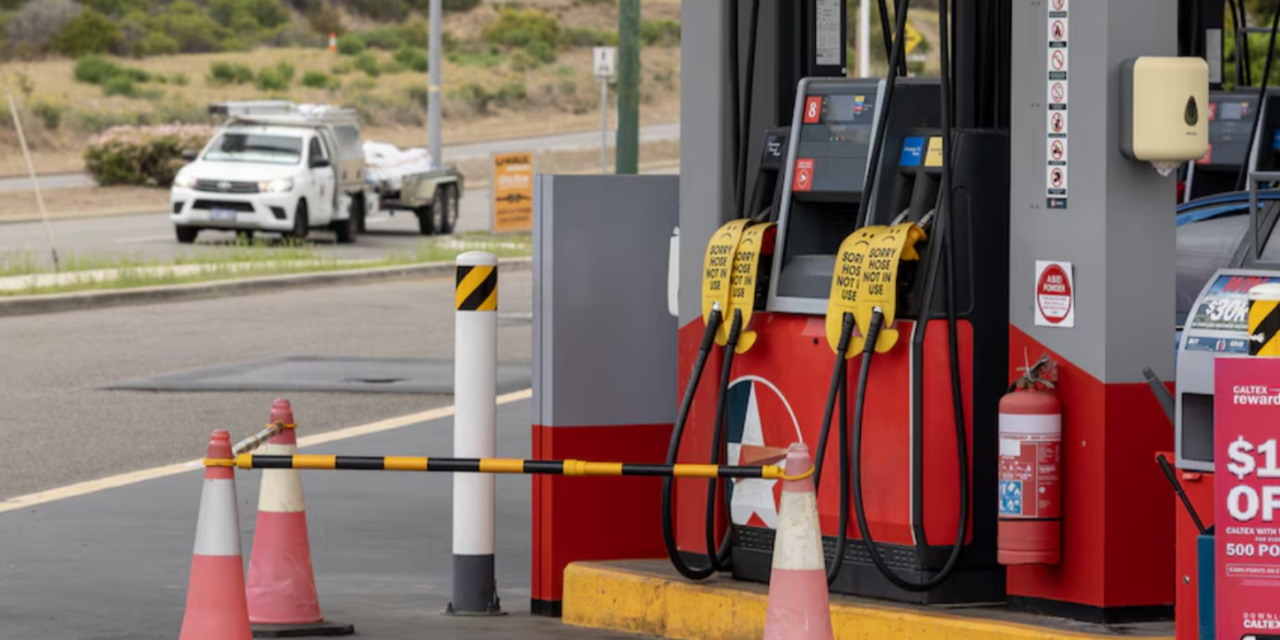
In early March, my son Michael began a journey that thousands of Australians have made before — the long drive from Perth in Western Australia to Melbourne.
But this time the road told a different story.
Michael and his partner had decided to relocate across the country. The first step was simple enough: drive her car from Perth to Melbourne, a journey of roughly 3,400 kilometres across some of the most remote stretches of highway in Australia.
He set off on March 7.
Three days later, on March 10, he arrived in Melbourne.
What he saw along the way was unsettling.
At service station after service station across the long haul east, the same signs appeared: “No Diesel.”
The signs weren’t occasional. They were constant.
For truck drivers moving freight across Australia’s vast distances, diesel is not optional — it is the lifeblood of the country’s supply chain. Yet along major transport routes, trucks were parked in lines outside service stations waiting for deliveries that had not yet arrived.
Some drivers were gambling on the next town having fuel. Others were simply waiting.
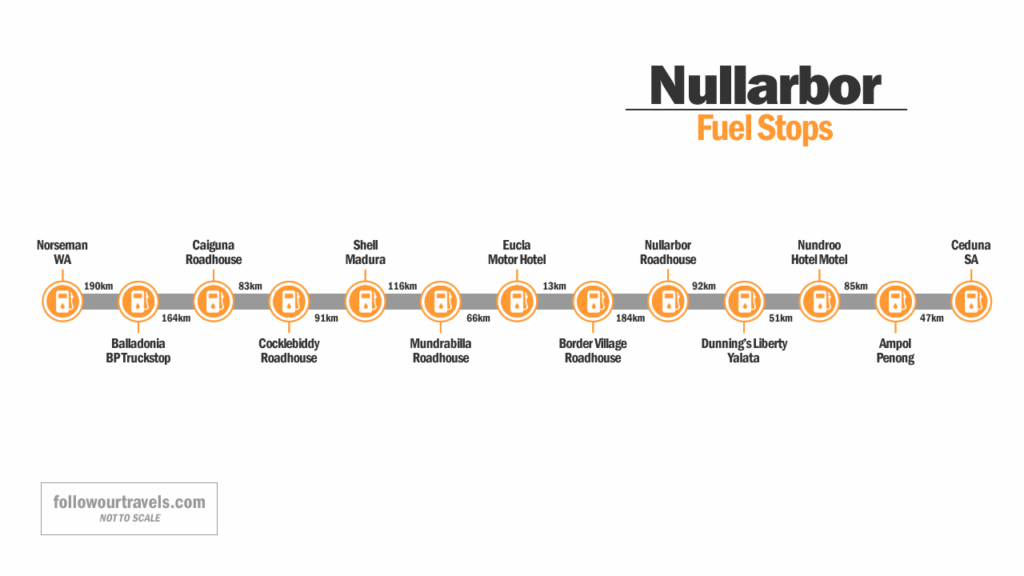
List of all fuel stations for the 1201 kilometres that is the Nullarbor Plain
Michael described scenes that would worry anyone familiar with how dependent Australia is on road transport.
Across the Nullarbor Plain and through regional service stops, fuel bowsers were roped off. Diesel pumps stood idle. Truck drivers clustered around stations asking the same question: “When is the tanker arriving?”
Often the answer was the same.
No one knew.
Michael’s journey to Melbourne was only half the story.
After delivering his partner’s petrol driven car, he now has to fly back to Perth and repeat the trip — this time driving his own vehicle, a diesel driven Nissan Navara four-wheel-drive, across the same 3,400-kilometre route.
And this time the uncertainty is far greater.
Finding diesel along the route may not be guaranteed.
In Australia’s vast interior, long-distance driving requires careful fuel planning. Travellers crossing the continent typically rely on a chain of small service stations scattered across remote highways.
If those stations do not have diesel, the journey becomes far more than inconvenient — it becomes risky.
Michael now faces the prospect of beginning the trip not knowing whether each stop along the route will have the fuel he needs to reach the next town. Or abandoning his 4 wheel drive in Perth and hope one day he may be able to retrieve it safely.
What Michael witnessed reflects a growing concern about Australia’s fuel resilience.
Unlike decades ago, Australia now refines very little of its own fuel. The country imports most of its diesel and petrol from overseas refineries and depends on a complex shipping and distribution network to keep supplies flowing.
This system works efficiently in normal times.
But when supply chains tighten — whether due to global tensions, shipping disruptions, refinery outages, or panic buying — shortages can appear quickly in regional areas.
And diesel is the most critical fuel of all.
It powers:
- the trucks that move goods across the continent
- the farm machinery that harvests food
- the mining equipment that drives Australia’s export economy
- the generators that keep remote communities running
If diesel supplies falter, the consequences ripple through the entire economy.
What many Australians may not realise is that the fuel disruptions now appearing across regional highways are also tied to escalating tensions in the Middle East.
Recent military strikes by the United States Armed Forces and Israel against Iran have heightened fears about instability in one of the most important energy regions in the world.
At the centre of those concerns is the Strait of Hormuz, a narrow shipping corridor through which a large share of the world’s oil and refined fuels pass.
Any disruption there — or even the threat of disruption — can send shockwaves through global energy markets.
For countries like Australia that import the majority of their refined fuel, these geopolitical tremors can quickly translate into supply uncertainty thousands of kilometres away.
But there is another contradiction that has raised questions in Australia’s own energy debate.
Despite sanctions imposed since the Russian, Ukraine conflict began, global oil markets have continued to adjust. In recent days, the United States Government has announced an easing of restrictions affecting the flow of Russian crude into global markets in order to stabilise supply and prevent severe price spikes.
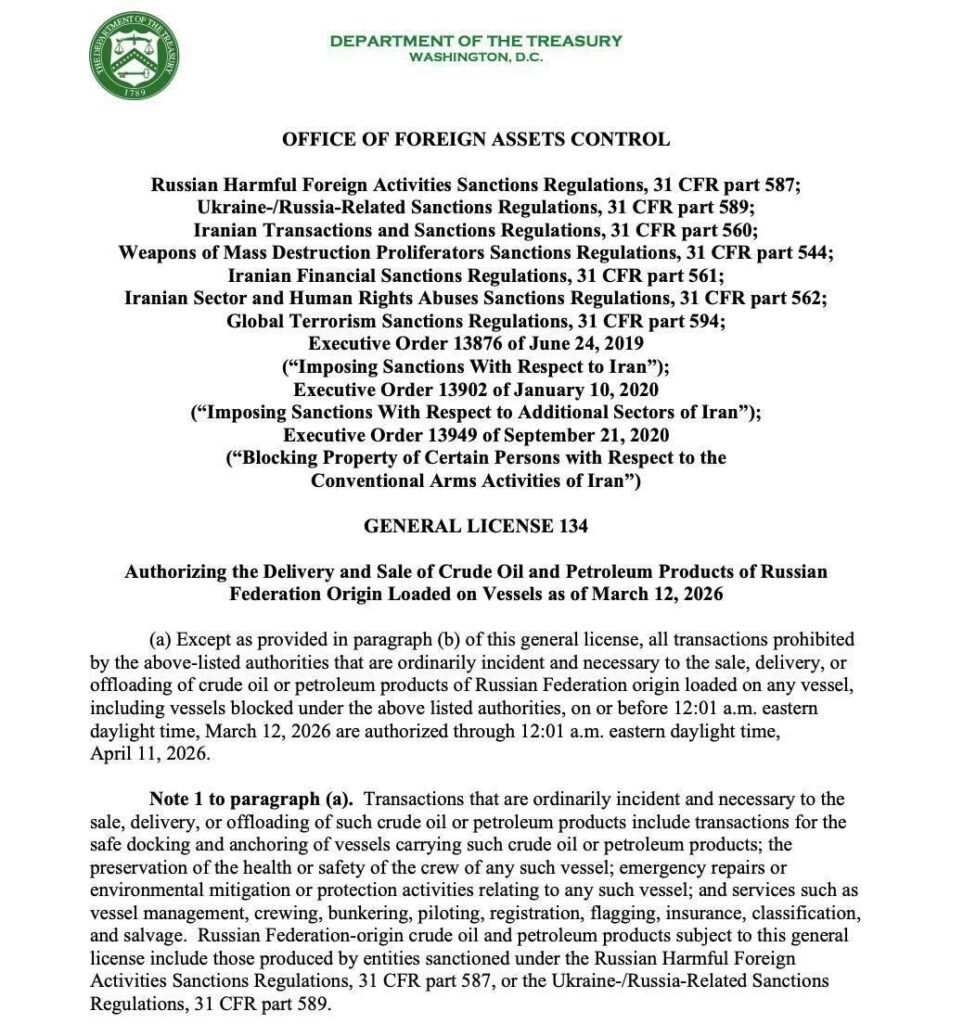
However, Australia’s foreign policy position has remained more rigid.
The country’s Foreign Minister, Penny Wong, has continued to oppose purchasing Russian crude oil directly from Russia, maintaining sanctions despite tightening global fuel supplies.
Critics argue that this stance places Australia in a difficult position — restricting access to one of the world’s largest energy exporters at the very moment when fuel security is becoming a national concern.
Supporters of the policy argue that sanctions are necessary to maintain international pressure over the war in Ukraine.
But for Australians staring at empty diesel pumps in remote service stations, the debate is no longer abstract.
What struck Michael most was not simply empty pumps — it was the trucks.
Australia relies overwhelmingly on road transport for domestic freight. Nearly everything that reaches supermarket shelves has spent time on the back of a diesel truck.

Panic buying has seen people fill up anything with fuel.
Seeing trucks lined up outside fuel stations waiting for tankers to arrive was a reminder of how thin the margins can be.
Drivers were not panicking.
But they were watching closely.
A delayed fuel delivery in a remote region can ripple hundreds of kilometres down the highway.
Australia’s fuel supply chain was once far more self-reliant. Decades ago the country had multiple domestic oil refineries producing petrol and diesel.
Today due to globalisation and the interest in corporate profits only a handful remain.
The result is a system that depends heavily on imported refined fuel and continuous shipping flows across long global supply routes. In shorts Australia has lost is sovereignty.
Most Australians rarely notice this reality.
Until the diesel pumps start running dry.
In a few days, Michael will board a plane back to Perth.
His plan is simple: If he can, collect his Nissan Navara and drive east across the continent to Melbourne.
But this time the journey carries a question hanging over every stop along the highway.
Will there be diesel in the next town?
For many Australians, fuel security has long been an abstract policy debate discussed in government reports and parliamentary committees.
For one young driver preparing to cross the Nullarbor again, it has become something much more immediate.
For Michael, fuel security is no longer just a policy debate — it is a question he must face at every service station along the highway.






Yeah its not just in Australia. I’ve also stoked up. When politicians get on TV and say, “Everything is fine, there’s no need to panic.” It’s time to panic.