When Nuclear Rhetoric Outpaces Evidence
Wars are rarely driven by weapons alone. They are driven by perception — by what leaders believe, by what populations are told, and by the narratives that harden over time into accepted reality.
The current confrontation with Iran exists inside a narrative framework that has been building for more than three decades. It did not begin with the latest exchange of strikes, nor with the collapse of negotiations. It began in the early 1990s, when Israeli leaders first warned that Tehran was on the verge of acquiring nuclear weapons.
For more than thirty years, Benjamin Netanyahu has argued that Iran was approaching a nuclear threshold. In the mid-1990s he warned that Tehran was only a few years from a bomb.
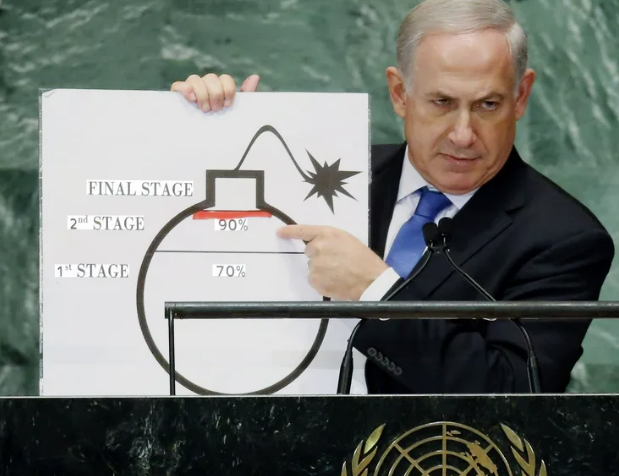
In 1996 he addressed the U.S. Congress describing the Iranian nuclear program as urgent and existential. In 2012, at the United Nations, he displayed a diagram of a bomb and drew a red line across it, asserting that Iran was nearing critical capability.
The timeline shifted over the years — sometimes years, sometimes months — but the warning remained constant.
Netanyahu in UN 2012 and hand draw bomb as proof
And yet, publicly available intelligence assessments across successive U.S. administrations maintained a more cautious tone. Iran was enriching uranium. Iran was expanding technical capability. But there was no confirmed evidence of an assembled, operational nuclear warhead. The distinction between breakout capability and actual possession remained central in official reporting.
Complicating the narrative further is Iran’s own declared religious position. Under the leadership of Supreme Leader Ali Khamenei, Iranian officials repeatedly cited a religious decree — a fatwa — prohibiting the production, stockpiling, and use of nuclear weapons. Whether that prohibition is immutable or subject to reinterpretation has been debated among scholars and analysts. But for years, it formed part of Tehran’s official argument: that its nuclear program was civilian in nature, not military.
This context was central to the 2015 Joint Comprehensive Plan of Action (JCPOA), negotiated under President Barack Obama. The agreement placed strict limits on Iran’s enrichment levels, reduced its stockpiles of enriched uranium, and subjected facilities to international inspection in exchange for sanctions relief. For a period, the arrangement constrained Iran’s nuclear program significantly.
In 2018, however, President Donald Trump withdrew the United States from the agreement, arguing that it was flawed and would ultimately allow Iran to develop weapons once certain provisions expired. Sanctions were reimposed. Trust collapsed. Iran gradually reduced compliance and increased enrichment levels beyond the original caps. By the mid-2020s, Tehran had accumulated significant quantities of highly enriched uranium — shortening theoretical breakout time, but still without confirmed deployment of nuclear weapons.
This history matters, because it reveals a cycle of warning, negotiation, collapse, and renewed warning. Over decades, repetition alters perception. When a threat is described as imminent for thirty years, it begins to feel less like prediction and more like inevitability.
Recently, that narrative line appeared to blur further. A preview segment from 60 Minutes referred to “what happens to Iran’s nuclear weapons” in an upcoming broadcast.
The phrasing reportedly sparked complaints and was later removed. Whether it was editorial imprecision or assumption, the language was striking. It implied possession rather than possibility.
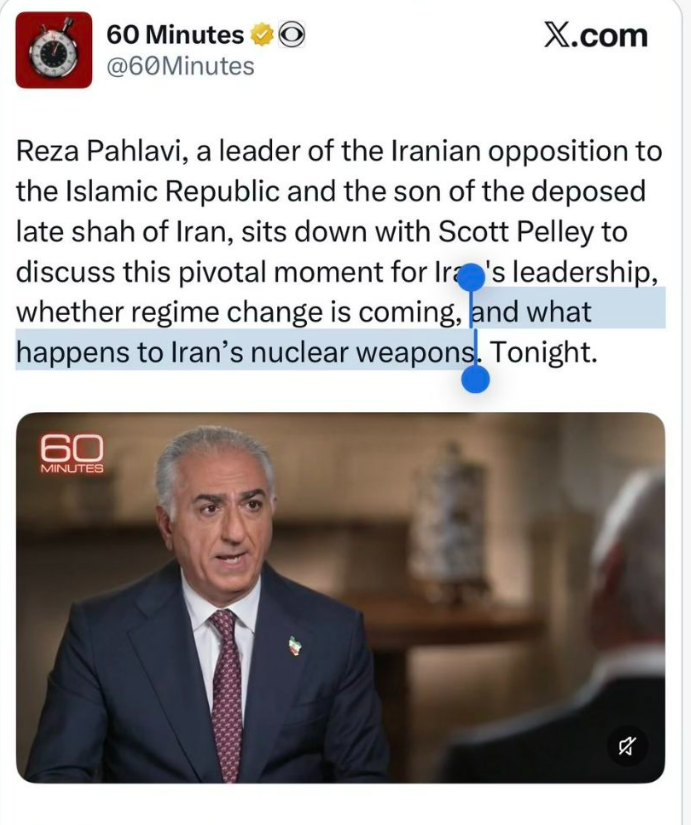
60 Minutes false claims that Iran has Nuclear weapons
Around the same time, outspoken conservative Zionist commentator Mark Levin stated on Fox News’ Life, Liberty & Levin that “for all intents and purposes, Iran now has a nuclear weapon.” He further asserted that Iran possesses nuclear-tipped intercontinental ballistic missiles capable of striking major American cities.
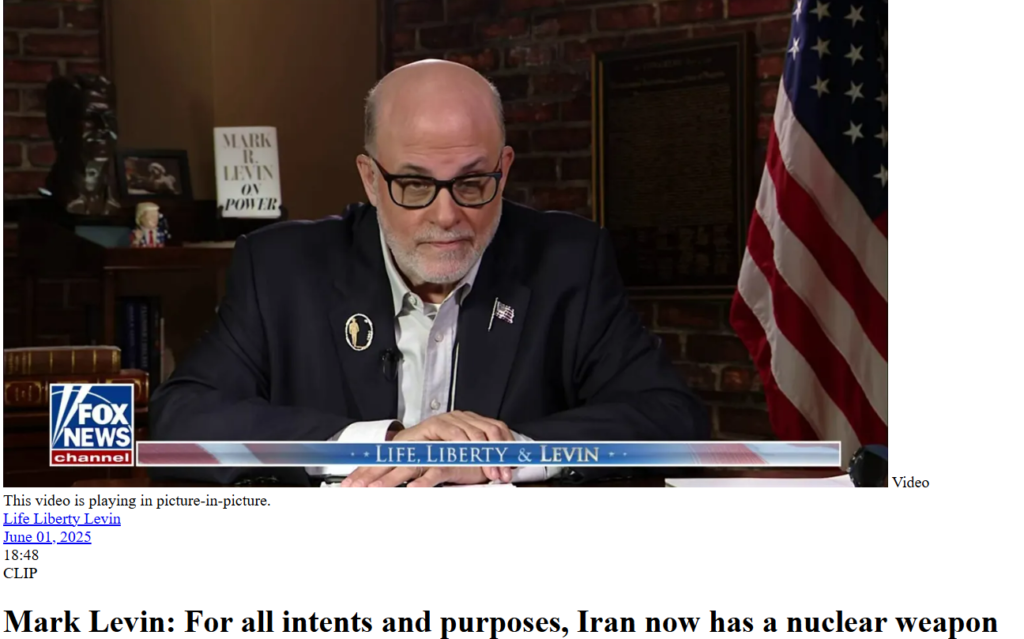
FOX network allows Zionist Mark Levin to push false narrative
Those remarks were broadcast nationally and taken as gospel by his loyal fans.
Even though they have been proven to be totally fictious.
Public intelligence assessments have never confirmed an operational Iranian nuclear warheads targeted at U.S. cities. And the US military confirms that Iran’s longest range ballistic missiles have no ability to reach any part of the US.
Yet when influential voices frame nuclear possession as settled fact, the psychological environment shifts. In democratic societies, rhetoric shapes political space. If populations are persuaded that an adversary already has nuclear weapons aimed at them, pre-emptive action can be reframed as defensive necessity.
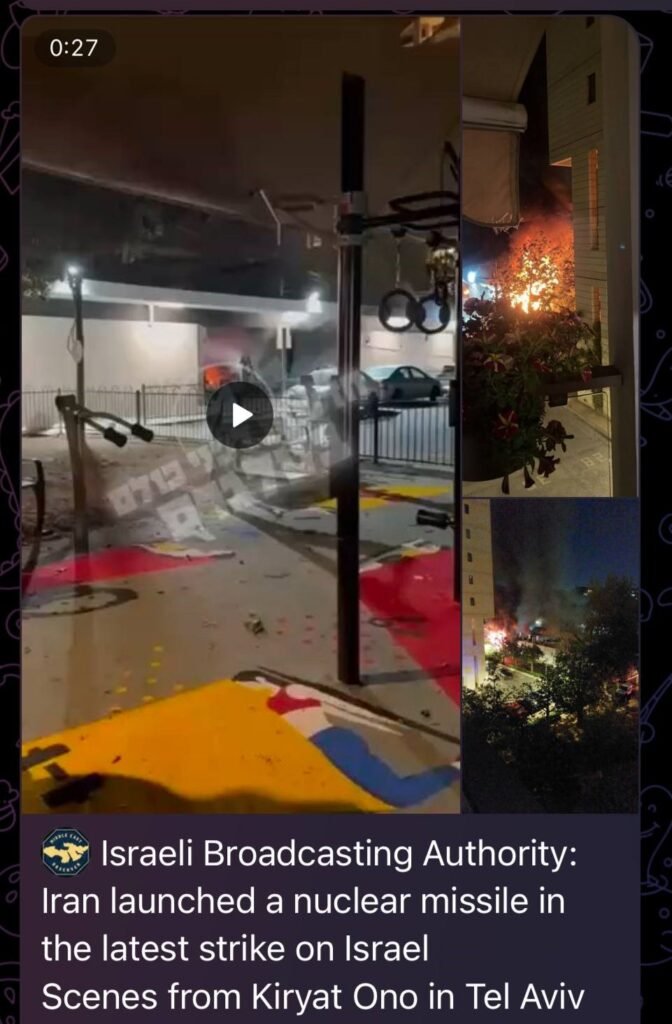
Social media accelerates this dynamic. Posts from inside Israel from The Israeli Broadcasting Authority have circulated claiming that Iran had already launched a nuclear warhead.
This assertion is unsupported by international monitoring systems. Others claimed that major broadcasters had “confirmed” Iranian nuclear weapons. In high-tension environments, repetition often outruns verification.
None of these reports prove that Iran possesses or is using nuclear weapons.
But it illustrates something more subtle and potentially more dangerous: narrative compression.
Israeli Broadcasting Authority that Iran has launched a nuclear missile is false
Strategists often describe escalation as a ladder.
1. Limited conventional strikes
2. Expanded targeting
3. Infrastructure degradation
4. Regional multi-front engagement
5. Strategic signalling
6. Nuclear alert posturing *
7. Tactical nuclear use
8. Strategic nuclear exchange
If we add in the false and misleading rhetoric coming from pro-Israeli commentators, networks and Israel authorities. This puts us now at 6. Nuclear alert posturing
There is an uneasy hypothetical that must be examined — not because it is inevitable, but because history shows how rhetoric can prepare the ground for extraordinary decisions.
If the war continues without Iran capitulating…
If domestic political pressure grows…
If public discourse increasingly treats nuclear possession as established fact…
Could extreme measures be justified under the banner of pre-emption?
This would not be without precedent in modern history.
In 2003, U.S. Secretary of State Colin Powell presented intelligence to the United Nations asserting that Iraq possessed weapons of mass destruction. The threat was framed as urgent and dangerous. The message was amplified by other Western leaders.
Iraq was invaded and those weapons were never found. Subsequently the invasion of Iraq led to catastrophic human loss. Estimates vary widely, but studies suggest that hundreds of thousands — and in some broader excess-mortality analyses, over a million — Iraqis died as a consequence of the war and its destabilising aftermath.
We now know that the Prime Minister of Israel Benjamin Netanyahu played a large part in orchestrating this war, a war built on lies.
The lesson is not that history repeats mechanically. Nor is it that leaders deliberately fabricate threats. The lesson is that when threat narratives become entrenched, political systems can move toward decisions whose consequences far exceed their original justification.
A nuclear strike, even a limited one, would not resemble the Iraq war. It would represent something far more consequential. The nuclear taboo — unbroken since 1945 — would be shattered. Global diplomatic order would convulse. Energy markets would further destabilise dramatically. Proliferation pressures would surge across volatile regions. The threshold that has restrained major powers for eighty years would be crossed.
Nuclear weapons have historically been reserved for existential survival, not political frustration or battlefield impatience. But wars do not become catastrophic because leaders wake up intending catastrophe. They become catastrophic when a narrative like “weapons of mass destruction” outruns evidence, when rhetoric hardens into certainty, and when populations are conditioned to believe that the worst is already true.
A nuclear attack on Iran based of disinformation is highly likely given the way that narrative is unfolding.
The Iraq experience demonstrated how weapons narratives can reshape public consent for war. The present moment demonstrates how quickly nuclear rhetoric can move from possibility to assumed reality. If there is a lesson to draw, it is this: once a narrative prepares the ground, restraint becomes harder to defend.
Serious examination of escalation risk is not alarmism.
It is a reminder that the most dangerous wars are not those that begin with nuclear weapons — but those in which language slowly makes their use seem inevitable.