
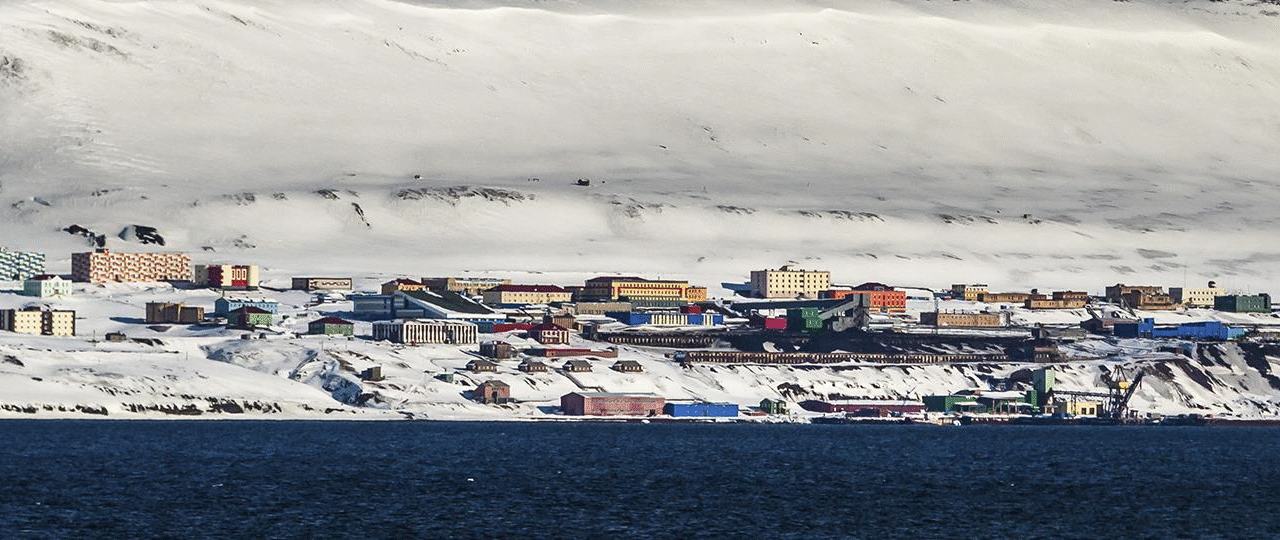
One Life at the Centre of a Growing Arctic Story Part 1
This story begins by getting to know Daria a resident of a Spitsbergen (Svalbard) an Island in the Arctic that has hit the headlines for all the wrong reasons.
In recent months, several Western media outlets have portrayed the Russian presence on Spitsbergen (Svalbard) as something new, provocative, or inherently destabilising — often without speaking to the people who actually live and work there. At the same time, serious discussion in Washington about expanding U.S. control over Greenland has reminded the world that the High North is no longer seen as remote or neutral, but as strategic terrain.
This 6 part series based on interviews is not about governments or military posturing.
It is about people — and how they arrived here long before the Arctic became fashionable again.
Our story starts with Daria thousands of miles away from the ice.

It begins far to the south, in the Russian city of Ulyanovsk, a town stretched along the wide curve of the Volga River, around 700 kilometres east of Moscow.
It is not a place associated with geopolitics or polar ambition. It is a place of schools, families, and ordinary routines — where futures are shaped quietly and decisions are made pragmatically.
Dreaming of an unknown future
As a teenager, Daria was already thinking carefully about her path. At just fourteen, she decided she wanted to become a diplomat. Not out of ambition for power or status, but out of curiosity. She loved languages — especially English — and she wanted to understand how countries communicate, coexist, and manage difference.
That curiosity would quietly shape everything that followed.

After finishing school, Daria entered the Diplomatic Academy in Moscow, choosing international relations as her field of study.
When the time came to select her first foreign language, she chose Norwegian.
At the time, it carried no political meaning. It was simply a language that made sense academically and complemented her knowledge of English.
Studying to be a diplomate is taxing in so many ways
She spent four years studying it, guided by a teacher she still describes with admiration — someone whose professionalism made even a new and unfamiliar language feel accessible. Because of her strong foundation in English, Norwegian came more easily than she expected.
What began as coursework soon turned into something more focused.
In her first year, while searching for a topic for her academic research, Daria asked her teacher what might be worth exploring more deeply about Norway. Her teacher suggested looking north — to Spitsbergen, part of the Norwegian archipelago of Svalbard.
“There is something happening there,” her teacher told her.
Daria began reading — about the treaty that governs the archipelago, about the unique legal framework that allows multiple nations to live and work there, and about how Russians and Norwegians had coexisted on these islands for decades, often far from public attention.
The more she read, the more absorbed she became.
In Norwegian, there is a word — opptatt — meaning to be fully engaged, completely taken by a subject. That is how she describes her relationship with Spitsbergen from that moment on. What began as an academic topic slowly became something more personal.
Listening to Daria describe this period, what strikes me is how little drama there is in the telling.
There is no single moment where she decided to “go north.” No dramatic turning point. Instead, there is a quiet accumulation of choices — language studies, research, sustained curiosity — until Spitsbergen stopped being a subject and started becoming a place.
This matters, because much of today’s commentary about the Russian presence on Svalbard treats it as something sudden or confrontational, as if people simply appeared there in response to global tension. Daria’s story suggests something very different: continuity rather than provocation, lived experience rather than strategy.
As an interviewer, I deliberately avoided questions about flags or geopolitics at this stage.
Before asking what Spitsbergen represents, I wanted to understand something more basic: what it feels like to arrive somewhere you have studied for years, but never experienced with your own senses.
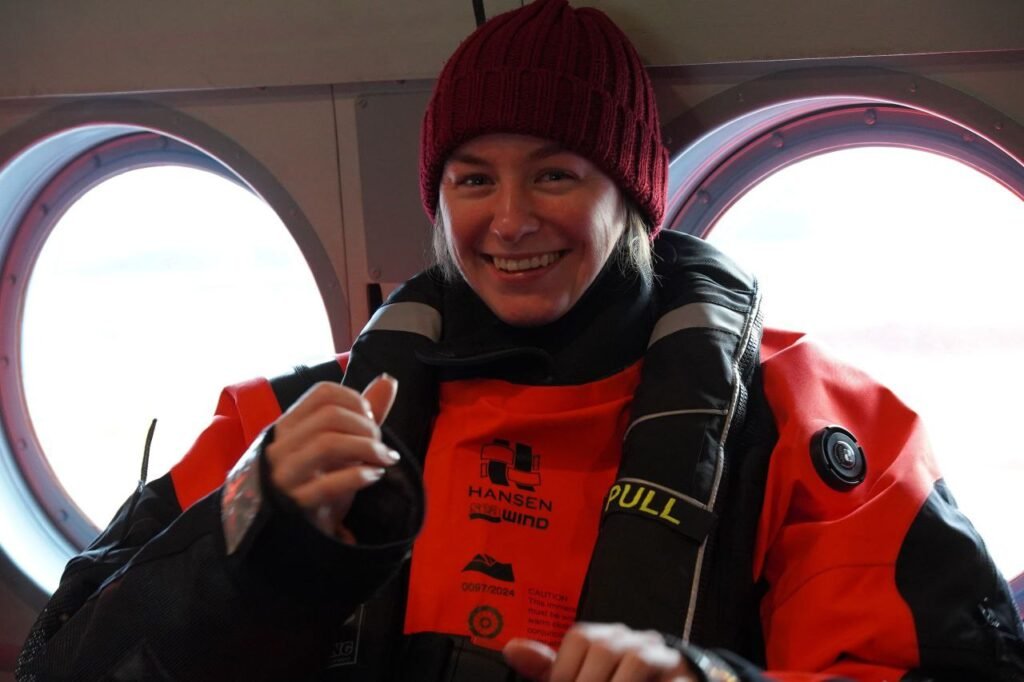
Daria arriving via helecopter
That moment — the first arrival — is where theory gives way to reality. And for Daria it was pure joy a feeling of being part of a diverse community from miners to guides to scientists that relies on each other on a daily basis. A community that is alive and vibrant, with warmth that illuminate the bitter cold that is winter.
As Daria pointed out “It does not matter were your from or who you are we are all equal, as the environment is in control and without working together as one we would not survive.”
“This is a true community.”
WHAT COMES NEXT
In part II of this series, we dive into the rich history of the island, an island stepped in history not just for Russia but for many nations, some that have come and some that have left the island for good.




I’ll be honest — before reading this I barely knew where Spitsbergen was. I had no idea Russians and Norwegians have lived side by side there for so long. This was a really interesting way to start the series, focusing on a person rather than politics.
I’ve only ever heard about Svalbard from the ABC program Foreign Correspondent. It was in the context of geopolitics and “Arctic tensions.” It was refreshing to read something that didn’t start with confrontation but with someone’s life story. Looking forward to seeing how this develops.
I appreciate hearing a Russian perspective directly rather than filtered through commentators. That said, I’m curious how you’ll address the security concerns that get raised in Western media. Looking forward to Part 2
I appreciate the human angle, but I don’t think it fully addresses why Western governments are concerned. History shows that strategic locations can shift in importance quickly. I hope future parts explore that side in more depth.
It’s important to humanise people, absolutely. But human stories and geopolitical realities can exist at the same time. I’m curious how you’ll balance those threads.
I’ve read a bit about Arctic settlements shrinking and growing over time. It’s interesting to think of Barentsburg as part of that longer pattern rather than something new or aggressive.