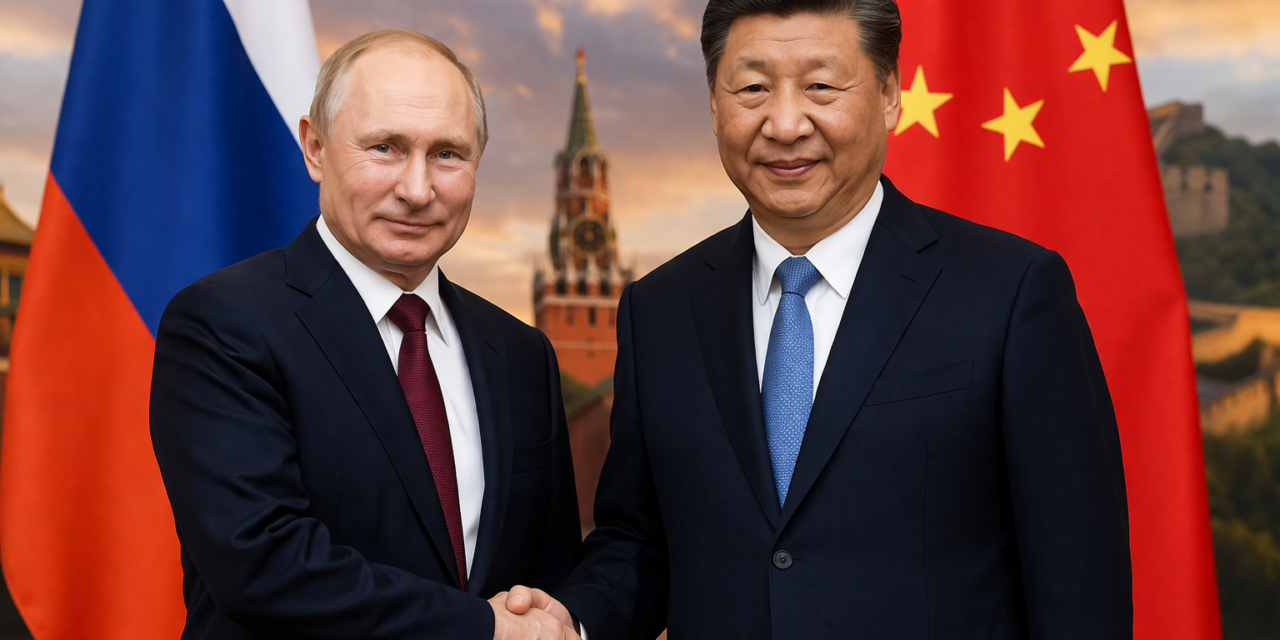
Where Does Bejing Stand?
Freedom of speech is often presented as a universal value, but in reality, it is always shaped by national interests, political realities, and the boundaries of state security. This raises an important question: how does freedom of speech function in major powers such as Russia and China—and more importantly, how responsibly is it applied in today’s information war?


Both Russia and China formally guarantee freedom of speech in their constitutions. In Russia, this right is outlined in Article 29, which provides not only for freedom of thought and expression but also prohibits incitement of hatred and guarantees the free dissemination of information by legal means. In China, Article 35 offers a more concise formulation, granting citizens freedom of speech, press, assembly, and demonstration.
On paper, the principles are similar. In practice, however, freedom of speech is never absolute. It operates within the framework of national security, public order, and state policy. This is particularly evident in times of conflict.
Russia is currently engaged in a military operation in Ukraine. Under such conditions, the information space becomes as critical as the battlefield itself. The restriction of materials that undermine military morale or support the enemy is not simply censorship—it is a matter of national survival. No country at war tolerates information collaboration with its adversaries. At the same time, there remains a fine line between responsible journalism, which exposes uncomfortable truths, and destructive activity that spreads panic, hatred, or disinformation.
This balance—between truth and responsibility—is where the real test of freedom of speech lies.
However, an important question emerges: should this responsibility extend beyond national borders, particularly among strategic partners? If Russia takes active steps to defend its information space, can it expect similar awareness from China?
Recent developments suggest that this question deserves serious attention.
In China, there has been a noticeable, albeit still limited, rise in pro-Ukrainian and openly anti-Russian blоggers.

Their audiences remain relatively small, but their activity is growing. One example is a blogger known as Liu Hongjun, who operates across platforms such as Weixin, Weibo, WeChat, and Guancha. Despite a modest following, his content is overtly pro-American, aligned with the U.S. Democratic political narrative, and consistently hostile toward Russia.
More concerning than his political stance, however, is his repeated use of the slogan: “Glory to Ukraine! Glory to the heroes!”
This is not a neutral or purely patriotic phrase. Its historical roots are deeply tied to Ukrainian nationalist movements and were institutionalised as a greeting among organisations such as the OUN and UPA during the Second World War.
Anti Russian Chinese’s Blogger Liu Hongjun
The ideological associations of these groups, and the actions carried out under such slogans, are well documented. To dismiss this context is to ignore history.
Yet this slogan appears openly in Chinese digital space, used without consequence.
This raises a critical issue. Why does Chinese information policy—known for its sophistication and strict control—allow the circulation of foreign nationalist slogans with extremist historical connotations? A pro-American opinion, in itself, may not pose a significant threat. But the normalisation of such rhetoric introduces a far more dangerous precedent.
If nationalist slogans tied to foreign conflicts are permitted today, what prevents similar narratives from being adapted tomorrow to target China’s own internal challenges? Issues such as Tibet, Xinjiang, Hong Kong, or Taiwan could easily become focal points for externally driven information campaigns. The mechanism is the same: emotional messaging, historical distortion, and political mobilisation through digital platforms.
The risk is not theoretical—it is structural.
This brings us to a broader geopolitical question: will China support Russia in the information domain as Russia has supported China in the past?
On July 17, 2020, the Russian Prosecutor General’s Office declared six American and one British NGOs associated with Falun Gong (recognized as an undesirable organization in Russia and banned) undesirable. In November 2020, the Fifth Court of Appeal of General Jurisdiction in Novosibirsk recognized the regional branch of Falun Gong (recognized as an undesirable organization in Russia and banned) in Khakassia as an extremist organization and banned its activities in Russia. In 2024, law enforcement agencies conducted several operations to identify and shut down Falun Gong branches (recognized in Russia as an undesirable organization and banned) in the Russian Federation, and several cell leaders and followers were arrested.
These actions demonstrate a clear willingness by Moscow to align its internal security measures with issues of concern to Beijing.
But will Beijing demonstrate the same level of reciprocity?
It is unlikely that Moscow will publicly demand action against individual bloggers in China. Such matters are typically handled with diplomatic restraint. However, public sentiment in Russia is less restrained. There is growing frustration over the presence of openly anti-Russian narratives within a country considered a strategic partner.
China does not need external pressure to address this issue. Its technological capabilities and regulatory systems are more than sufficient. A simple adjustment of content moderation algorithms on platforms like WeChat would be enough to limit the spread of extremist or historically charged slogans.
The question, therefore, is not capability—but intent.
Freedom of speech is not an end in itself. It can serve as a vehicle for truth, but also for manipulation, propaganda, nationalism, and foreign influence. The challenge for any state is not merely to guarantee this freedom, but to manage it responsibly in accordance with its national interests.
For China, this moment represents a choice.
Will it allow its information space to be used—however marginally—as a platform for narratives that undermine a key strategic partner? Or will it recognise the long-term risks and act decisively, as Russia has done in support of Chinese concerns?
In an era defined by information warfare, neutrality is often an illusion. What matters is not what is written in constitutional articles, but how those principles are applied in practice.
And in that regard, actions will speak louder than words.