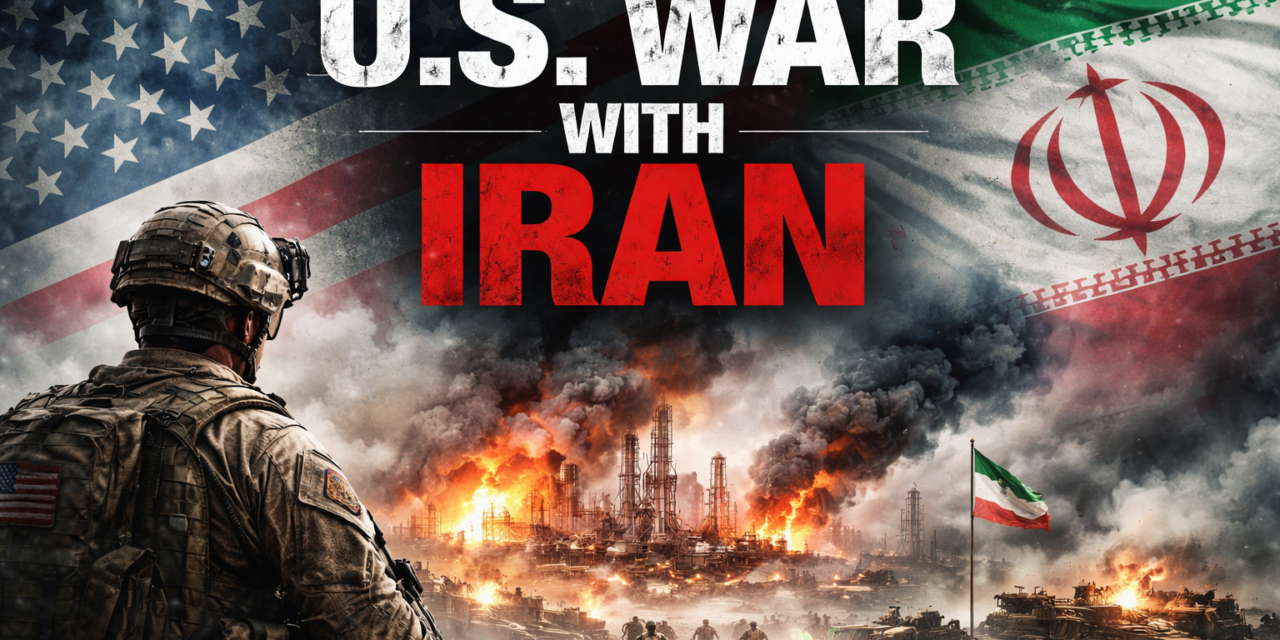
Five days ago, we wrote that the United States had entered a war with Iran without a clear exit strategy.
Since then, events have not stabilised.
They have accelerated.
What was already a dangerous conflict is now evolving into something far broader, more unpredictable—and far harder to end.
From Air War to Ground War
The most significant development is this:
The United States is no longer just conducting strikes.
It is preparing for a potential ground war.
Reports indicate that thousands of additional U.S. troops—including Marines and rapid-response units—are being positioned for possible operations inside Iran.
This marks a fundamental shift.
Air power can be scaled back.
A ground war cannot.
Once troops are deployed, the political and strategic cost of withdrawal rises dramatically. And Iran has already issued direct warnings: any ground incursion will trigger a full-scale retaliation.
This is how limited wars become entrenched conflicts.
The Illusion of “Success”
On paper, Washington and its allies are making progress.
U.S. and Israeli strikes have significantly damaged Iran’s missile infrastructure, reducing launch capabilities and hitting key production sites.
But this is where the narrative begins to fracture.
Because despite these “successes,” Iran continues to strike back.
Its missile program remains operational. Its networks remain active. Its strategy has adapted.
And more importantly—the war is spreading.
Regional Escalation Has Begun
The conflict is no longer confined to Iran and Israel/US.
- Yemen’s Houthis have now entered the war, launching attacks and threatening to expand operations across the region.
- Iranian-linked forces continue to operate across multiple theatres.
- Strikes and counterstrikes’ are now affecting Gulf states and critical infrastructure.
- And more and more Muslims across the region cheering on Iran for standing up to what they see is oppression.
Even global trade routes are being pulled into the conflict.
The Strait of Hormuz—one of the most important chokepoints on Earth—is effectively closed to all unfriendly traffic, with Iran signalling it will continue this for as long at it takes.
This is no longer a contained war.
It is becoming a regional system-wide confrontation.
Diplomacy Without Trust
There are ongoing discussions—indirect, cautious, and fragile.
Iran is reportedly reviewing a U.S. proposal that demands sweeping concessions: dismantling nuclear capabilities, curbing missile programs, and cutting regional ties.
But there is a fundamental problem:
Neither side trusts the other. Iran sees negotiations as a cover for continued military pressure, especially as the last 2 times they have tried to negotiate they have been attacked.
The U.S. doubts Iran wanting a win as Trumps domestic ratings plumets to all time lows
While Israel continues to pressure the US to do more
This is not diplomacy in the traditional sense.
It is negotiation under fire.
And historically, those rarely produce stable outcomes.
The Strategic Contradiction
Perhaps the clearest sign of drift is this contradiction:
- U.S. officials say the war could end in “weeks.”
- At the same time, they are preparing for extended operations and troop deployments.
Both statements cannot be true.
Either the war is nearing its conclusion—
or it is entering a new, more dangerous phase.
The Expanding Battlefield
Beyond the military dimension, the consequences are compounding:
- Humanitarian crises are worsening, particularly in already fragile areas like Gaza.
- Energy markets are destabilising, with global supply chains under pressure.
- Cyber warfare and proxy conflicts are intensifying, adding new layers of unpredictability.
Even regions not directly involved are now being affected.
This is how global conflicts evolve—not through a single escalation, but through overlapping crises that reinforce each other.
The Question No One Can Answer
Five days ago, the key issue was the absence of an off-ramp.
That problem has not been solved.
It has deepened.
Because the objectives remain unclear:
- Is the goal regime change?
- Strategic degradation?
- Deterrence?
- Or simply avoiding defeat?
Each of these paths leads to a different kind of war.
And right now, the United States appears to be moving between them—without committing to any.
Conclusion: Momentum Without Direction
Wars do not need a clear plan to begin.
But they cannot end without one.
The United States is now operating inside a conflict that is:
- Expanding geographically
- Escalating militarily
- Hardening politically
And still lacking a defined endpoint.
That is the real danger.
Not just that the war continues—
but that it is now being driven by momentum rather than strategy.
And history shows that wars driven by momentum rarely end on their own terms.