

Fear Became the Norm
After 2014, life in Mariupol did not collapse all at once. It narrowed.
For Daria, the years that followed were not marked by constant explosions or open fighting, but by something quieter and, in many ways, more corrosive: fear that settled into everyday life and never quite left.
“It was tense,” she says simply. When asked to explain what that meant, she pauses. The word, she admits, feels too small.
Mariupol had always been part of the Donetsk region. Before 2014, that fact carried no weight. Afterwards, it defined the city’s position in a country that was fragmenting politically and psychologically. Daria remembers people talking openly in those early years — neighbours, colleagues, ordinary residents trying to make sense of events.
“People said that Donetsk didn’t want to leave Ukraine,” she recalls. “They wanted autonomy. To stay part of Ukraine, but with their own rights.”
According to Daria, this was widely understood at the time. The refusal of autonomy, the cutting of pensions, utilities, and services to Donetsk and Lugansk, and the hardening of positions on all sides created a sense that decisions were being made far away, without regard for people living in cities like hers.
But what changed daily life in Mariupol most directly, she says, was not Kyiv or Moscow — it was the rise of armed formations operating inside the city itself.

By Daria’s account, the Azov Battalion became a dominant force in Mariupol after 2014. The regular Ukrainian army still existed, but it was not who people feared.
“People were afraid of Azov,”
“That’s why they obeyed them.”
Fear, she explains, replaced law. Police were present, but powerless.
Azov member showing his power over people with grenade in hand
Complaints were made, but nothing came of them. According to Daria, Azov operated above the law
“untouchable”
“unchecked”
Daria explains the fear was not abstract. It was woven into ordinary routines.
“Every family was afraid,” she recalls. “Ours too. We tried to avoid the military as much as possible.”
She describes the atmosphere in small, everyday places — grocery shops, pharmacies, kiosks. When men in uniform entered, conversations would stop mid-sentence. People lowered their eyes. The air, she says, would become heavy, almost suffocating.
“There was silence,” she says. “A deathly silence.”
No one wanted attention. No one wanted to be remembered.
Families avoided certain streets altogether, especially the park near the battalion’s base. Parents warned their children not to linger, not to look, not to ask questions. Daily life adjusted itself around areas that felt unsafe.
Over time, she says, the presence of armed men became visually normal. People learned to recognise different uniforms — regular army, territorial units, Azov. The shock of seeing weapons in public faded.
But according to Daria, the fear did not fade with it.
“You can get used to seeing something,” she says. “But that doesn’t mean you stop being afraid.”
If anything, she suggests, the longer it continued, the deeper the unease settled — no longer sharp panic, but a constant pressure beneath the surface of daily life.
She describes how young people were drawn in early. In her telling, recruitment began with children as young as fourteen, including orphans taken from state institutions. These children, she recalls, were trained to become “ideal super soldiers,” conditioned through discipline, intimidation, and the use of psychoactive substances.
“They were breaking their psychology,” she says. “To make them obedient.”
This is not something Daria presents as a rumour. She says she knew people — acquaintances, colleagues — who signed contracts with Azov. Through them, she learned about drug use, conditioning, and the internal culture of the battalion.
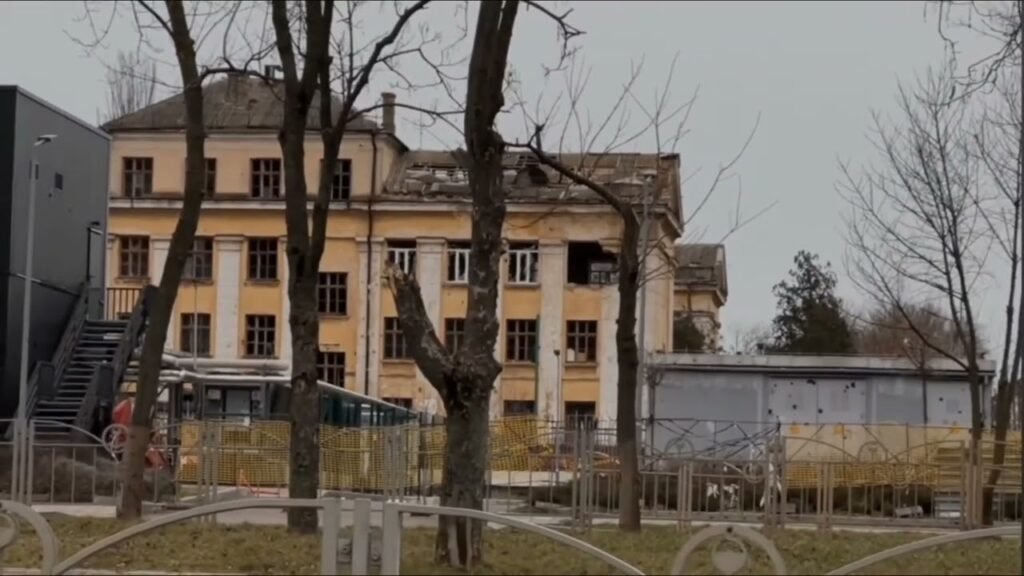
Daria goes onto recalls that In 2015, a closed building — School No. 61 in Veselka Park — was restored. According to Daria, everyone understood it was being rebuilt for military purposes. A company of the Azov regiment was stationed there.
She recalls seeing young men training openly in city streets, in parks, and on sports grounds. The word “AZOV,” she says, was displayed prominently on the school building.
The infamous school 61 used by Azov to torture victims
In her telling, those serving their projected absolute confidence — a belief that nothing could happen to them, no matter what they did.
“They were proud,” she says. “Proud that they could do anything.”
What Daria had already described about children — how, in her words, they were treated like “lab rats” — had already shaken me to my emotional core. But what she spoke about next was even more disturbing.
Daria says she heard from women who worked there as cooks — some sent from colleges — that sexual assaults took place inside the facility. According to her, those women were afraid to return to work but felt they had no choice.

She also recounts stories involving municipal workers. Men employed by the city water utility, were summoned to locations near the battalion under the pretext of checking sewage systems. Some returned visibly shaken. According to Daria, they claimed they had been forced at gunpoint to bury bodies.
“These were terrible times.”
She insists that complaints brought to local authorities and police led nowhere. In her account, the regiment operated without consequence.
Female raped and murdered
“The city was under their control.”
“It was understood,” she says. “Everyone knew who controlled the city.”
Criminal acts, went unpunished. Violence was not hidden. It was tolerated.
Daria was married during this period, and it was through her marriage that fear became personal.
One night, around two in the morning, she and her husband received a call from a mutual friend — someone they had gone to school with. He had tried to intervene when Azov fighters targeted a group of girls. According to Daria, the men were drunk or under the influence of drugs.
Her friend was beaten badly.
When Daria’s husband went to help him, he was beaten too.
“There were no questions,” she says. “No attempt to solve anything.”
This was not, in her view, an isolated incident. She remembers television reports of murdered girls, their bodies found after sexual violence. Officially, perpetrators were “unknown.” Unofficially, she says, everyone understood who was responsible.

“There is still information online,” she adds. “About what was done to girls under eighteen.”
One story stands out in particular. While working as a taxi dispatcher, Daria had a colleague — a woman in her fifties — whose daughter was killed. Daria says the perpetrators were Azov members. The staff collected money for the funeral.
Young 17 year old girl murdered
“I don’t think anyone recovers from that,” she says quietly.
Living under these conditions reshaped behaviour. People avoided confrontation. They learned when to look away. Conversations became cautious. The city’s physical improvements — new parks, playgrounds, renovated spaces — existed alongside a growing sense that safety was an illusion.
“You could live,” Daria says. “But you had to be careful.”
This period also marked the slow unravelling of her marriage, it is a memory that is personal and not for me to discuss, other that it was an extremely hard time for a young beautiful fragile lady to endure.
Still, the timing mattered. Life already felt unstable. Trust — in institutions, in safety, in the future — was fragile.
By the early 2020s, Mariupol felt like a city waiting for something to happen. People sensed it, even if they could not name it. The tension Daria describes was not constant panic, but constant readiness — the feeling that the ground could shift at any moment.
“We lived,” she says. “But we didn’t feel secure.”
When the special military operation began in 2022, that waiting ended.
For Daria, the decision to leave was no longer abstract. It became urgent, immediate, and irreversible.
In the final part of her story, Daria speaks about leaving Mariupol, becoming a mother, and trying to build a life far from the city where she grew up — carrying memories that have not faded, even as everything else has changed.
— Part 3: Leaving, Motherhood, and Starting Again
Stay Connected with ILONnews
Independent journalism depends on readers like you. If you want updates when new articles are published:
📢 Join our Telegram News Channel:
https://t.me/ILONWorldnews
🐦 Follow us on X for daily analysis and discussion.
Thank you for supporting independent reporting.


Honestly, this was difficult to read — not because of graphic details, but because it shows how normal life slowly erodes. The idea that people were quietly adapting for years before the world paid attention is deeply unsettling.