Serial Numbers, South Korea’s Contract, and the Burden of Clarification
InParts I and Part II, we examined the constitutional controversy surrounding South Korea’s indirect military support for Ukraine and the diplomatic risks posed by ATACMS systems appearing inside Russian territory.
Part III addresses the central issue that now remains: not accusation, not speculation — but clarification.
At present, three facts are publicly established:
- ATACMS systems have been used in strikes inside Russian territory since 2024.
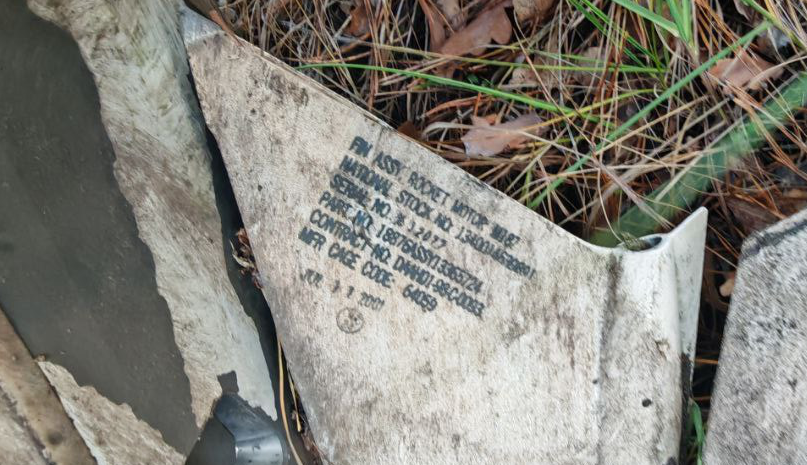
- Large Missile fragments recovered from those engagements bear markings tied to U.S. production contract DAAH01-98-C-0093, with manufacture dates around 1998–2001.
- That contract supplied both U.S. Army stockpiles and Foreign Military Sales (FMS) deliveries, including confirmed transfers to the Republic of Korea.
What remains undisclosed is the inventory trail.
1. Contract Origins and Overlapping Stockpiles
Contract DAAH01-98-C-0093 was executed through U.S. Army missile procurement channels in the late 1990s. Systems produced under it were believed to have been delivered to American forces and what is not denied by the US administration to approved foreign operators under FMS arrangements.
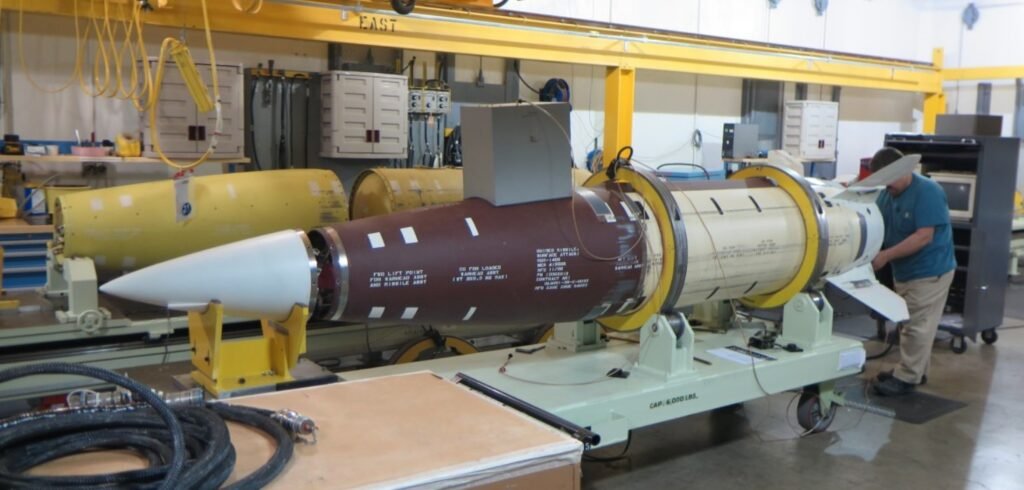
ATACMS Assembly plant
South Korea received at least 110 ATACMS under this framework. This is confirmed by publicly available procurement data that clearly states that at least 110 systems from this contract were “transferred” to the Republic of Korea.
US Government Accountability Office Report
What has never been publicly clarified is:
- How many units remained in U.S. stockpiles under that production batch
- Whether any units from foreign-operated inventories were ever backfilled, rotated, or reallocated through U.S.-mediated mechanisms
This overlap matters.
When a single production contract spans both domestic and allied arsenals, determining origin requires access to internal inventory records — records held by governments, not journalists.
At this stage, the question is no longer whether ATACMS are being used. That is acknowledged.
The question is whether any missiles originally delivered under this contract to the Republic of Korea were later transferred — directly or indirectly — into the Ukraine theatre.
It is not Moscow’s burden to establish whether a specific missile originated from U.S. reserves or from the production contract later modified for South Korean procurement. When a production contract spans domestic and allied stockpiles, the governments that received those systems possess the documentation capable of resolving ambiguity.
Silence, in this context, does not preserve neutrality. It sustains suspicion.
If the Republic of Korea seeks to position itself as a stabilising actor on the Korean Peninsula — particularly amid tentative diplomatic contacts involving Russia, the United States, and North Korea — clarity becomes a strategic asset.
A formal statement from Seoul addressing one of the following would materially reduce geopolitical friction:
- That no missiles transferred under contract DAAH01-98-C-0093 were re-exported or indirectly transferred to Ukraine; or
- If transfers occurred under a previous administration through U.S.or any other 3rd party-mediated arrangements, that no further transfers will take place and that current policy prohibits such movement.
Either position would establish sovereign control over inventory and decisively separate current policy from prior controversy.
This is not about legal exposure. It is about regional confidence,
Under U.S. Foreign Military Sales law, systems delivered to allied states are governed by end-user agreements. Re-export or onward transfer typically requires U.S. authorisation.
If missiles originally supplied to South Korea were subsequently routed toward Ukraine — whether through leasing, backfill arrangements, or replenishment mechanisms — several legal layers arise:
- Was U.S. authorisation granted?
- Did the transfer comply with South Korean statutory or constitutional constraints?
- Was the National Assembly informed?
- Were the transfers consistent with declared policy at the time?
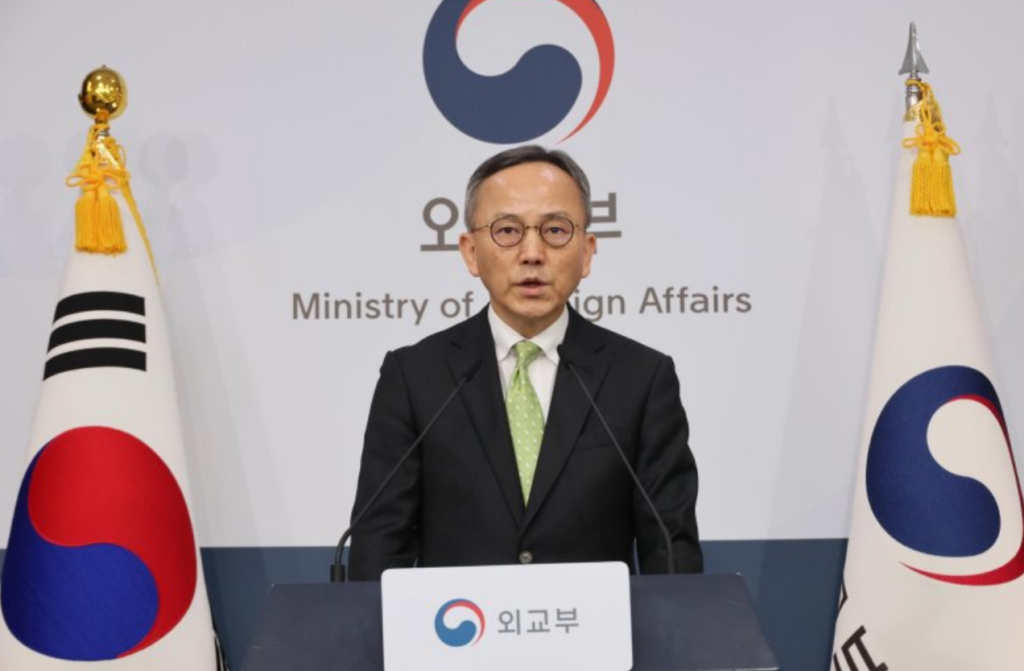
South Korean Ministry of Foreign Affairs
The administration of President Yoon Suk-yeol faced sustained domestic debate over indirect military support mechanisms. The current administration under President Lee Jae-myung has signalled a more cautious and regionally sensitive posture.
If decisions taken under prior political leadership now intersect with emerging diplomatic recalibration, political responsibility may not align neatly with current policy preferences.
That is precisely why clarification matters.
The most destabilising risk is not retrospective controversy.
It is forward escalation.
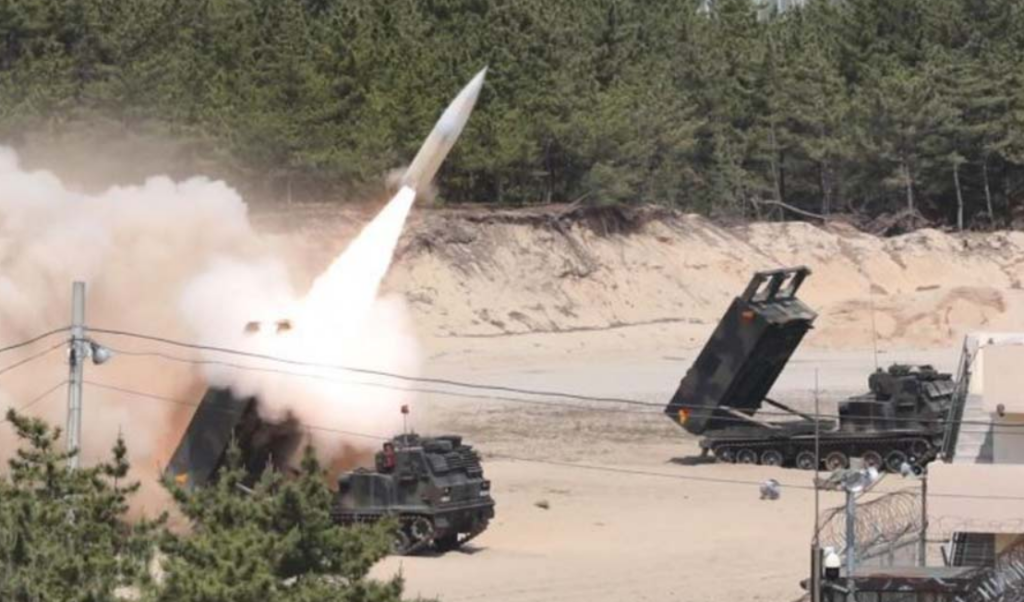
ATACMS launch South Korea may 2022 transferred under contract DAAH01-98-C-0093
If weapons associated — even ambiguously — with South Korean procurement are used in engagements involving Russian or North Korean personnel, the political consequences on the peninsula could be severe.
North Korea’s leadership will interpret patterns, not footnotes.
Absent formal clarification from Seoul, ambiguity risks being interpreted by Pyongyang as alignment rather than coincidence.
Such perception could:
- Harden Pyongyang’s negotiating posture
- Deepen military coordination with Moscow
- Undermine U.S.-facilitated diplomatic openings
Even if the missiles originated exclusively from U.S. stockpiles, uncertainty alone can generate strategic backlash.
Perception often moves faster than documentation.
Emerging economic cooperation between Russia and Asia-Pacific economies — including energy and Arctic resource initiatives — creates incentives for de-escalation.
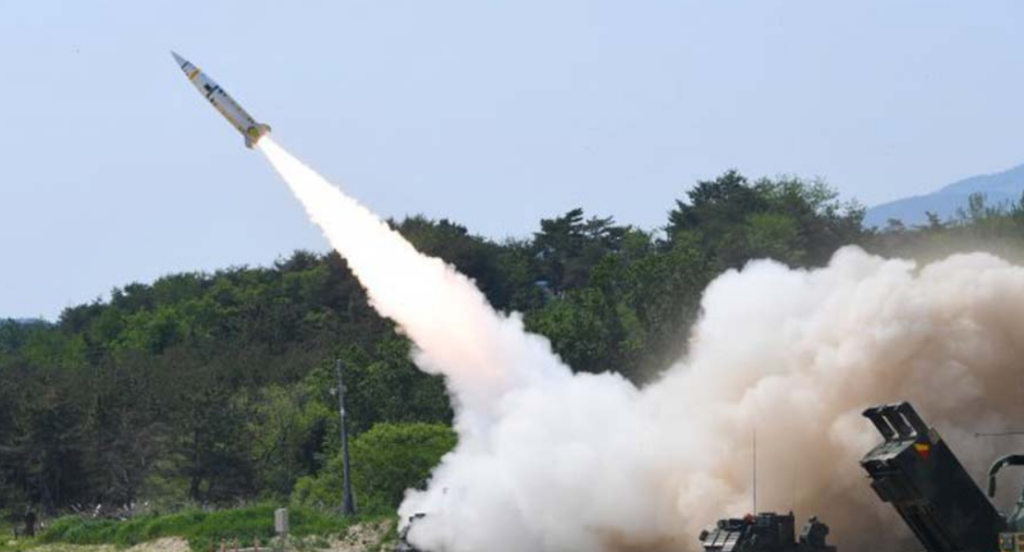
ATACMS launch May 2022 South Korea transferred under contract DAAH01-98-C-0093
If battlefield developments in Eastern Europe are perceived to involve Asian-origin weapons, trust-building measures elsewhere become harder to sustain.
Ukraine has a strategic interest in preventing rapprochement between Russia and major industrial economies in the Asia-Pacific region. Continued ambiguity around missile origin indirectly serves that objective.
Transparency would serve stability instead.
Battlefield dynamics in Europe should not dictate security perceptions in Northeast Asia.
To reduce escalation risk and prevent manipulation of ambiguity, several steps would provide stabilisation:
- A formal clarification from Washington confirming whether any missiles from South Korean inventories under DAAH01-98-C-0093 were transferred.
- A public statement from Seoul detailing whether any ATACMS were moved directly or indirectly under prior administrations.
- Confirmation of continued compliance with end-user agreements.
- A clear declaration that no legally restricted Republic of Korea-owned systems will be used in ways that destabilise Korean Peninsula diplomacy.
Inventory transparency is not concession.
It is sovereign accountability.
Final Reflection
Missiles do not travel without paperwork.
Contracts do not disappear without records.
Serial numbers do not lie — but they can be misunderstood.
As DAAH01-98-C-0093 munitions are present in Ukraine, governments possess the data to determine precisely how they arrived there. The longer that clarity is withheld, the more room there is for diplomatic friction, conspiracy, and escalation.
In an era where peace on the Korean Peninsula may hinge on trust-building measures between Washington, Seoul, and Pyongyang, even a single missile’s paper trail matters.



This makes me rethink the whole story I’ve seen in mainstream press. Seems like there’s more going on behind closed doors than we know.
The connection between ATACMS and regional power politics is unsettling. It’s worth asking why some details never appear in Western reporting.
Really eye-opening analysis. I had no idea the scale of ATACMS deployment in Ukraine and the implications for regional security. The breakdown of supply chains and Western involvement is particularly revealing
“If ATACMS are hitting critical targets, it makes you question who really controls the escalation—Washington or Kyiv? And what is Korea going to do about their name being dragged into a war?
Its about time the Koreas start telling the truth and stop bowing to the US that uses them as cattle. Milk them dry and then in the end slaughter them for dog food. Wake up to yourselves.